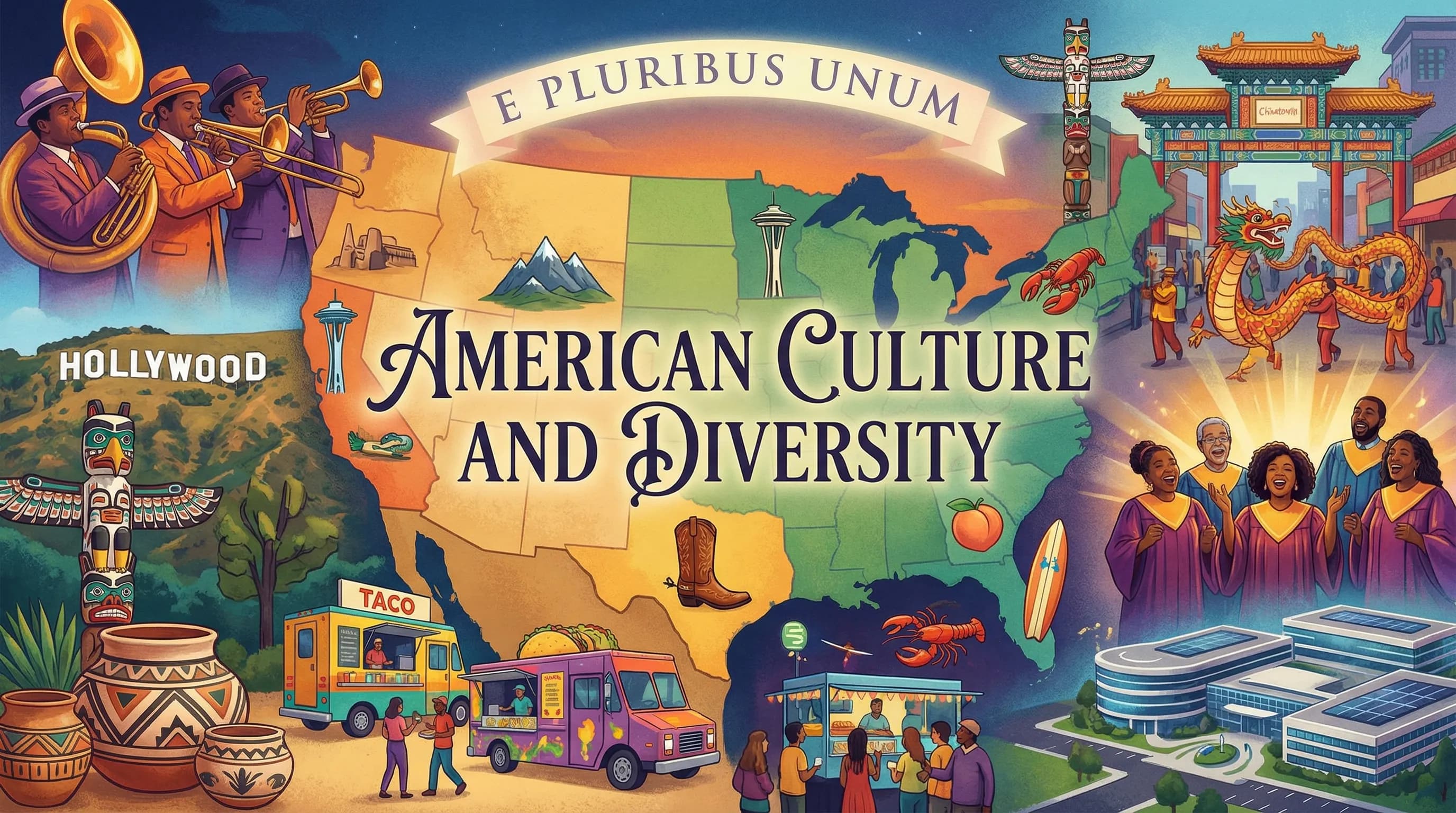
Explore American culture, diversity and contemporary issues.
E Pluribus Unum - From Many, One
America's national motto reflects its diversity - but also ongoing tensions about what it means to be American. The United States has always been shaped by immigration and by debates about who belongs.
Learning Objectives:
- Understand the composition of American diversity
- Analyze debates about immigration and national identity
- Evaluate different models of handling diversity (melting pot vs. salad bowl)
- Compare American and Norwegian approaches to diversity
Key Demographics (2023):
- White: ~58% (non-Hispanic)
- Hispanic/Latino: ~19%
- Black/African American: ~13%
- Asian: ~6%
- Two or more races: ~3%
- Native American: ~1%
America is often called "a nation of immigrants" - but this is complicated.
Indigenous Peoples:
- Were here first, for thousands of years
- Not immigrants - their land was taken
- About 5.2 million today (1.6% of population)
- 574 federally recognized tribes
Enslaved Africans:
- Brought against their will (not immigrants)
- 10-12 million brought to the Americas
- About 388,000 to what became the US
- Ancestors of most Black Americans today
Colonial Settlers:
- English, Dutch, German, Scottish-Irish
- Came voluntarily seeking opportunity, religious freedom
- Became "original" Americans, established English dominance
Waves of Immigration:
1820-1880: Northern/Western Europe
- Irish (famine), Germans, Scandinavians
- Initially seen as "different" but eventually assimilated
1880-1920: Southern/Eastern Europe
- Italians, Poles, Jews, Greeks
- Faced discrimination as "not white enough"
- Immigration restricted in 1924 based on national origin
1965-Present: Global Immigration
- 1965 law removed national quotas
- Latin America (especially Mexico)
- Asia (China, India, Philippines, Vietnam)
- Africa, Caribbean, Middle East
Current Immigration:
- About 45 million foreign-born (13.7% of population)
- Plus about 11 million undocumented immigrants
- Immigration is the main source of population growth
Example: The Changing Definition of "White"
One of the most striking aspects of American diversity is how the definition of "white" has changed over time.
The 19th Century:
When Irish immigrants arrived fleeing famine in the 1840s-50s, they were not considered "white" by many Americans:
- "No Irish Need Apply" signs in job listings
- Called "white negroes" by some
- Discriminated against in housing and employment
The Early 20th Century:
Italians, Poles, Jews, and others from Southern/Eastern Europe faced similar treatment:
- Seen as racially inferior
- 1924 Immigration Act designed to exclude them
- KKK targeted them alongside Black Americans
"Becoming White":
Over generations, these groups were accepted as "white":
- Economic success
- Moving to suburbs
- Intermarriage with earlier immigrant groups
- Being included in government programs (GI Bill)
- Distinguishing themselves from Black Americans
Why It Matters:
- "Race" is a social construction, not biological reality
- Who is included in the majority group can change
- Today's "outsiders" may become tomorrow's "insiders"
- But this process has not worked the same way for all groups
Current Debates:
- Are Hispanic/Latino Americans "white"? (Census allows identifying as both)
- Will they follow the Irish/Italian path to "whiteness"?
- Or will racial categories persist?
Key Insight:
American diversity is not fixed - categories shift over time based on politics, economics, and culture.
Analyze American immigration history:
Why is it complicated to call America "a nation of immigrants"?
How did different immigrant groups experience America differently?
What does the changing definition of "white" tell us about race in America?
Compare immigration then and now:
What do 19th-century Irish immigrants and 21st-century Mexican immigrants have in common?
What is different about their situations?
The idea that immigrants should assimilate into a unified American culture.
Characteristics:
- English language dominance
- Shared "American values" (individualism, hard work)
- Cultural differences fade over generations
- National identity trumps ethnic identity
In Practice:
- Immigrants often lost languages within 2-3 generations
- European immigrants assimilated into "white" American culture
- Pressure to conform, fit in
- Success = becoming "American"
Salad Bowl / Cultural Mosaic
The idea that groups can maintain distinct identities while contributing to a diverse whole.
Characteristics:
- Multilingualism valued
- Cultural heritage preserved
- Hyphenated identities (Mexican-American, Chinese-American)
- Diversity as strength
In Practice:
- Ethnic neighborhoods, festivals, media
- Bilingual education debates
- Cultural foods, music, traditions maintained
- Identity politics based on group membership
Current Reality:
America is somewhere between these models:
- Second-generation immigrants usually speak English
- But ethnic identities remain strong
- Some assimilation occurs, but not complete absorption
- Different groups have different experiences
Example: American Culture - Made by Many
Food
"American food" is itself diverse and borrowed:
- Hot dogs and hamburgers: German origin
- Pizza: Italian (but American style)
- Tacos: Mexican (but Tex-Mex is American)
- Chinese American food: invented in America
- Soul food: African American traditions
- Apple pie: actually English origin
Music
America's greatest cultural contributions are from diversity:
- Jazz: African American, roots in blues and African music
- Rock and Roll: African American origins, adopted by white artists
- Hip Hop: African American and Latino urban culture
- Country: Scottish-Irish folk + African American blues
- Salsa: Cuban and Puerto Rican in New York
Language
American English is filled with borrowed words:
- Spanish: ranch, canyon, tornado, plaza
- German: kindergarten, deli, pretzel
- Yiddish: bagel, chutzpah, schmuck
- Italian: pizza, cappuccino, paparazzi
- Japanese: karaoke, emoji, tsunami
Pop Culture
American entertainment dominates globally:
- Hollywood films feature diverse casts
- Music genres from Hip Hop to K-pop influences
- Sports: basketball invented in US, now global
- Fashion influences from every culture
Key Point:
What we think of as "American culture" is really the product of many cultures meeting, mixing, and creating something new. This is America's greatest cultural strength.
Compare melting pot and salad bowl models:
What are the advantages of the "melting pot" approach?
What are the advantages of the "salad bowl" approach?
Which model does Norway follow more closely?
Analyze American cultural contributions:
Choose one genre of American music (jazz, hip hop, rock, country). How does it reflect American diversity?
Why has American culture (music, film, food) been so influential globally?
Summary
Key Points:
1. Complex History: America's diversity comes from Indigenous peoples, enslaved Africans, and successive waves of immigrants - each with different experiences.
2. Changing Categories: Racial categories like "white" have changed over time; who is considered an outsider or insider shifts based on politics and economics.
3. Melting Pot vs. Salad Bowl: Two competing models for handling diversity - assimilation into unified culture vs. maintaining distinct identities within a diverse whole.
4. Cultural Mixing: American culture itself is the product of many cultures meeting and mixing - music, food, language all show this fusion.
5. Ongoing Tensions: Debates about immigration, language, and identity continue; diversity is both America's strength and source of conflict.
Key Vocabulary:
- Melting pot - model where immigrants assimilate into unified culture
- Salad bowl/Cultural mosaic - model where groups maintain distinct identities
- Hyphenated identity - e.g., Mexican-American, combining ethnic and national identity
- Assimilation - process of adopting dominant culture
- Multiculturalism - policy of valuing and preserving cultural diversity
Essay question (250-350 words):
"Diversity is America's greatest strength." Discuss this statement, considering both the benefits and challenges of American diversity.
Comparative analysis:
Create a table comparing diversity in the United States and Norway, including: demographics, immigration history, integration policies, cultural attitudes.
What can each country learn from the other about handling diversity?
What challenges do both countries face regarding diversity?
Sources and Further Reading
- Takaki, R. (2008). A Different Mirror: A History of Multicultural America. Back Bay Books.
- US Census Bureau: census.gov
- Smithsonian - National Museum of the American Indian: americanindian.si.edu
Dette kapitlet er skrevet av Anthropics toppmodeller (Claude Opus og Claude Fable) og er foreløpig ikke manuelt gjennomgått — kvalitetskontrollen gjøres av uavhengige KI-agenter, og innmeldte feil rettes fortløpende. Funnet en feil? Meld fra, så retter vi den. Les mer om hvordan innholdet lages.