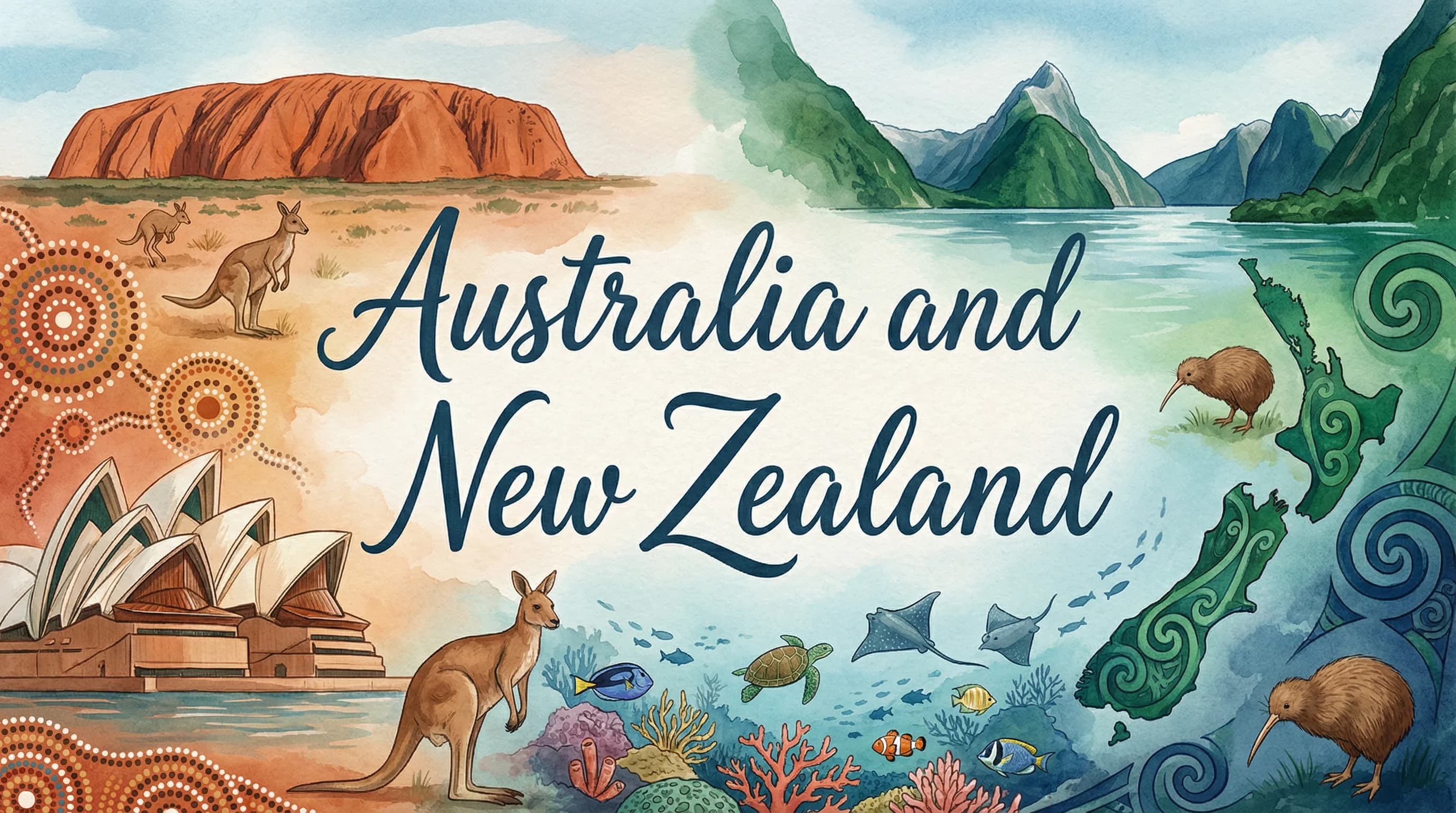
Explore society, culture and history of Australia and New Zealand.
The Land Down Under
Australia and New Zealand share British colonial heritage but have developed distinct national identities. Both are modern, multicultural democracies grappling with their colonial past and relationship with indigenous peoples.
Learning Objectives:
- Understand the history and culture of Australia and New Zealand
- Compare approaches to indigenous rights and reconciliation
- Analyze contemporary issues in both countries
- Compare with Norway's relationship with the Sámi
Australia Facts:
- Population: ~26 million
- Indigenous Australians: 65,000+ years of history
- British colony from 1788 (originally as penal colony)
- Federation in 1901
New Zealand Facts:
- Population: ~5 million
- Māori arrived ~1250-1300 AD
- British colony from 1840 (Treaty of Waitangi)
- Known for progressive policies
Aboriginal Australians have lived on the continent for at least 65,000 years - the oldest continuous culture on Earth.
Before European arrival:
- Population estimated at 300,000-1 million
- Over 250 language groups
- Complex systems of law, spirituality, and land management
- "Dreamtime" - creation stories connecting people to land
British Colonization (1788-1901)
- Australia claimed under "terra nullius" (empty land) - Aboriginal peoples legally invisible
- First colony: convict settlement in Sydney
- Free settlers followed, displacing indigenous peoples
- Violence, disease, and dispossession devastated Aboriginal population
- By 1900, Aboriginal population had fallen to about 90,000
The Stolen Generations (1910-1970)
Government policy forcibly removed Aboriginal children from families:
- Goal: "breed out" Aboriginal identity through assimilation
- Estimated 10-33% of Aboriginal children taken
- Children placed in institutions or with white families
- Lost language, culture, family connections
- Trauma continues across generations
Modern Australia
- Federation in 1901; initially "White Australia Policy" restricted non-European immigration
- 1967 referendum: Aboriginal people counted in census, federal government could make laws for them
- 1992 Mabo decision: overturned terra nullius, recognized native title
- 2008: Prime Minister Kevin Rudd formally apologized for Stolen Generations
- 2023: Voice to Parliament referendum failed (60% voted No)
Example: The Uluru Statement from the Heart (2017)
What Is It?
In 2017, Aboriginal and Torres Strait Islander leaders gathered at Uluru and issued a statement calling for constitutional recognition.
Key Requests:
1. Voice to Parliament:
A permanent advisory body where Aboriginal people can have input on laws affecting them. Not a veto, just a voice.
2. Makarrata Commission:
A process to supervise agreement-making between governments and Aboriginal peoples.
3. Truth-telling:
Acknowledgment of the full history of colonization.
The Statement's Words:
"We seek constitutional reforms to empower our people and take a rightful place in our own country. When we have power over our destiny our children will flourish."
The 2023 Referendum:
The government held a referendum on the Voice to Parliament:
- 60% voted No
- Only 40% voted Yes
- No state had majority Yes vote
Why Did It Fail?
Arguments varied:
- Some thought it went too far (creating division)
- Some thought it didn't go far enough (just symbolic)
- Misinformation spread about what it would do
- Political divisions turned it into a partisan issue
Significance:
The failure disappointed many Aboriginal Australians but highlighted ongoing debates about reconciliation and indigenous rights.
Analyze Australian indigenous history:
What was "terra nullius" and why was it significant?
What were the Stolen Generations and what was their impact?
Why did the 2023 Voice referendum fail, and what does this tell us about reconciliation?
Evaluate the Uluru Statement:
What did the Uluru Statement ask for?
Why might some people support a Voice to Parliament? Why might others oppose it?
Māori are Polynesian peoples who arrived in New Zealand around 1250-1300 AD:
- Developed distinct culture, language, and social structures
- iwi (tribes) controlled different regions
- Elaborate art, carving, tattoo (tā moko)
- Complex oral traditions and mythology
The Treaty of Waitangi (1840)
Unlike Australia, New Zealand was colonized through a treaty:
What the Treaty Said (debated):
- Māori ceded governance (sovereignty?) to British Crown
- Māori retained possession of lands, forests, fisheries
- Māori became British subjects with full rights
The Problem:
English and Māori versions differ. Māori believed they kept authority (tino rangatiratanga); British believed they gained sovereignty.
Colonization's Impact
Despite the treaty:
- Land wars (1845-1872) as settlers took Māori land
- By 1900, Māori held only 10% of New Zealand
- Population fell from ~100,000 to ~42,000
- Language and culture suppressed in schools
Modern New Zealand - Better But Not Equal
- Māori language (te reo) is official since 1987
- Waitangi Tribunal (1975) hears treaty claims
- Māori seats in Parliament guaranteed since 1867
- Māori culture integrated into national identity (haka, carving)
- BUT: Māori still overrepresented in poverty, prison, poor health outcomes
Example: The Haka - Cultural Pride and Global Recognition
What Is the Haka?
The haka is a traditional Māori ceremonial dance or challenge:
- Involves chanting, foot-stamping, chest-beating, and fierce facial expressions
- Originally performed before battle or to honor guests
- Many different haka exist for different purposes
"Ka Mate" - The Famous Haka
The most famous haka was composed around 1820 by warrior chief Te Rauparaha:
- Tells story of his escape from enemies
- "Ka mate! Ka mate! Ka ora! Ka ora!" (I die! I die! I live! I live!)
- Performed by New Zealand's All Blacks rugby team since 1905
Cultural Significance:
The All Blacks' haka has become globally famous:
- Performed before every international match
- Shows Māori culture as central to New Zealand identity
- Has inspired pride in Māori culture
- Seen by billions worldwide
Debates:
- Is using haka for sports appropriate?
- Should non-Māori perform haka?
- Does global popularity help or commercialize Māori culture?
Comparison with Australia:
New Zealand has integrated Māori culture into national identity far more than Australia has with Aboriginal culture. The haka example shows how this works - the national sports team performs an indigenous ceremony that has become iconic worldwide.
Key Question:
Does this integration represent genuine respect, or does it risk reducing a sacred tradition to entertainment?
Compare Australia and New Zealand approaches:
What was the Treaty of Waitangi and why did it create a different situation than in Australia?
How is Māori culture more integrated into New Zealand national identity than Aboriginal culture in Australia?
Despite better integration, why do Māori still face inequality?
Compare with Norway:
How does Norway's relationship with the Sámi compare to Australia and New Zealand?
What can these countries learn from each other about indigenous rights?
Summary
Key Points:
1. Australia's Colonial History: Claimed as "terra nullius," Aboriginal peoples' rights not recognized; Stolen Generations caused lasting trauma; reconciliation remains contested.
2. New Zealand's Treaty: Treaty of Waitangi (1840) created legal framework for Māori rights, though interpretation debated; Māori culture more integrated into national identity.
3. Different Outcomes: Both countries colonized indigenous peoples, but New Zealand's approach has produced better (though still unequal) outcomes for Māori than Australia for Aboriginal peoples.
4. Modern Challenges: Both countries face ongoing debates about reconciliation, constitutional recognition, and addressing inequality affecting indigenous peoples.
5. Comparison with Norway: Norway's relationship with the Sámi shares some similarities, especially with New Zealand's approach.
Key Vocabulary:
- Terra nullius - "empty land," legal doctrine used to justify taking Aboriginal land
- Stolen Generations - Aboriginal children forcibly removed from families
- Treaty of Waitangi - founding document of New Zealand's relationship with Māori
- Tino rangatiratanga - Māori self-determination or sovereignty
- Reconciliation - process of addressing historical wrongs and building better relationships
Essay question (250-350 words):
"New Zealand's approach to indigenous rights is a model for other countries." Discuss this statement, comparing New Zealand with Australia and considering whether Norway could learn from it.
Research and presentation:
Choose ONE aspect of either Australian or New Zealand society to research: sports culture, wildlife/environment, immigration policy, indigenous culture, or political system.
Research your topic using reliable sources.
Create a 3-minute presentation OR 300-word report explaining what you learned and how it compares to Norway.
Sources
- Clark, M. (2006). A Short History of Australia. Penguin Books.
- King, M. (2003). The Penguin History of New Zealand. Penguin Books.
- Australian Government: australia.gov.au
- UDIR (2020). Læreplan i engelsk (ENG01-04). Utdanningsdirektoratet. https://www.udir.no/lk20/eng01-04
Dette kapitlet er skrevet av Anthropics toppmodeller (Claude Opus og Claude Fable) og er foreløpig ikke manuelt gjennomgått — kvalitetskontrollen gjøres av uavhengige KI-agenter, og innmeldte feil rettes fortløpende. Funnet en feil? Meld fra, så retter vi den. Les mer om hvordan innholdet lages.