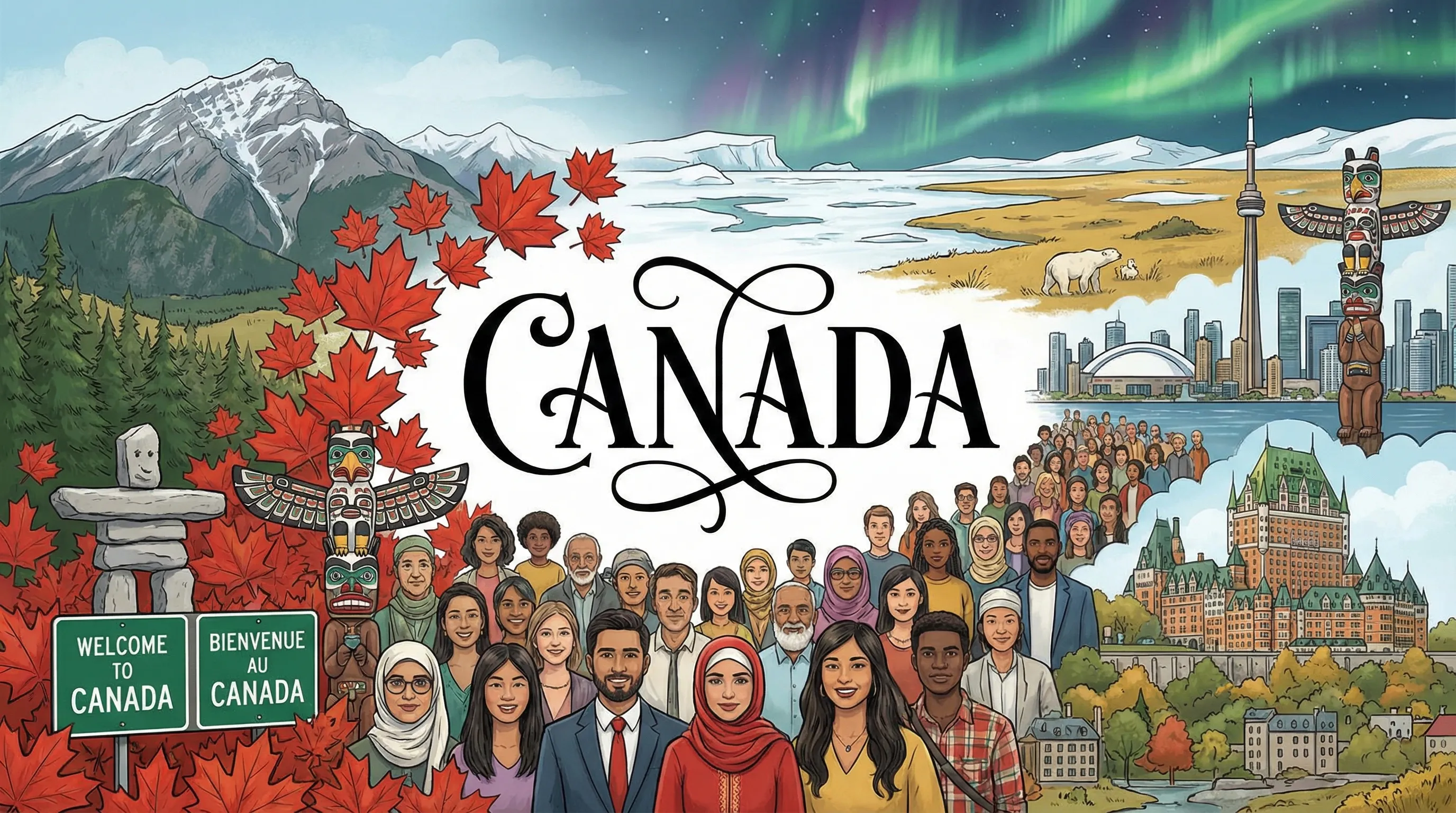
Explore Canadian society, culture and bilingualism.
True North Strong and Free
Canada is the world's second-largest country by area, known for multiculturalism, bilingualism, and natural beauty. Often seen as America's quieter, more polite neighbor, Canada has its own distinct identity and challenges.
Learning Objectives:
- Understand Canadian history, bilingualism, and multiculturalism
- Analyze Canada's relationship with indigenous peoples
- Compare Canadian and American identity
- Compare Canada with Norway
Key Facts:
- Population: ~40 million
- Two official languages: English and French
- Constitutional monarchy (British monarch as head of state)
- Known for healthcare, peacekeeping, politeness
Canada has two "founding nations" (besides Indigenous peoples):
- French: Colonized from 1534, concentrated in Quebec
- British: Took over in 1763 after Seven Years' War
The Language Divide:
- English: ~75% of population
- French: ~20% of population
- Quebec: ~80% French-speaking
- Rest of Canada: ~95% English-speaking
The Quiet Revolution (1960s)
Quebec underwent rapid modernization:
- Secularization (break from Catholic Church dominance)
- Growth of Quebec nationalism
- French language protection laws
- Movement toward separation from Canada
Quebec Separatism:
- 1980 Referendum: 40% voted to leave Canada
- 1995 Referendum: 49.4% voted to leave (extremely close!)
- Independence movement has weakened but not disappeared
- Bloc Québécois remains active in federal politics
Official Bilingualism (since 1969):
- Federal government services in both languages
- All products labeled in both languages
- Supreme Court operates bilingually
- But practically, most Canadians are monolingual in their region
Example: Bill 101 and Language Politics in Quebec
What Is Bill 101?
Quebec's Charter of the French Language (1977) makes French the official language of Quebec:
Key Provisions:
- French is the language of government, business, and education
- Businesses with 50+ employees must operate in French
- Outdoor commercial signs must be in French (or French more prominent)
- Immigrant children must attend French schools (with exceptions)
Why It Exists:
- Fear of French being overwhelmed by English
- Immigrants historically chose English
- Global English dominance threatened French
- Preserving Quebec's distinct culture
Controversies:
The "Language Police" (Office québécois de la langue française):
- Enforces language laws
- Inspects businesses for compliance
- Cases like "pastagate" (2013): Italian restaurant told "pasta" must be translated
- Seen as protecting French OR as excessive
English Rights:
- English speakers feel marginalized
- Some anglophones left Quebec
- Debates about minority language rights
Comparison with Norway:
Norway has two official written forms (Bokmål and Nynorsk) and requires both in education. But this isn't linked to geographic separation or independence movements the way Quebec's French is.
Key Question:
How should societies protect minority languages without restricting individual rights?
Analyze Canada's bilingualism:
Why is language such a sensitive political issue in Canada?
What are the arguments for and against laws like Bill 101?
How does Quebec's situation compare to Norway's language policies?
Research question:
Why did the 1995 Quebec independence referendum nearly succeed (49.4% Yes)?
Why has the independence movement weakened since then?
Canada was the first country to adopt official multiculturalism:
Key Principles:
- All citizens can keep their cultural identity
- Government supports cultural diversity
- English and French are official languages, but heritage languages valued
- "Cultural mosaic" not "melting pot"
In Practice:
- Higher immigration per capita than most Western countries
- Diverse cities: Toronto 47% foreign-born, Vancouver 40%
- Ethnic media, festivals, communities supported
- Generally positive attitudes toward immigration
Indigenous Peoples in Canada
Three recognized groups:
- First Nations: 630+ communities, diverse cultures
- Inuit: Arctic peoples of northern Canada
- Métis: Mixed Indigenous and European heritage
Residential Schools (1831-1996)
Canada forcibly sent Indigenous children to boarding schools:
- Goal: "Kill the Indian in the child" - force assimilation
- Children forbidden to speak languages, practice culture
- Physical, sexual, and emotional abuse widespread
- At least 4,100 children died (likely many more)
- Last school closed in 1996
Truth and Reconciliation (2008-2015)
TRC investigated residential schools:
- Heard from over 7,000 survivors
- Called residential schools "cultural genocide"
- Issued 94 Calls to Action for reconciliation
- Discovered unmarked graves at former schools (2021+)
Ongoing Issues:
- Missing and Murdered Indigenous Women and Girls (MMIWG)
- Clean water: many reserves lack safe drinking water
- Land claims and treaty rights disputes
- Overrepresentation in prisons and child welfare
Example: The Discovery of Unmarked Graves
What Happened (2021)
In May 2021, the Tk'emlúps te Secwépemc First Nation announced the discovery of 215 unmarked graves at a former residential school in Kamloops, British Columbia.
The Impact:
- Searches began at other former school sites
- Over 1,300 potential graves found across Canada
- National mourning: flags lowered for months
- Canada Day celebrations cancelled by some
- Pope Francis visited and apologized (2022)
What It Revealed:
- Death toll from residential schools higher than known
- Many children never returned home
- Families never told what happened to their children
- Records were destroyed or incomplete
- Government and churches complicit
Survivor Testimony:
Survivors described:
- Severe punishment for speaking their language
- Inadequate food, clothing, heating
- Physical and sexual abuse
- Siblings forbidden from speaking to each other
- Children as young as three years old
Comparison with Norway:
Norway also had assimilation policies toward the Sámi:
- Norwegianization policy (1850s-1960s)
- Sámi children in boarding schools
- Language suppression
- Less violent than Canadian system but also caused trauma
- Truth and Reconciliation Commission established 2018
Key Question:
How should nations address historical crimes committed by their governments and churches?
Analyze the residential school system:
What was the purpose of residential schools?
Why does the TRC describe this as "cultural genocide"?
What should reconciliation look like?
Compare Canada and Norway:
List three similarities between Canada and Norway.
What can Canada and Norway learn from each other about indigenous rights?
Summary
Key Points:
1. Bilingualism: Canada has two official languages (English and French), with French concentrated in Quebec; language politics have fueled separatist movements.
2. Multiculturalism: Canada was the first country with official multiculturalism; "cultural mosaic" approach welcomes diversity more than American "melting pot."
3. Indigenous Peoples: First Nations, Inuit, and Métis face ongoing challenges from colonial legacy; residential schools caused "cultural genocide."
4. Truth and Reconciliation: TRC documented residential school abuses; discovery of unmarked graves brought renewed attention; reconciliation is ongoing.
5. Canada-Norway Comparison: Similar in many ways (climate, resources, welfare state, indigenous peoples); can learn from each other's approaches.
Key Vocabulary:
- Bilingualism - use of two languages officially
- Quiet Revolution - Quebec's rapid modernization in the 1960s
- Cultural mosaic - model where diverse cultures maintain distinct identities
- Residential schools - boarding schools that forcibly assimilated Indigenous children
- Truth and Reconciliation - process of documenting historical wrongs and seeking healing
Essay question (250-350 words):
"Canada's official multiculturalism is a model for other countries." Evaluate this claim, considering both strengths and limitations of Canada's approach.
Comparative project:
Create a comparison table: Canada vs. USA vs. Norway, covering: political system, healthcare, immigration policy, indigenous rights, diversity approach.
Based on your comparison, which country would you most want to live in? Why?
What does Canada do better than either the US or Norway? What does it do worse?
Sources
- Bumsted, J. M. (2014). A History of the Canadian Peoples. Oxford University Press.
- Government of Canada: canada.ca
- Truth and Reconciliation Commission of Canada (2015). Final Report.
- UDIR (2020). Læreplan i engelsk (ENG01-04). Utdanningsdirektoratet. https://www.udir.no/lk20/eng01-04
Dette kapitlet er skrevet av Anthropics toppmodeller (Claude Opus og Claude Fable) og er foreløpig ikke manuelt gjennomgått — kvalitetskontrollen gjøres av uavhengige KI-agenter, og innmeldte feil rettes fortløpende. Funnet en feil? Meld fra, så retter vi den. Les mer om hvordan innholdet lages.