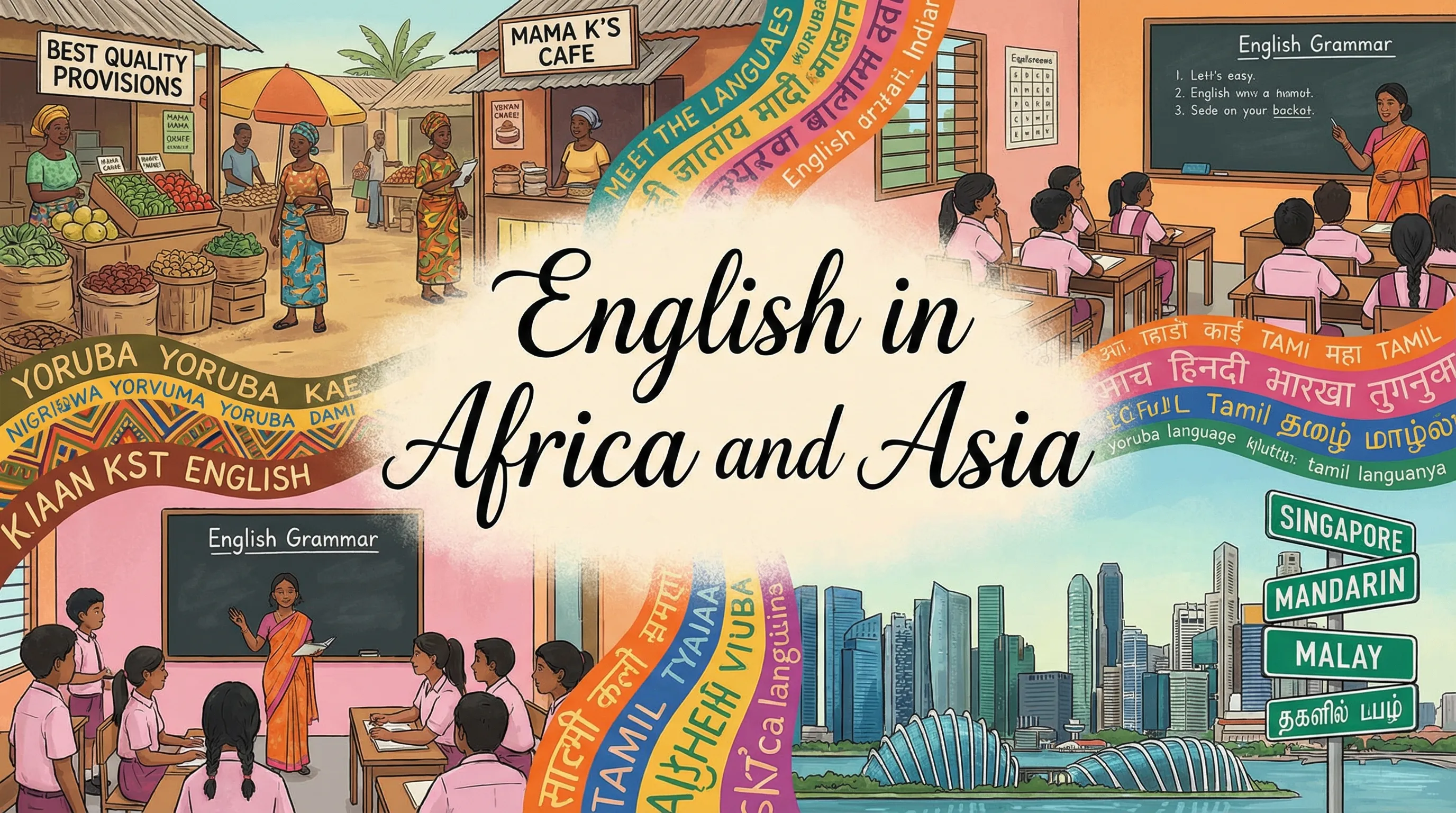
Examine the role of English in African and Asian countries.
English Across Continents
English serves as an official language in many African and Asian countries, often alongside indigenous languages. This is largely a legacy of British colonialism, but the role of English has evolved since independence.
Learning Objectives:
- Understand why English is used in many former colonies
- Analyze the advantages and disadvantages of English as a post-colonial language
- Recognize different varieties of English as legitimate
- Consider the politics of language and identity
African Countries Using English:
Nigeria, South Africa, Kenya, Ghana, Zimbabwe, Uganda, and many more
Asian Countries Using English:
India, Singapore, Philippines, Pakistan, Hong Kong, Malaysia
British ruled India from 1858-1947 (and through the East India Company before that).
Why English Was Introduced:
- Colonial administration needed officials who spoke English
- 1835: Macaulay's Minute on Education - English education for elite
- Goal: create "a class of persons, Indian in blood and colour, but English in taste, in opinions, in morals, and in intellect"
- English became language of power, education, and law
Independence (1947) - Keep English or Remove It?
Debate at independence:
- Some wanted Hindi as sole national language
- South Indians (non-Hindi speakers) protested
- Compromise: Hindi AND English as official languages
- English as "link language" between regions
English in India Today:
- Official language at federal level
- ~125 million second-language speakers (estimates vary)
- ~250,000 native speakers (small minority)
- Language of higher education, business, courts, technology
- Growing: more Indians learning English each year
The English Advantage:
- Higher salaries for English speakers
- Access to global economy and technology
- Social mobility for those who master it
- BUT: Creates inequality between those with and without English access
Example: Indian English - A Legitimate Variety
Is Indian English "Correct" English?
Yes. Indian English is as legitimate as British or American English. Like other varieties, it has:
Distinctive Vocabulary:
| Indian English | British/American |
|---|---|
| prepone | move earlier (opposite of postpone) |
| lakh | 100,000 |
| crore | 10,000,000 |
| eve-teasing | sexual harassment |
| do the needful | do what is necessary |
| mugging | studying hard |
| timepass | killing time |
Grammar Features:
- "I am having two brothers" (vs. "I have two brothers")
- "He is not knowing the answer" (continuous for states)
- "Isn't it?" used for all question tags
- "Only" for emphasis: "Yesterday only I saw him"
Code-Switching:
Many Indians mix English with Hindi or other languages:
- "Hinglish" - Hindi + English
- "Yaar, what's happening?" (friend, what's happening?)
- Common in everyday speech, advertising, Bollywood
Why Indian English Matters:
- More people speak English in India than in the UK
- Indian English literature (Salman Rushdie, Arundhati Roy) wins global prizes
- Indian tech workers shape global English
- Represents legitimate linguistic evolution
The Debate:
Some argue for "Standard British English" in education; others say Indian English should be taught and respected. This reflects broader questions about who "owns" English.
Analyze English in India:
Why did India keep English after independence instead of adopting only Hindi?
How does English create both opportunity and inequality in India?
Is Indian English "correct" English? Explain your view.
Analyze code-switching:
What is code-switching? Give an example.
Why might bilingual speakers code-switch?
Over 20 African countries use English officially, including:
- Nigeria: ~230 million people; English is official, alongside 500+ local languages
- South Africa: English is one of 11 official languages
- Kenya: English and Swahili are official
- Ghana: English is the only official language
Why English in Africa?
- Colonial legacy (British colonies)
- Ethnic neutrality: English doesn't favor one ethnic group over others
- International business and diplomacy
- Education in European languages was established
African English Varieties:
Each country has developed its own variety:
- Nigerian English, Kenyan English, South African English
- Influenced by local languages
- Legitimate varieties with their own features
Singapore: A Multilingual Success Story
Singapore is unique - deliberately chose English as primary language:
- Chinese, Malay, Tamil are official alongside English
- English is language of education and business
- "Singlish" - English mixed with Chinese, Malay, Tamil
Why Singapore Chose English:
- No ethnic majority: Chinese 74%, Malay 13%, Indian 9%
- English as neutral language avoiding ethnic conflict
- Global business connections
- Highly educated workforce
Singlish Examples:
- "Can" = yes, okay
- "Lah" = emphasis particle ("Don't worry lah")
- "Kiasu" = afraid to lose (from Hokkien)
- Government campaigns against Singlish but it persists as identity marker
Example: Nigeria - English in Africa's Most Populous Country
Background:
Nigeria has ~230 million people and over 500 languages:
- Major languages: Hausa (north), Yoruba (southwest), Igbo (southeast)
- English is the official language
- Nigerian Pidgin English spoken by 100+ million
Why English Works in Nigeria:
1. Ethnic neutrality: Choosing Hausa, Yoruba, or Igbo would favor one group
2. Colonial infrastructure: Education, law, administration built in English
3. International access: Business, diplomacy, media
4. Elite consensus: Powerful groups educated in English
Nigerian English Features:
- "I want to hear word" = I want advice
- "How far?" = How are you? What's up?
- "Shine your eye" = Be careful
- "Chop" = eat
Nigerian Pidgin:
A separate language with millions of speakers:
- "Wetin dey happen?" = What's happening?
- "How body?" = How are you?
- "I no sabi" = I don't know
- Used in everyday conversation, music, media
- Some argue it should be official
The Tension:
- English is necessary for education and advancement
- But English education is unequal (better in cities, for wealthy)
- Local languages and culture may be lost
- Nigerian literature in English (Chinua Achebe, Wole Soyinka) wins global acclaim
Chinua Achebe on English:
The famous Nigerian author wrote in English but defended this choice: "The price a world language must be prepared to pay is submission to many different kinds of use."
Key Question:
Can a colonial language become truly African?
Analyze English in Africa:
Why do many African countries use English despite it being a colonial language?
What are the advantages and disadvantages for Nigeria of using English?
Analyze Singapore's language policy:
Why did Singapore choose English as its main language when most Singaporeans are ethnically Chinese?
What is Singlish and why does it persist despite government campaigns against it?
Summary
Key Points:
1. Colonial Legacy: English is used in many African and Asian countries because of British colonialism; it was imposed but has been adapted.
2. Post-Colonial Utility: Countries keep English for ethnic neutrality, international access, and because systems (education, law) were built in English.
3. Local Varieties: Indian English, Nigerian English, Singlish are all legitimate varieties with their own features - not "incorrect" English.
4. Inequality: English creates opportunity for those who master it but excludes those without access to English education.
5. Identity Questions: Debates continue about whether colonial languages can become truly local, and whether local varieties should be taught or "standard" English.
Key Vocabulary:
- Lingua franca - common language used between speakers of different native languages
- Code-switching - mixing two or more languages in conversation
- Variety - a distinct form of a language (Indian English is a variety)
- Pidgin - simplified language developed for communication between groups
- Language policy - government decisions about official languages and education
Essay question (250-350 words):
"Former colonies should replace English with local languages." Discuss this statement, considering practical and cultural factors.
Research and reflection:
Choose one English-speaking country in Africa or Asia not covered in detail above (e.g., Kenya, Ghana, Philippines, Pakistan, Hong Kong).
Research: What role does English play? Why? What local variety has developed?
Reflect: How does Norway's use of English compare? Norway wasn't colonized but English is increasingly important - is this different?
Sources
- Achebe, C. (1975). "The African Writer and the English Language." In Morning Yet on Creation Day. Anchor Books.
- Kachru, B. B. (1986). The Alchemy of English. University of Illinois Press.
- Bolton, K. (2003). Chinese Englishes: A Sociolinguistic History. Cambridge University Press.
- UDIR (2020). Læreplan i engelsk (ENG01-04). Utdanningsdirektoratet. https://www.udir.no/lk20/eng01-04
Dette kapitlet er skrevet av Anthropics toppmodeller (Claude Opus og Claude Fable) og er foreløpig ikke manuelt gjennomgått — kvalitetskontrollen gjøres av uavhengige KI-agenter, og innmeldte feil rettes fortløpende. Funnet en feil? Meld fra, så retter vi den. Les mer om hvordan innholdet lages.