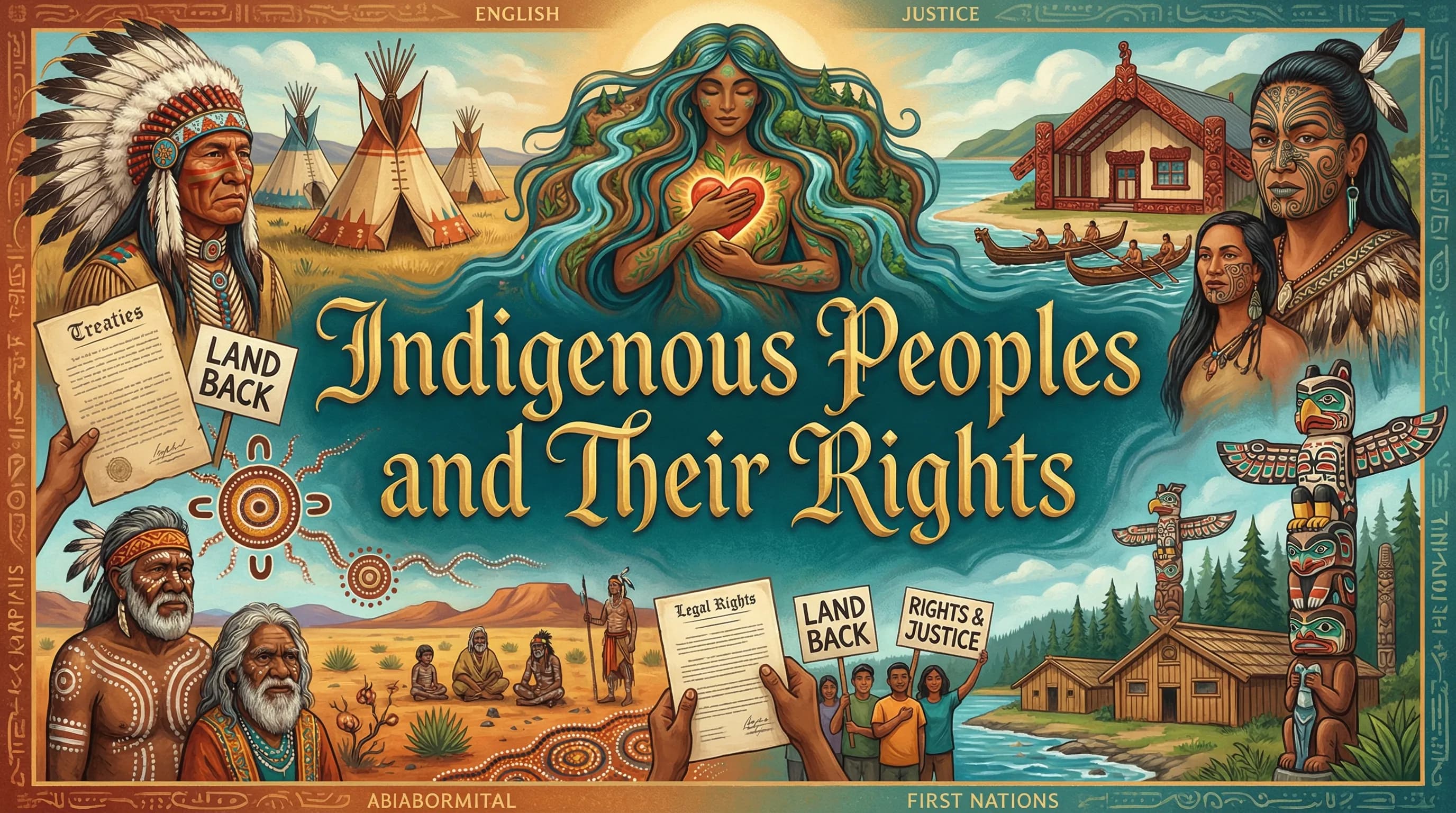
Learn about indigenous peoples in English-speaking countries.
Indigenous Rights in the English-speaking World
Indigenous peoples across English-speaking countries share histories of colonization, dispossession, and ongoing struggles for rights and recognition. While each group has unique experiences, common patterns emerge.
Learning Objectives:
- Understand the shared and distinct experiences of indigenous peoples
- Analyze different approaches to indigenous rights and reconciliation
- Compare situations across countries, including Norway
- Evaluate what meaningful reconciliation requires
Common Experiences:
- Loss of land and resources
- Destruction of language and culture
- Forced assimilation policies (boarding schools)
- Ongoing discrimination and inequality
- Movements for rights and self-determination
- About 5.2 million people (1.6% of US population)
- 574 federally recognized tribes
- Sovereignty: Tribes are "domestic dependent nations"
- Treaties: US signed and often broke hundreds of treaties
Historical Trauma:
- Genocide through war, disease, starvation
- Trail of Tears (1830s): forced removal to Oklahoma
- Boarding schools: "Kill the Indian, save the man"
- Termination policies (1950s): ended tribal recognition
Current Issues:
- Reservation poverty: some areas lack basic infrastructure
- Land rights: Standing Rock protests against pipelines
- Mascots debate: Washington Commanders (formerly Redskins)
- Missing and Murdered Indigenous Women
Canada - First Nations, Inuit, and Métis
- About 1.7 million people (4.9% of population)
- Over 600 First Nations, plus Inuit (Arctic) and Métis (mixed)
- Treaty relationships (some historical, some modern)
Historical Trauma:
- Residential schools (covered in previous chapter)
- Forced relocations
- "Sixties Scoop": Indigenous children adopted to white families
Current Issues:
- Clean water: many reserves lack safe drinking water
- MMIWG: Missing and Murdered Indigenous Women and Girls
- Land claims: disputes over unceded territory
- Truth and Reconciliation implementation
Example: The Standing Rock Protests (2016-2017)
What Happened:
The Dakota Access Pipeline (DAPL) was planned to carry oil near the Standing Rock Sioux Reservation in North Dakota.
Why It Mattered:
- Pipeline crossed under Lake Oahe, the tribe's water supply
- Route crossed sacred burial sites
- Original route near Bismarck (mostly white) rejected for safety; moved near reservation
- Tribe was not properly consulted
The Protest:
- Thousands gathered in solidarity camps
- "Water Protectors" faced police with water cannons, dogs, rubber bullets
- Largest Native American gathering in over 100 years
- Support from indigenous peoples worldwide
- #NoDAPL trended globally
What It Revealed:
1. Environmental racism: Dangerous projects often placed near minority communities
2. Treaty rights: Pipeline crossed territory covered by 1851 treaty
3. Sovereignty limits: Tribal objections overruled by federal government
4. Indigenous solidarity: Global indigenous movement emerging
5. Ongoing colonialism: Land and resources still taken from indigenous peoples
Outcome:
Obama administration halted pipeline; Trump administration restarted it. Pipeline completed and operating. Legal battles continue.
Key Question:
How do indigenous rights intersect with environmental protection and economic development?
Analyze the Standing Rock protests:
Why did the Standing Rock Sioux oppose the Dakota Access Pipeline?
What does "environmental racism" mean and how does Standing Rock illustrate it?
Why is this issue relevant beyond the United States?
Compare indigenous experiences in the US and Canada:
What similarities exist between Native American and First Nations experiences?
What differences exist in how the two countries approach indigenous rights?
- Australia: No treaty; terra nullius; Stolen Generations; 2023 Voice referendum failed
- New Zealand: Treaty of Waitangi; Māori language official; better integration but inequality remains
The UN Declaration on the Rights of Indigenous Peoples (UNDRIP, 2007)
International framework for indigenous rights:
- Right to self-determination
- Right to lands, territories, and resources
- Free, prior, and informed consent before projects on indigenous lands
- Right to practice and revitalize culture and language
Adoption:
- Initially opposed by US, Canada, Australia, New Zealand
- All four eventually endorsed (with reservations)
- Not legally binding but sets standards
Elements of Justice and Reconciliation:
1. Truth-Telling:
- Document what happened
- Acknowledge harm
- Examples: Canada TRC, Australian "Bringing Them Home" report
2. Apologies:
- Official government apologies
- Australia (2008), Canada (2008), US (2009 - buried in legislation)
- Symbolic but meaningful
3. Land Rights:
- Return of stolen lands
- Treaty settlements
- Native title recognition
4. Self-Governance:
- Tribal/First Nations governments
- Sámi Parliament model
- Control over own affairs
5. Language and Culture:
- Language revitalization programs
- Cultural education
- Protection of sacred sites
Example: Comparing Approaches - A Table
| Factor | USA | Canada | Australia | New Zealand | Norway (Sámi) |
|---|---|---|---|---|---|
| Treaty/Legal Basis | Treaties (often broken) | Treaties + Constitution | No treaty | Treaty of Waitangi | Sámi Parliament |
| Formal Apology | 2009 (buried) | 2008 (residential schools) | 2008 (Stolen Generations) | 1995 (land confiscation) | 1997 (Norwegianization) |
| Self-Governance | Tribal sovereignty | Self-government agreements | Limited | Treaty settlements | Sámi Parliament (advisory) |
| Language Status | Some tribal official | Some provinces | Not official | Official since 1987 | Official in some areas |
| % of Population | 1.6% | 4.9% | 3.3% | 17% | ~2.5% |
| Truth Commission | No | Yes (2008-2015) | No (inquiry) | Waitangi Tribunal | Yes (2018-) |
What the Table Shows:
- New Zealand has strongest integration (Māori 17% of population, language official)
- Canada most active in recent reconciliation (TRC)
- Australia and US lag in formal reconciliation processes
- Norway relatively progressive but indigenous population small
Key Insight:
No country has fully achieved justice for indigenous peoples. All are works in progress.
Questions for Reflection:
- What does genuine reconciliation require?
- Can past wrongs ever be fully "fixed"?
- What role should indigenous peoples have in defining reconciliation?
Analyze the UN Declaration on Indigenous Rights:
What rights does UNDRIP protect?
Why did the US, Canada, Australia, and New Zealand initially oppose it?
Is UNDRIP enough to protect indigenous rights? Why or why not?
Compare with Norway:
How does the Sámi Parliament work and what powers does it have?
What was Norwegianization and how was it similar to policies elsewhere?
What can Norway learn from other countries about indigenous rights?
Summary
Key Points:
1. Shared History: Indigenous peoples across English-speaking countries experienced colonization, land loss, forced assimilation, and cultural destruction.
2. Distinct Situations: Each country has different legal frameworks - from treaties to terra nullius - creating different paths for rights and reconciliation.
3. Ongoing Struggles: Issues like land rights, clean water, environmental justice, and violence against indigenous women and girls continue.
4. International Standards: UNDRIP provides a framework for indigenous rights, though implementation varies.
5. Reconciliation Elements: Truth-telling, apologies, land rights, self-governance, and language preservation are all part of meaningful reconciliation.
6. Norway Connection: The Sámi experience shares patterns with indigenous peoples elsewhere; comparing approaches can inform better policy.
Key Vocabulary:
- Tribal sovereignty - legal concept that tribes are self-governing nations
- Terra nullius - "empty land" doctrine denying indigenous land rights
- Treaty - agreement between indigenous nation and colonial/national government
- UNDRIP - UN Declaration on the Rights of Indigenous Peoples
- Self-determination - right of peoples to determine their own political status
- Reconciliation - process of addressing historical wrongs and building new relationships
Essay question (300-400 words):
Compare how TWO countries from this chapter approach indigenous rights. Which approach is more effective and why? Consider: legal frameworks, reconciliation efforts, current outcomes.
Reflection and research project:
What responsibilities do you think Norway has toward the Sámi people today?
Research one specific Sámi rights issue in Norway today (e.g., wind power conflicts, language rights, Fosen case).
How does this Norwegian issue connect to what you have learned about indigenous rights globally?
Present your findings in a 5-minute presentation or 400-word report.
Sources
- Dunbar-Ortiz, R. (2014). An Indigenous Peoples' History of the United States. Beacon Press.
- Reynolds, H. (2006). The Other Side of the Frontier. UNSW Press.
- United Nations (2007). Declaration on the Rights of Indigenous Peoples.
- UDIR (2020). Læreplan i engelsk (ENG01-04). Utdanningsdirektoratet. https://www.udir.no/lk20/eng01-04
Dette kapitlet er skrevet av Anthropics toppmodeller (Claude Opus og Claude Fable) og er foreløpig ikke manuelt gjennomgått — kvalitetskontrollen gjøres av uavhengige KI-agenter, og innmeldte feil rettes fortløpende. Funnet en feil? Meld fra, så retter vi den. Les mer om hvordan innholdet lages.