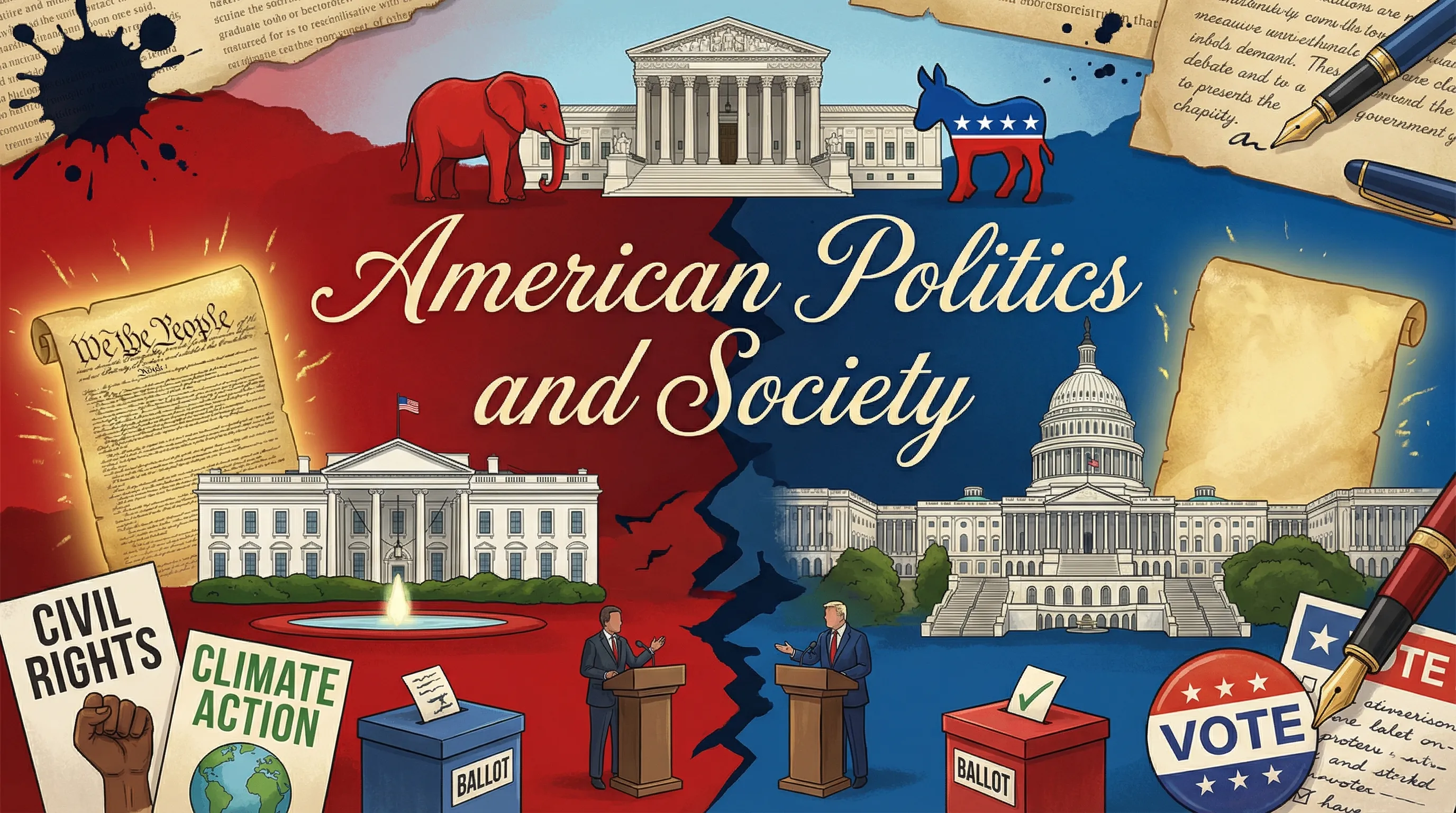
Understand the US political system and contemporary issues.
The American Political System
The United States has a federal system with separation of powers, designed by the founders to prevent tyranny. Today, this system faces challenges from polarization, money in politics, and debates about its democratic functioning.
Learning Objectives:
- Understand the structure of American government
- Analyze the two-party system and political polarization
- Compare American and Norwegian political systems
- Evaluate strengths and weaknesses of American democracy
Key Features:
- Federal system: power shared between national and state governments
- Separation of powers: legislative, executive, judicial
- Checks and balances: each branch can limit others
- Two-party system: Democrats and Republicans
The oldest written national constitution still in use. Key principles:
- Federalism: Power divided between national and state governments
- Separation of powers: Three branches with distinct roles
- Checks and balances: Each branch can limit the others
- Limited government: Bill of Rights protects individual freedoms
Executive Branch - The President:
- Head of state AND head of government (unlike UK)
- Commander-in-chief of military
- Signs or vetoes laws
- Appoints judges, cabinet, ambassadors
- 4-year terms, maximum 2 terms (22nd Amendment)
- Powers have expanded dramatically over time
Legislative Branch - Congress:
Senate (Upper House):
- 100 members: 2 per state regardless of population
- 6-year terms (1/3 elected every 2 years)
- Confirms appointments, ratifies treaties
- Equal representation benefits small states
House of Representatives (Lower House):
- 435 members: distributed by population
- 2-year terms
- Originates spending bills
- Majority needed to pass laws
Judicial Branch - Federal Courts:
- Supreme Court: 9 justices, lifetime appointments
- Interprets Constitution, can declare laws unconstitutional
- Lower federal courts handle cases involving federal law
- Judges appointed by President, confirmed by Senate
Example: How a Law is Made (and Why It's Hard)
The Journey of a Bill
Let's trace a hypothetical climate bill:
Step 1: Introduction
A member of Congress introduces the bill. In 2023-24, over 10,000 bills were introduced; fewer than 100 became law.
Step 2: Committee
The bill goes to a committee (e.g., Energy and Commerce). Most bills die here. The committee can:
- Hold hearings
- Mark up (amend) the bill
- Vote to send it forward - or not
Step 3: Floor Vote - House
If the committee approves, the full House debates and votes. Needs simple majority (218 votes).
Step 4: Senate
The bill goes to the Senate. But here's the catch: the filibuster.
- A Senator can talk indefinitely to block a vote
- 60 votes needed to end debate (cloture)
- In practice, this means most significant legislation needs 60 votes, not 51
Step 5: Conference
If House and Senate pass different versions, a conference committee reconciles them. Both chambers vote again.
Step 6: President
President can sign (law!) or veto. Congress can override veto with 2/3 vote in both chambers (rare).
Why It's So Hard:
- House and Senate must agree
- Filibuster requires 60 Senate votes
- President can veto
- Courts can strike down laws
- States can resist implementation
Result:
American government is designed to make change DIFFICULT. This prevents tyranny but also prevents action on problems.
Explain the structure of American government:
What is "separation of powers" and why did the founders want it?
How do "checks and balances" work? Give two examples.
Why does the Senate give equal representation to all states regardless of population?
Analyze why passing laws is difficult in America:
What is the filibuster and how does it affect legislation?
Is making change difficult a strength or weakness of the American system?
Unlike Norway's multi-party system, America has two dominant parties:
Democrats (Center-left to left):
- Support government programs (healthcare, education, environment)
- Generally favor gun control, abortion rights, immigration paths
- Base: cities, minorities, educated voters, young people
- Symbols: donkey, blue color
Republicans (Center-right to right):
- Support lower taxes, less regulation, traditional values
- Generally favor gun rights, abortion restrictions, immigration limits
- Base: rural areas, white voters, religious conservatives, older voters
- Symbols: elephant, red color
Why Only Two Parties?
- Winner-take-all elections: only first place matters
- Electoral College: third parties can't win states
- Ballot access laws favor major parties
- Media attention focuses on two parties
Political Polarization
Americans are more divided than in decades:
Evidence:
- In 1994, 16% had "very unfavorable" view of other party; now 60%+
- Mixed marriages (Democrat + Republican) have declined
- People increasingly live near like-minded others
- Different media sources (Fox News vs. MSNBC)
Causes:
- Social media creates echo chambers
- Geographic sorting (liberals in cities, conservatives in rural)
- Primaries favor extreme candidates
- Cultural issues (guns, abortion) are hard to compromise on
- Loss of local news and shared information
Example: The Electoral College - Democratic or Not?
How It Works:
Americans don't directly elect the President. They vote for "electors" who then vote for President.
- Each state gets electors equal to its Congressional representation (Senators + Representatives)
- Most states: winner of state popular vote gets ALL electors
- Need 270 of 538 electoral votes to win
The Problem:
A candidate can win the Electoral College while losing the national popular vote.
This Has Happened:
- 2000: George W. Bush won with 271 electoral votes despite Al Gore winning 500,000 more votes nationally
- 2016: Donald Trump won with 304 electoral votes despite Hillary Clinton winning 2.9 million more votes nationally
Arguments FOR the Electoral College:
- Protects small states' influence
- Prevents regional candidates
- Forces candidates to build broad coalitions
- Tradition, founders' wisdom
Arguments AGAINST:
- Undemocratic - loser of popular vote can win
- Focuses campaigns on "swing states" only
- Small states already protected by Senate
- Most founders didn't anticipate current system
Campaign Reality:
In 2020, Trump and Biden made 96% of their campaign stops in just 12 states. California (55 electoral votes, reliably Democratic) got zero visits. Wyoming (3 electoral votes, reliably Republican) got zero visits.
Key Question:
Should the person with the most votes always become President?
Analyze the Electoral College:
How can a candidate win the presidency while losing the popular vote?
What are the strongest arguments for and against the Electoral College?
How does this compare to how Norway chooses its government?
Analyze political polarization:
What evidence suggests America is more polarized than before?
What factors contribute to polarization?
Summary
Key Points:
1. Federal System: Power is divided between national government and 50 state governments, each with significant authority.
2. Separation of Powers: Three branches (executive, legislative, judicial) check and balance each other, making change deliberately difficult.
3. Two-Party System: Winner-take-all elections produce two dominant parties, unlike Norway's multi-party system.
4. Electoral College: Presidents are chosen by electoral votes, not popular vote, which can produce results where the popular vote loser wins.
5. Polarization: Americans are increasingly divided by party, geography, media consumption, and cultural issues.
Key Vocabulary:
- Federalism - division of power between national and state governments
- Checks and balances - system where branches limit each other's power
- Electoral College - system of electors who formally choose the President
- Filibuster - tactic allowing Senators to block legislation by extended debate
- Swing states - states where either party might win, receiving most campaign attention
Comparative essay (250-350 words):
Compare the American and Norwegian political systems. Which do you think is more democratic? Consider: representation, voting systems, party systems, and who gets power.
Current events analysis:
Find a recent news article about American politics (election, legislation, Supreme Court decision, etc.).
Summarize the key facts in 100 words.
Using what you've learned about the American political system, explain why this is happening or why it matters.
How might this same issue be handled differently in Norway?
Sources
- Foner, E. (2019). Give Me Liberty! An American History. W. W. Norton.
- Zinn, H. (2015). A People's History of the United States. Harper Perennial.
- US Government: usa.gov/branches-of-government
- UDIR (2020). Læreplan i engelsk (ENG01-04). Utdanningsdirektoratet. https://www.udir.no/lk20/eng01-04
Dette kapitlet er skrevet av Anthropics toppmodeller (Claude Opus og Claude Fable) og er foreløpig ikke manuelt gjennomgått — kvalitetskontrollen gjøres av uavhengige KI-agenter, og innmeldte feil rettes fortløpende. Funnet en feil? Meld fra, så retter vi den. Les mer om hvordan innholdet lages.