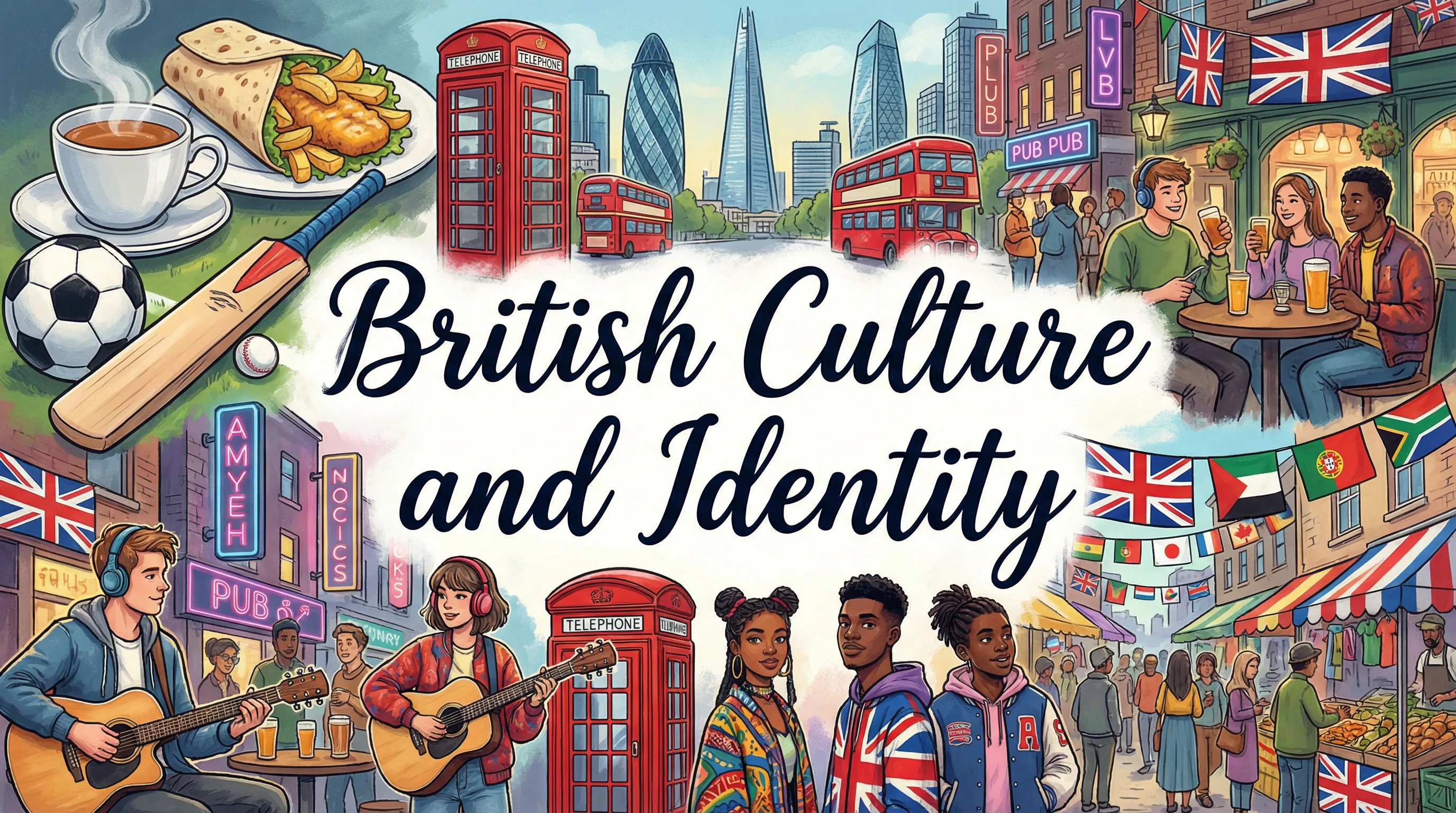
Explore British culture, traditions and contemporary issues.
What Does It Mean to Be British?
British identity is complex and contested, shaped by history, class, region, and diversity. In recent decades, debates about what it means to be British have intensified, influenced by immigration, devolution, and Brexit.
Learning Objectives:
- Understand the components of British cultural identity
- Analyze how class, region, and diversity shape British society
- Compare stereotypes with reality
- Reflect on how national identity is constructed and debated
Components of British Culture:
- National traditions (monarchy, ceremonies)
- Popular culture (music, TV, literature)
- Social norms (queuing, politeness, irony)
- Sports (football, cricket, rugby)
- Regional identities (English, Scottish, Welsh, Northern Irish)
Britain has a historically rigid class system that still influences society:
Upper Class:
- Aristocracy (lords, ladies, hereditary titles)
- "Old money" - inherited wealth
- Private schools (confusingly called "public schools"): Eton, Harrow
- Oxford and Cambridge universities
- Distinct accent: "Received Pronunciation" (RP)
Middle Class:
- Professionals (doctors, lawyers, teachers)
- Business owners
- Suburban homeowners
- Grammar schools, some private schools
- Regional accents often modified
Working Class:
- Manual and service workers
- Council housing (social housing)
- State comprehensive schools
- Strong regional accents
- Traditional industries (mining, factories, docks)
Class Indicators:
- Accent is the biggest giveaway
- School and university attended
- Vocabulary choices
- Hobbies and interests
- Newspaper read
Regional Identities:
England, Scotland, Wales, and Northern Ireland have distinct cultures:
- Different accents and dialects
- Different attitudes and stereotypes
- Different sports (rugby in Wales, shinty in Scotland)
- Different national symbols and celebrations
Example: How Accent Reveals Class
In most countries, accent indicates where you're from. In Britain, accent also indicates social class.
Received Pronunciation (RP) / "The Queen's English":
- Associated with upper and upper-middle class
- Learned in private schools
- Used in BBC broadcasting (historically)
- About 3% of population speaks "pure" RP
Regional Working-Class Accents:
- Cockney (London East End)
- Scouse (Liverpool)
- Geordie (Newcastle)
- Brummie (Birmingham)
- Yorkshire, Manchester, etc.
The Accent Prejudice:
Studies show:
- RP speakers perceived as more intelligent, competent
- Regional accents perceived as friendlier but less professional
- Accent discrimination in hiring documented
Changing Attitudes:
- More regional accents on TV and radio
- "Estuary English" (between RP and Cockney) becoming common
- Scottish and Welsh accents gaining prestige
- Young people mixing accents
Cultural Example:
In the film "My Fair Lady" (1964), Professor Higgins transforms Eliza Doolittle from a Cockney flower seller into a "lady" simply by changing her accent - showing how central accent is to British class perception.
Analyze the British class system:
What are some "markers" or indicators of social class in Britain?
How does this compare to Norway? Is class less visible in Norwegian society?
Why might accent be such an important class marker?
Research and compare regional identities:
What stereotypes exist about people from different parts of the UK (Scotland, Wales, Northern England, London)?
How accurate are these stereotypes?
Britain has always been shaped by immigration, but modern diversity largely began after WWII:
1948-1971: Commonwealth Immigration
- The Windrush generation: Caribbean migrants invited to rebuild post-war Britain
- South Asian immigration: India, Pakistan, Bangladesh
- Filling labor shortages in NHS, transport, factories
1973-2020: European Immigration
- EU membership allowed free movement
- Polish community grew dramatically after 2004
- Eastern European workers in agriculture, construction, services
Current Demographics:
- About 14% of UK residents born abroad
- London: 37% born abroad, over 300 languages spoken
- Other diverse cities: Birmingham, Manchester, Leicester, Bradford
Debates About Multiculturalism:
Pro-multiculturalism arguments:
- Diversity enriches culture
- Economic benefits from skilled workers
- Historical responsibility to former colonies
- Human rights obligations
Anti-multiculturalism arguments:
- Concerns about integration
- Pressure on public services
- Cultural change too fast
- Security concerns
"British Values" Debate:
Government promoted "fundamental British values":
- Democracy
- Rule of law
- Individual liberty
- Mutual respect and tolerance
Critics ask: Are these uniquely British? Or universal values?
Example: The Windrush Generation
The Story:
In 1948, the ship HMT Empire Windrush arrived at Tilbury Docks carrying 492 passengers from Jamaica. They were the first of hundreds of thousands invited to come to Britain to help rebuild after WWII.
Why They Came:
- Britain desperately needed workers
- Caribbean people were British subjects (colonies)
- Better economic opportunities
- They saw themselves as coming to the "mother country"
What They Found:
- Jobs in hospitals, transport, factories
- But also racism: "No Blacks, No Irish, No Dogs" signs in lodging houses
- Teddy Boy attacks and Notting Hill riots (1958)
- Gradual acceptance but continued discrimination
The Windrush Scandal (2018):
People who had lived legally in Britain for decades were:
- Denied healthcare
- Fired from jobs
- Detained by immigration
- Some deported to countries they hadn't seen since childhood
Why? The Home Office destroyed landing cards; people couldn't prove their status.
Legacy:
The Windrush generation and their descendants transformed British culture:
- Music: ska, reggae, jungle, grime
- Food: Caribbean cuisine now mainstream
- Language: Jamaican Patois influences British slang
- Sport: countless athletes
- The Notting Hill Carnival: Europe's largest street festival
Key Lesson:
Immigration involves both opportunity and discrimination, contribution and struggle.
Analyze the Windrush generation experience:
Why did Caribbean people come to Britain after WWII?
What challenges did they face?
How have Caribbean Britons contributed to British culture?
Compare approaches to diversity:
What is the difference between multiculturalism, integration, and assimilation?
Which approach does Norway take? Which does Britain take?
Summary
Key Points:
1. British vs. English: "British" includes English, Scottish, Welsh, and Northern Irish. These are distinct identities, and using them interchangeably can offend.
2. Class System: Britain has a historically rigid class system visible in accent, education, and social markers. This is changing but still influential.
3. Regional Diversity: Different regions have distinct identities, accents, and cultures. Stereotypes exist but oversimplify reality.
4. Multicultural Britain: Post-war immigration transformed Britain. About 14% of residents were born abroad, and London is one of the world's most diverse cities.
5. Identity Debates: Questions about "Britishness," immigration, and multiculturalism remain contested, as shown in Brexit debates.
Key Vocabulary:
- Received Pronunciation (RP) - the prestige accent associated with upper classes
- Windrush generation - Caribbean immigrants who came to Britain from 1948
- Multiculturalism - policy of different cultures coexisting while maintaining distinct identities
- British values - government-promoted values (democracy, rule of law, liberty, tolerance)
- Devolution - separate parliaments for Scotland, Wales, and Northern Ireland
Critical thinking essay (250-350 words):
"Stereotypes about Britain and the British are mostly harmless fun." Do you agree? Discuss with examples.
Comparative analysis:
Create a comparison between British and Norwegian national identity, considering: symbols, values, attitudes to immigration, regional differences.
What can each country learn from the other about handling diversity?
Sources and Further Reading
- Storry, M. & Childs, P. (2017). British Cultural Identities. Routledge.
- BBC Culture: bbc.com/culture
- The Guardian - Society: theguardian.com/society
Dette kapitlet er skrevet av Anthropics toppmodeller (Claude Opus og Claude Fable) og er foreløpig ikke manuelt gjennomgått — kvalitetskontrollen gjøres av uavhengige KI-agenter, og innmeldte feil rettes fortløpende. Funnet en feil? Meld fra, så retter vi den. Les mer om hvordan innholdet lages.