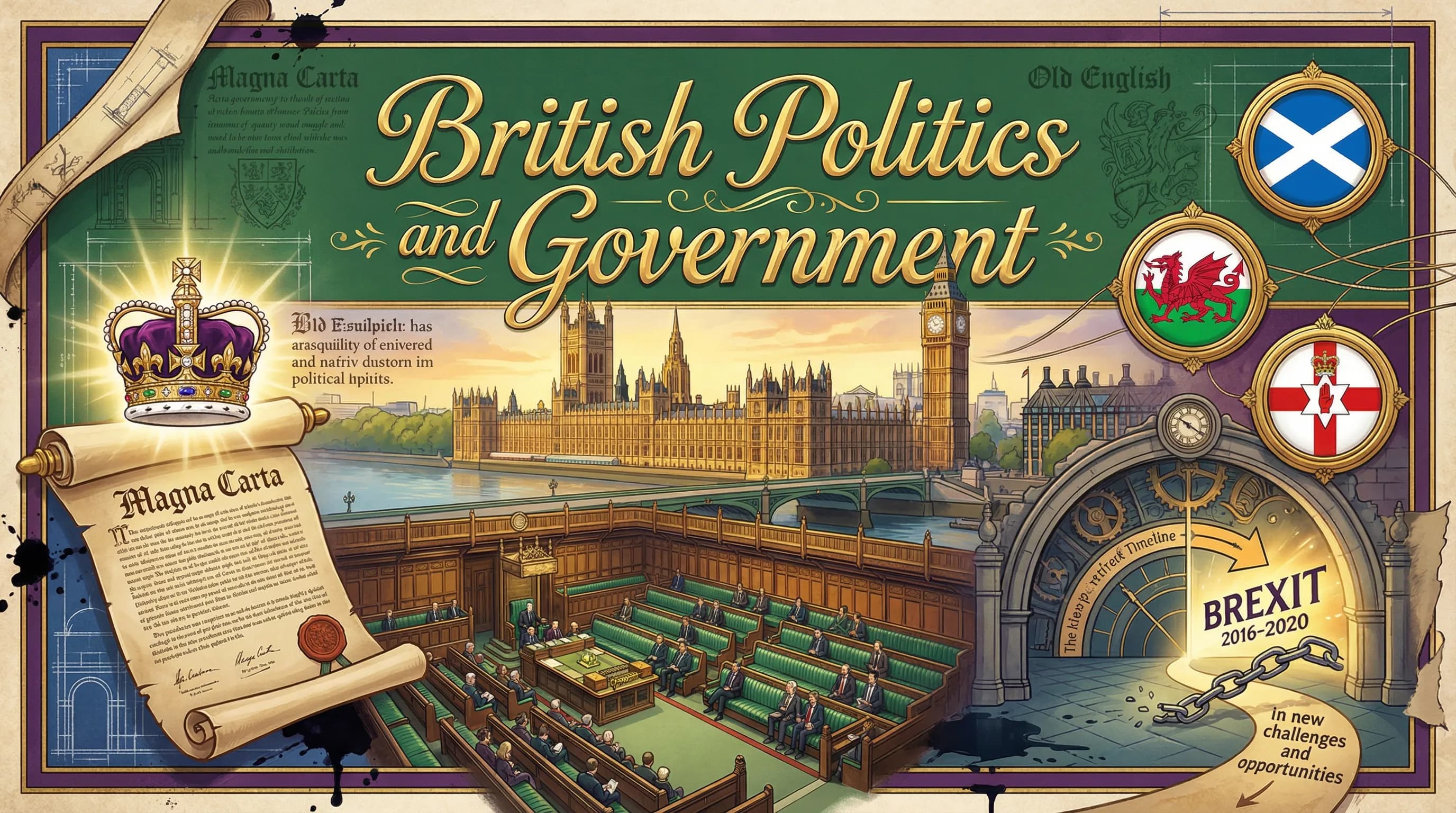
Understand the UK's political system and government.
How Britain is Governed
The United Kingdom is a constitutional monarchy with a parliamentary democracy - one of the oldest in the world. Understanding British politics helps you interpret news, understand history, and compare political systems.
Learning Objectives:
- Understand the structure of British government
- Compare British and Norwegian political systems
- Analyze key political issues facing the UK today
- Evaluate the strengths and weaknesses of the British system
Key Features:
- Monarch as head of state (ceremonial)
- Prime Minister as head of government
- Parliament makes laws
- No single written constitution
Currently King Charles III (since 2022). The monarch's role is ceremonial:
- Opens Parliament with the King's Speech (written by government)
- Gives "Royal Assent" to laws (never refused since 1708)
- Meets weekly with the Prime Minister
- Represents the UK abroad
- "Reigns but does not rule"
Parliament (Legislative Branch)
Parliament makes laws and holds government accountable.
House of Commons (Lower House):
- 650 Members of Parliament (MPs) elected by voters
- Elections at least every 5 years
- The government must maintain majority support
- Real power lies here
House of Lords (Upper House):
- About 800 members (not elected!)
- Life peers appointed by the monarch on PM's advice
- 92 hereditary peers (inherit their seats)
- 26 bishops of the Church of England
- Can delay and revise laws, but Commons can override
The Prime Minister and Cabinet
- PM is leader of the largest party in Commons
- Not directly elected by voters (unlike US President)
- Chooses Cabinet ministers to run government departments
- Can be removed by their own party or losing Commons vote
Example: How a British Law is Made
Step 1: Proposal
A "Bill" (proposed law) is introduced to Parliament. Most come from the government, but individual MPs can propose "Private Members' Bills."
Step 2: House of Commons
- First Reading: Bill announced (no debate)
- Second Reading: General debate on principles
- Committee Stage: Detailed examination, amendments
- Third Reading: Final debate and vote
Step 3: House of Lords
Same process. Lords can propose amendments. If they disagree with Commons, the bill goes back and forth ("ping pong") until agreement or Commons uses the Parliament Acts to override.
Step 4: Royal Assent
The monarch formally approves the bill. This is automatic - no monarch has refused since 1708.
Step 5: Law
The bill becomes an "Act of Parliament" and is the law.
Example: Marriage (Same Sex Couples) Act 2013
- Proposed by coalition government
- Passed Commons despite many Conservative MPs voting against
- Lords debated and passed with amendments
- Royal Assent July 2013
- Same-sex marriage became legal in England and Wales
Explain the structure of British government:
What is the difference between the Head of State and Head of Government in the UK?
Why is the House of Commons more powerful than the House of Lords?
How does someone become Prime Minister?
Analyze the House of Lords:
Why might having unelected legislators be considered undemocratic?
What arguments could be made FOR keeping the House of Lords?
The UK = England + Scotland + Wales + Northern Ireland
Devolution:
Since 1999, Scotland, Wales, and Northern Ireland have their own parliaments/assemblies with certain powers:
- Scottish Parliament: Controls education, health, justice, some taxes
- Welsh Senedd: Similar but fewer powers
- Northern Ireland Assembly: Unique power-sharing arrangements
England has no separate parliament - English laws are made by the UK Parliament.
Brexit (2016-2020)
The UK voted 52-48% to leave the European Union:
- Leave arguments: Sovereignty, immigration control, save money
- Remain arguments: Economic benefits, cooperation, influence
- Ongoing issues: Trade barriers, Northern Ireland border, labor shortages
Scottish Independence
Scotland voted 55-45% to stay in UK (2014), but Brexit (which Scotland opposed) renewed calls for another referendum. The Scottish National Party (SNP) wants independence.
Northern Ireland
Complex history of conflict between:
- Unionists (mostly Protestant) - want to stay in UK
- Nationalists (mostly Catholic) - want to join Republic of Ireland
The Good Friday Agreement (1998) brought peace but Brexit created new tensions.
Example: Brexit - A Case Study in Direct Democracy
The Referendum (June 23, 2016)
Prime Minister David Cameron promised a vote on EU membership to unite his Conservative Party. He expected Remain to win easily.
The Result:
- Leave: 51.9% (17.4 million votes)
- Remain: 48.1% (16.1 million votes)
- Turnout: 72.2%
Geographic Divide:
- England and Wales voted Leave
- Scotland and Northern Ireland voted Remain
- London and other cities voted Remain
- Rural and post-industrial areas voted Leave
What Happened Next:
- Cameron resigned
- Three years of political chaos
- Three Prime Ministers in three years
- Finally left EU on January 31, 2020
Ongoing Debates:
- Was the referendum fair? (Claims of misinformation, foreign interference)
- Should a simple majority decide such a major change?
- Should there be another referendum now people know the consequences?
- How should the UK handle the economic impacts?
Key Lesson:
Direct democracy (referendums) can create as many problems as it solves, especially on complex issues.
Analyze Brexit:
Why did the UK vote to leave the EU? List arguments from both sides.
Why did Scotland and Northern Ireland vote differently from England?
What does Brexit show about the challenges of using referendums for complex decisions?
Compare British and Norwegian political systems:
List two similarities between the systems.
List two key differences.
Summary
Key Points:
1. Constitutional Monarchy: The UK has a monarch (currently King Charles III) who reigns but does not rule. Real power lies with the elected government.
2. Parliament: The House of Commons (elected) has more power than the House of Lords (unelected). The government must maintain Commons support.
3. No Written Constitution: The UK has no single constitutional document - constitutional rules come from laws, court decisions, and traditions.
4. Devolution: Scotland, Wales, and Northern Ireland have their own parliaments with certain powers, creating a complex multi-level system.
5. Current Tensions: Brexit, Scottish independence, and Northern Ireland's status are major ongoing political issues.
Key Vocabulary:
- Constitutional monarchy - system where monarch is head of state but with limited powers
- Parliamentary democracy - government responsible to elected legislature
- Devolution - transfer of powers from central to regional governments
- Brexit - British exit from the European Union
- First-past-the-post - electoral system where candidate with most votes wins (no proportional representation)
Essay question (200-300 words):
"The House of Lords should be abolished or reformed." Discuss arguments for and against, and give your own view.
Create a comparison table:
Create a table comparing the UK, Norway, and USA political systems.
Which system do you think is most democratic? Explain your reasoning.
Sources and Further Reading
- UK Parliament: parliament.uk
- BBC News - UK Politics: bbc.co.uk/news/politics
- Norton, P. (2020). Governing Britain. Manchester University Press.
Dette kapitlet er skrevet av Anthropics toppmodeller (Claude Opus og Claude Fable) og er foreløpig ikke manuelt gjennomgått — kvalitetskontrollen gjøres av uavhengige KI-agenter, og innmeldte feil rettes fortløpende. Funnet en feil? Meld fra, så retter vi den. Les mer om hvordan innholdet lages.