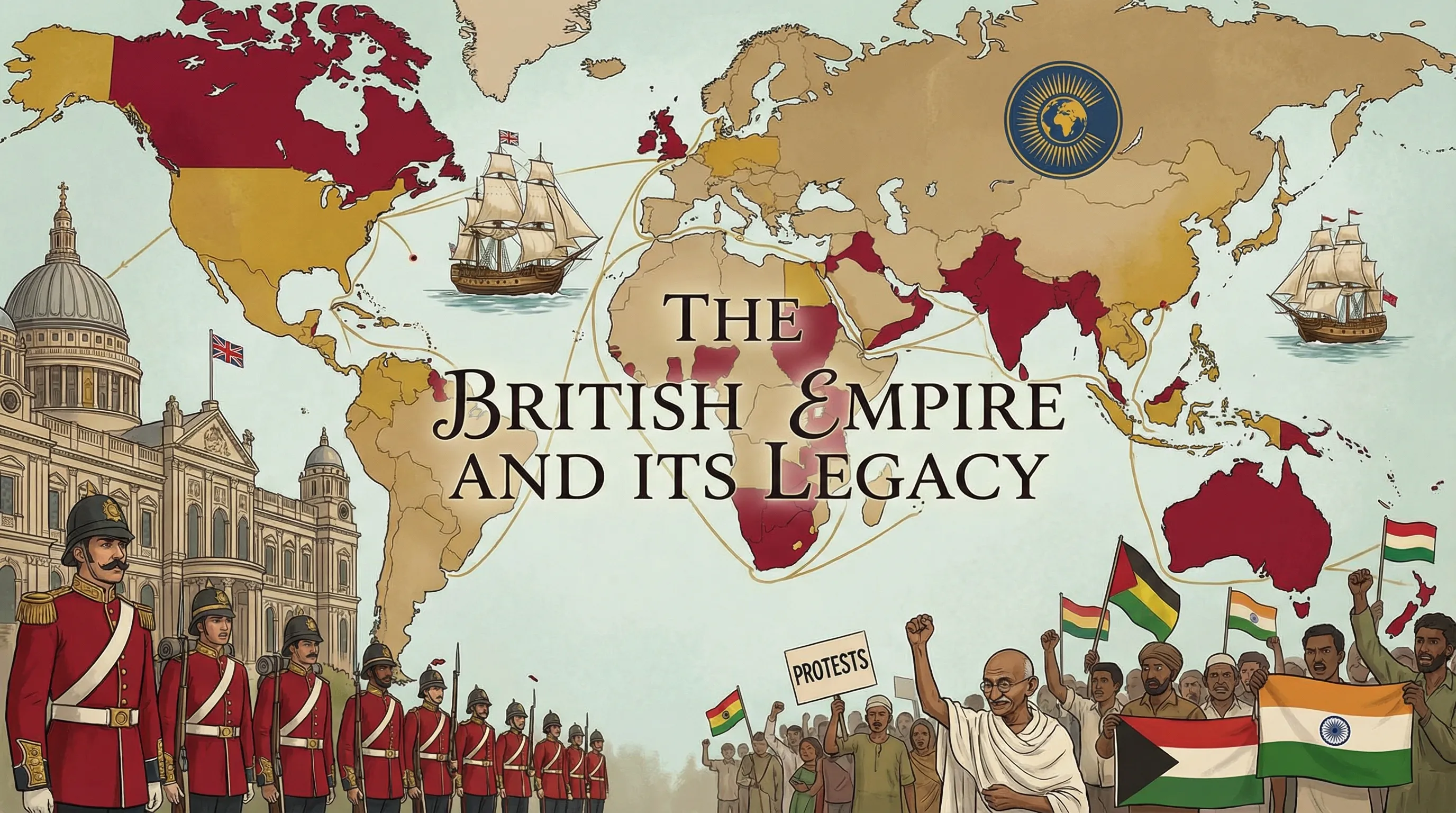
Understand the British Empire and its lasting impact.
The Sun Never Sets
At its height, the British Empire was the largest in history, controlling about 25% of the world's land and population. The saying "the sun never sets on the British Empire" was literally true - it spanned so many time zones that it was always daylight somewhere in British territory.
Learning Objectives:
- Understand the scope and methods of British colonialism
- Analyze both positive and negative legacies of empire
- Evaluate how colonial history affects the present
- Discuss complex ethical questions about historical responsibility
Key Phases:
- First Empire (1583-1783): Americas, Caribbean
- Second Empire (1783-1914): India, Africa, Asia, Pacific
- Decline (1914-1997): World Wars, decolonization
The Empire's Legacy:
- Spread of English language
- Common law systems
- Parliamentary democracy models
- Cricket and other sports
- But also: slavery, exploitation, cultural destruction
Britain's first empire focused on the Americas and Caribbean:
- North America: 13 colonies that became the United States
- Caribbean: Jamaica, Barbados - sugar plantations using enslaved labor
- Canada: Taken from France in 1763
This empire ended with American independence (1776-1783).
The Second British Empire (1783-1914)
After losing America, Britain focused on Asia, Africa, and the Pacific:
- India: "The Jewel in the Crown" - controlled through the East India Company, then directly after 1857
- Africa: Egypt, Sudan, Nigeria, Kenya, South Africa, and more - the "Scramble for Africa"
- Pacific: Australia, New Zealand, Fiji, and many islands
- Asia: Hong Kong, Singapore, Burma, Malaya
Methods of Empire:
1. Trading companies: East India Company had its own army
2. Military conquest: Often with superior technology
3. Treaties: Sometimes fair, often coerced
4. Indirect rule: Using local leaders
5. Settlers: Europeans taking land (Australia, New Zealand, South Africa)
Example: India - The Jewel in the Crown
How Britain Took Control:
The East India Company arrived as traders in 1600. Over 250 years, they gradually conquered the entire subcontinent through a combination of:
- Military force
- Playing local rulers against each other
- Economic control
- Taking over during famines and crises
What Britain Extracted:
- Raw materials (cotton, tea, spices, indigo)
- Tax revenue
- Markets for British manufactured goods
- Soldiers (Indian troops fought in British wars worldwide)
British Justifications:
- "Civilizing mission" - bringing "progress" to "backward" peoples
- Spreading Christianity
- Building railways and infrastructure
- Creating "order" and "good government"
Indian Perspective:
- Deindustrialization - India went from manufacturing textiles to exporting raw cotton
- Famines killed millions while food was exported
- Cultural suppression and racism
- Loss of self-governance
Legacy:
- English as a unifying language in diverse India
- Railways (built for resource extraction)
- Legal and administrative systems
- Cricket and parliamentary democracy
- BUT ALSO: Partition (1947) killed 1-2 million; borders that created lasting conflicts
Analyze the British Empire's methods and justifications:
List three methods Britain used to build its empire.
What was the "civilizing mission"? How did the British justify colonialism?
How might colonized peoples have viewed these justifications?
Using the India example, analyze colonial economics:
How did British rule change what India produced?
Who benefited from this change? Who suffered?
After World War II, the empire rapidly dissolved:
- 1947: India and Pakistan independent (Partition killed 1-2 million)
- 1960s: Most African colonies independent
- 1997: Hong Kong returned to China
Why Did the Empire End?
- WWII weakened Britain economically
- Independence movements grew stronger
- Changing attitudes about race and rights
- Cold War pressures from US and USSR
- Cost of maintaining empire exceeded benefits
The Commonwealth Today:
54 member states, 2.5 billion people. Voluntary association. The British monarch is head of state in 15 countries (including Canada, Australia).
Lasting Negative Legacies:
- Borders: African and Asian borders drawn by Europeans, dividing ethnic groups and creating conflicts
- Economic structures: Economies still oriented toward exporting raw materials
- Racism: Racial hierarchies established during colonialism
- Trauma: Slavery, violence, cultural destruction
- Inequality: Former colonies are generally poorer than former colonizers
Lasting Positive Legacies:
- Language: English as a global language enabling international communication
- Legal systems: Rule of law, independent courts
- Infrastructure: Railways, ports, universities (though built for colonial purposes)
- Democracy: Parliamentary systems in many former colonies
Example: The Scramble for Africa
The Berlin Conference (1884-1885)
European powers met in Berlin to divide Africa among themselves. No Africans were invited.
What Happened:
- Europeans drew straight-line borders on maps
- These borders ignored ethnic, linguistic, and historical boundaries
- By 1914, only Ethiopia and Liberia remained independent
Case Study: Nigeria
Britain created Nigeria by combining:
- Hausa-Fulani (Muslim, north)
- Yoruba (southwest)
- Igbo (southeast)
- Plus 250+ other ethnic groups
These groups had different languages, religions, and histories. They were forced into one country.
The Consequences:
- Civil war (1967-1970): Igbo attempted secession, 1-3 million died
- Ongoing ethnic and religious tensions
- Political instability
- Competition for oil resources along ethnic lines
The Pattern Repeats:
Similar problems in Rwanda (Hutu/Tutsi), Sudan (North/South), and many other African nations where colonial borders created unnatural states.
Key Question:
Are these conflicts "African problems" or the result of colonial decisions?
Analyze the impact of colonial borders:
Why did Europeans draw borders without considering local populations?
How have these borders contributed to conflicts in Africa?
Why is it difficult to change these borders today?
Evaluate the debate about reparations:
What arguments support former colonial powers paying reparations?
What arguments oppose reparations?
Summary
Key Points:
1. Scale: The British Empire was the largest in history, controlling 25% of the world's land and population.
2. Methods: Empire was built through trading companies, military conquest, treaties, indirect rule, and settler colonialism.
3. Justifications: The British claimed a "civilizing mission," but this masked economic exploitation and racism.
4. Decolonization: The empire ended after WWII due to weakened Britain, independence movements, and changing attitudes.
5. Legacy: Colonial history created lasting structures - some beneficial (language, legal systems), many harmful (borders, economic inequality, racism).
Key Vocabulary:
- Colonialism - political and economic control over another country
- Decolonization - the process of colonies becoming independent
- Commonwealth - voluntary association of former British colonies
- Reparations - compensation for historical wrongs
- "Civilizing mission" - justification claiming colonizers were helping colonized peoples
Write a balanced essay (250-350 words):
"The British Empire left more positive than negative legacies." Discuss this statement, presenting arguments for both sides before giving your own conclusion.
Research project:
Choose one former British colony (not covered above).
Research: When was it colonized? How? When did it become independent?
What lasting legacies - positive and negative - can you identify?
Present your findings in a 3-minute oral presentation or 300-word report.
Sources
- Ferguson, N. (2003). Empire: How Britain Made the Modern World. Penguin Books.
- Darwin, J. (2012). Unfinished Empire: The Global Expansion of Britain. Penguin Books.
- Elkins, C. (2005). Britain's Gulag: The Brutal End of Empire in Kenya. Pimlico.
- UDIR (2020). Læreplan i engelsk (ENG01-04). Utdanningsdirektoratet. https://www.udir.no/lk20/eng01-04
Dette kapitlet er skrevet av Anthropics toppmodeller (Claude Opus og Claude Fable) og er foreløpig ikke manuelt gjennomgått — kvalitetskontrollen gjøres av uavhengige KI-agenter, og innmeldte feil rettes fortløpende. Funnet en feil? Meld fra, så retter vi den. Les mer om hvordan innholdet lages.