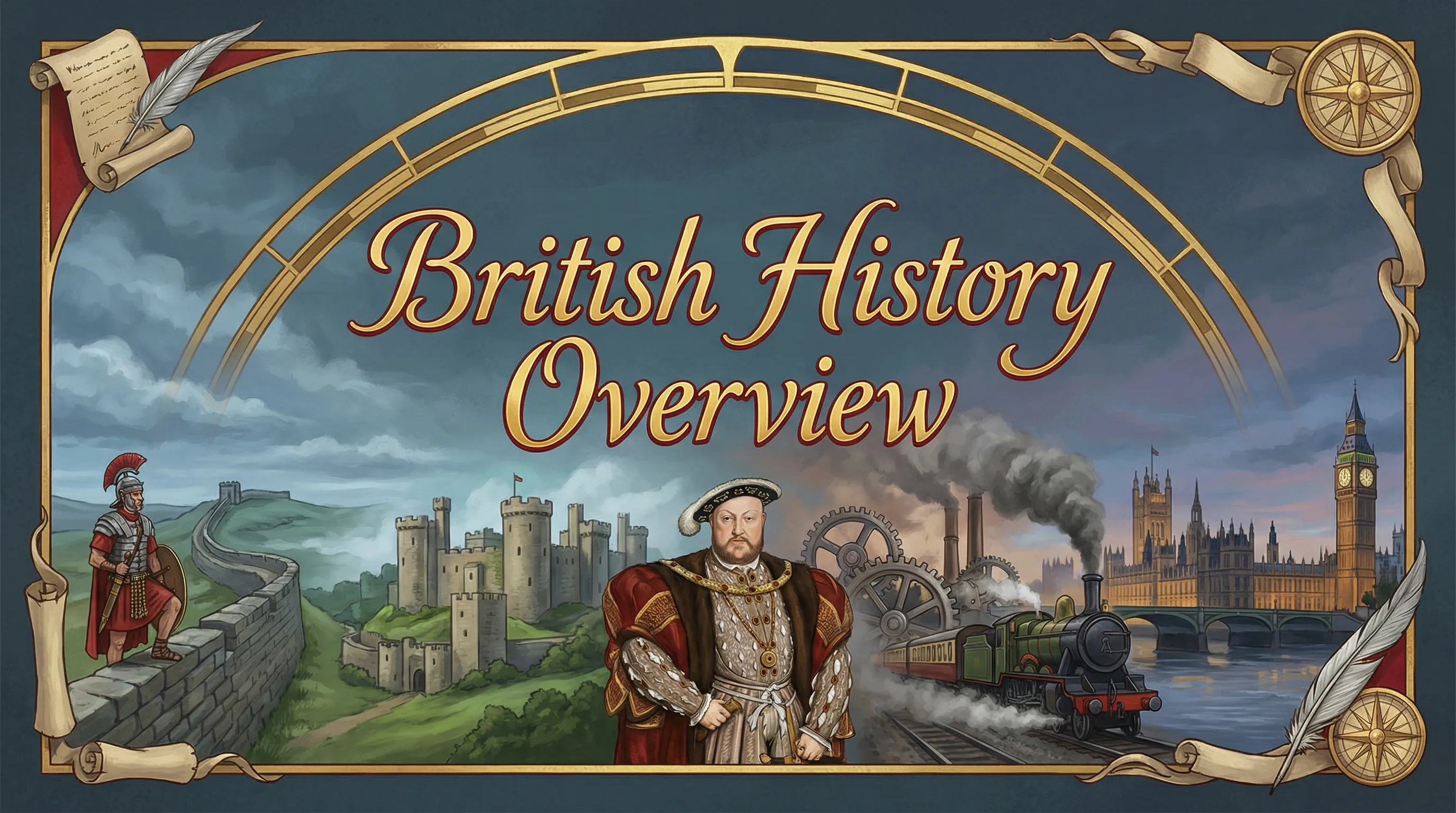
Explore key events and periods in British history.
A Brief History of Britain
British history spans thousands of years and has shaped the modern world profoundly. From Roman occupation to the Industrial Revolution, from a tiny island kingdom to a global empire, Britain's story is one of transformation, conflict, and influence.
Learning Objectives:
- Identify key periods and events in British history
- Understand how historical events shaped modern Britain
- Analyze the connections between past and present
- Compare British historical development with other nations
Key Periods:
- Roman Britain (43-410 AD)
- Anglo-Saxon England (410-1066)
- Norman England (1066-1154)
- Medieval Period (1154-1485)
- Tudor Era (1485-1603)
- Civil War & Restoration (1642-1714)
- Industrial Revolution (1760-1840)
- Victorian Era (1837-1901)
- 20th Century Wars and Decline
- Post-War and Modern Britain
The Romans invaded Britain in 43 AD under Emperor Claudius. They built roads, cities like Londinium (London), and Hadrian's Wall. Roman rule brought Christianity, Latin, and advanced engineering. When Rome fell, the legions left, and Britain entered a period of uncertainty.
Anglo-Saxon England (410-1066)
Germanic tribes - Angles, Saxons, and Jutes - migrated to Britain after Roman withdrawal. They established kingdoms like Wessex, Mercia, and Northumbria. King Alfred the Great (871-899) united much of England against Viking invaders. The Anglo-Saxons gave England its name ("Angle-land") and the foundation of the English language.
The Norman Conquest (1066)
William, Duke of Normandy, defeated King Harold at the Battle of Hastings. This single event transformed England:
- Language: French became the language of court and law
- Society: Feudal system imposed
- Architecture: Castles and cathedrals built
- Law: Centralized legal system developed
The Domesday Book (1086) surveyed all of England - an unprecedented administrative achievement.
Example: How the Norman Conquest Changed English
Before 1066, English was a purely Germanic language. After the Norman Conquest, thousands of French words entered English, creating the rich vocabulary we have today.
Food Words:
| Anglo-Saxon (animals) | French (meat) |
|---|---|
| cow | beef |
| pig | pork |
| sheep | mutton |
| deer | venison |
Why? Anglo-Saxon peasants raised the animals; French-speaking nobles ate them.
Legal/Government Words from French:
court, judge, jury, parliament, government, royal, noble, authority
Anglo-Saxon Words That Survived:
house, home, mother, father, child, love, friend, earth, water
This linguistic legacy shows how deeply the Norman Conquest transformed English society.
Match each event with its historical significance:
Roman Britain (43-410 AD)
Anglo-Saxon Period
Norman Conquest (1066)
Analyze the linguistic impact of the Norman Conquest:
Why do we have two words for farm animals and their meat (cow/beef, pig/pork)?
What does this tell us about social class in Norman England?
The Tudors - Henry VII, Henry VIII, Edward VI, Mary I, and Elizabeth I - transformed England. Henry VIII's break from Rome created the Church of England. Elizabeth I's reign saw Shakespeare, the defeat of the Spanish Armada, and early colonization.
The Civil War and Revolution (1642-1688)
Parliament and King Charles I went to war over power and religion. Charles was executed (1649) - the first time in European history that a reigning king was put on trial and killed by his own people. A brief republic under Oliver Cromwell followed, then monarchy was restored. The Glorious Revolution (1688) established that Parliament, not the monarch, held supreme power.
The Industrial Revolution (1760-1840)
Britain became the world's first industrialized nation:
- Technology: Steam power, factories, railways
- Society: Urbanization, new working class, child labor
- Economy: From agriculture to manufacturing
- Global impact: Britain became the world's dominant economic power
Victorian Era (1837-1901)
Queen Victoria's reign saw Britain at its peak:
- Largest empire in history
- Cultural confidence and moral values
- Scientific and technological advancement
- But also: poverty, inequality, rigid class system
Example: The Industrial Revolution's Double Edge
Manchester in 1850:
Manchester was called "Cottonopolis" - the world's first industrial city. It produced more cotton textiles than anywhere else on Earth.
The Bright Side:
- Wages higher than rural areas
- New technologies improving life
- Growing middle class
- Products affordable for ordinary people
The Dark Side:
Friedrich Engels lived in Manchester and documented conditions:
- Workers lived in slums with no sanitation
- Average life expectancy: 17 years in poor areas vs. 38 in wealthy areas
- Children as young as 5 worked 16-hour days
- Air so polluted that grass wouldn't grow
Legacy:
The Industrial Revolution created both modern prosperity AND the need for workers' rights, public health, and social reform. Many laws we take for granted - child labor laws, workplace safety, environmental protection - came from addressing industrial-era problems.
Analyze the Industrial Revolution:
List three positive effects of the Industrial Revolution.
List three negative effects of the Industrial Revolution.
How did the problems lead to reforms that benefit us today?
Research and explain the significance of the English Civil War:
What were the main causes of the conflict between Parliament and King Charles I?
Why was the execution of Charles I so shocking to Europeans?
Summary
Key Points:
1. Layered History: British identity was built layer by layer - Celtic, Roman, Anglo-Saxon, Norman, and beyond.
2. Language as Evidence: English vocabulary reveals social history - Germanic words for everyday life, French words for power and refinement.
3. Constitutional Development: From Magna Carta (1215) through the Civil War (1640s) to the Glorious Revolution (1688), Britain gradually limited royal power and established parliamentary supremacy.
4. Industrial Pioneer: Britain was the first industrialized nation, experiencing both the benefits and costs of rapid economic transformation.
5. Global Influence: British history shaped not just one island, but legal systems, languages, and political ideas worldwide.
Key Vocabulary:
- Norman Conquest - the 1066 invasion that transformed English society
- Magna Carta - 1215 document limiting royal power
- Industrial Revolution - transformation from agricultural to manufacturing economy
- Parliamentary supremacy - principle that elected Parliament holds ultimate power
Write a short essay (200-300 words) on ONE of these topics:
"The Norman Conquest was the most important event in English history." Do you agree or disagree? Give reasons.
Compare the Industrial Revolution in Britain with industrialization in Norway. What similarities and differences can you identify?
Create a timeline of British history:
Mark at least 8 key events from 43 AD to 1901.
For each event, write one sentence explaining why it was significant.
Identify which events still affect life in Britain today and explain how.
Sources and Further Reading
- Schama, S. (2000). A History of Britain. BBC Books.
- Ackroyd, P. (2011). Foundation: The History of England. Macmillan.
- BBC History: bbc.co.uk/history
Dette kapitlet er skrevet av Anthropics toppmodeller (Claude Opus og Claude Fable) og er foreløpig ikke manuelt gjennomgått — kvalitetskontrollen gjøres av uavhengige KI-agenter, og innmeldte feil rettes fortløpende. Funnet en feil? Meld fra, så retter vi den. Les mer om hvordan innholdet lages.