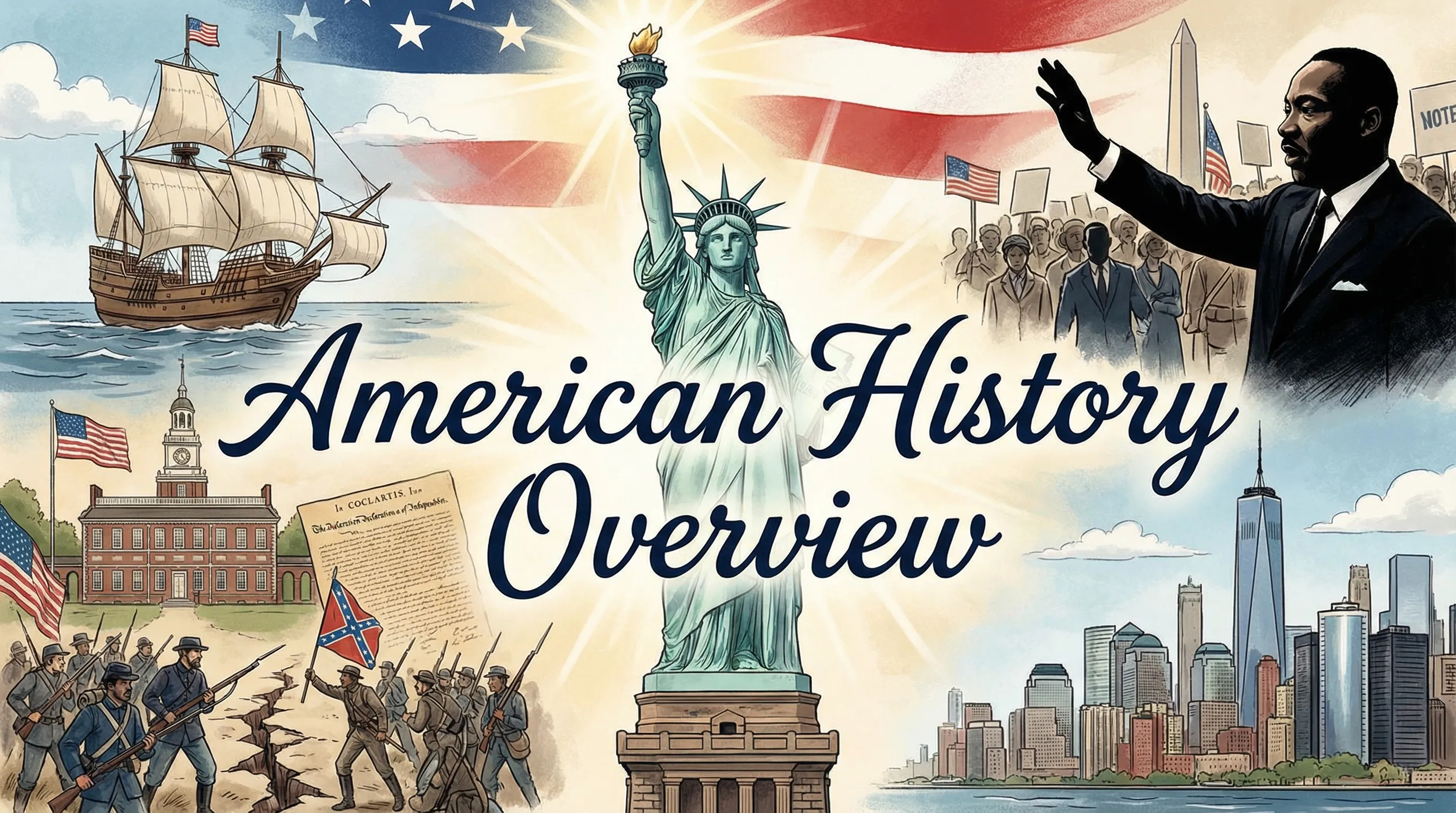
Explore key events and periods in American history.
The American Story
American history spans from indigenous peoples through colonization, revolution, expansion, civil war, and emergence as a global superpower. It is a story of ideals and contradictions, of freedom proclaimed while millions were enslaved, of democracy expanded while others were excluded.
Learning Objectives:
- Understand key periods and events in American history
- Analyze contradictions between American ideals and practices
- Connect historical events to contemporary issues
- Compare American historical development with other nations
Key Periods:
- Indigenous America (before 1492)
- Colonial Era (1607-1776)
- Revolution and Early Republic (1776-1860)
- Civil War and Reconstruction (1860-1877)
- Industrialization and Immigration (1877-1914)
- World Wars (1914-1945)
- Cold War (1945-1991)
- Modern Era (1991-present)
Before European arrival, millions of Native Americans lived in diverse societies:
- Eastern Woodlands: Iroquois Confederacy, farming communities
- Plains: nomadic buffalo hunters (after horses arrived)
- Southwest: Pueblo peoples, cliff dwellings, irrigation
- Pacific Northwest: fishing, totem poles, complex social systems
European diseases killed an estimated 90% of the indigenous population - the greatest demographic catastrophe in human history.
Colonial Era (1607-1776)
European powers competed for North America:
- Spain: Florida, Southwest, California
- France: Canada, Mississippi Valley
- Britain: Eastern seaboard (13 colonies)
- Netherlands: New York (briefly)
British colonies developed different characters:
- New England: Puritan religious communities, trade, education
- Middle Colonies: Diverse, tolerant, farming, trade
- Southern Colonies: Plantation agriculture, slavery
The American Revolution (1775-1783)
Why did colonists rebel?
- "No taxation without representation"
- British attempts to control colonial trade
- Enlightenment ideas about liberty and natural rights
- Local elites wanted more power
Declaration of Independence (1776):
"We hold these truths to be self-evident, that all men are created equal, that they are endowed by their Creator with certain unalienable Rights, that among these are Life, Liberty and the pursuit of Happiness."
Example: The Contradiction of Freedom
The Founding Fathers and Slavery
The Declaration of Independence proclaims that "all men are created equal" with rights to "Life, Liberty and the pursuit of Happiness." Yet many who signed it owned slaves.
Thomas Jefferson:
- Wrote the Declaration of Independence
- Owned over 600 slaves throughout his life
- Called slavery a "moral and political depravity"
- Yet never freed his slaves (except a few in his will)
- Had children with Sally Hemings, an enslaved woman
The Constitution (1787):
- Never uses the word "slave" but protects slavery
- Three-Fifths Compromise: enslaved people counted as 3/5 of a person for representation (giving slave states more power)
- Fugitive Slave Clause: escaped slaves must be returned
- Banned Congress from ending slave trade until 1808
Why the Contradiction?
- Southern states wouldn't join without slavery protections
- Many founders believed slavery would die out naturally (it didn't - it expanded)
- Economic interests trumped ideals
- Racism: many didn't truly believe Black people were equal
Legacy:
This "original sin" of slavery would tear the nation apart in the Civil War and continues to shape American society today.
Key Question:
Should we judge historical figures by the standards of their time or ours? Many people in the 1700s opposed slavery - the founders knew it contradicted their ideals.
Analyze the contradiction between American ideals and slavery:
Why is the Declaration of Independence's claim that "all men are created equal" contradictory given slavery?
Why did the founders include slavery protections in the Constitution?
How should we view historical figures who proclaimed liberty while owning slaves?
Compare American independence with other revolutions:
What were the main reasons American colonists rebelled against Britain?
How did the American Revolution influence later revolutions (French, Latin American)?
After independence, the US expanded dramatically:
- Louisiana Purchase (1803): doubled the nation's size
- Indian Removal: Native Americans forced west ("Trail of Tears")
- Mexican-American War (1846-48): gained Texas, California, Southwest
- "Manifest Destiny": belief that expansion was divinely ordained
Each expansion raised the question: would new territories allow slavery?
The Civil War (1861-1865)
When Abraham Lincoln (Republican, anti-slavery expansion) won the 1860 election, Southern states seceded. The war killed over 620,000 - more Americans than all other wars combined.
What Was it About?
Confederate states were explicit: they seceded to preserve slavery. Confederate Vice President Alexander Stephens said their government's "corner-stone rests upon the great truth that the negro is not equal to the white man."
Reconstruction (1865-1877)
After the war:
- 13th Amendment: abolished slavery
- 14th Amendment: citizenship and equal protection
- 15th Amendment: voting rights regardless of race
- Black men voted, held office, attended school
But Reconstruction ended in 1877, and white supremacy returned through:
- Jim Crow laws (segregation)
- Voter suppression
- Terrorism (KKK)
- Economic exploitation (sharecropping)
Civil Rights Movement (1950s-1960s)
Nearly 100 years later, African Americans fought for the rights promised in Reconstruction:
- Brown v. Board of Education (1954): school segregation unconstitutional
- Montgomery Bus Boycott (1955-56)
- March on Washington (1963): MLK's "I Have a Dream"
- Civil Rights Act (1964): banned discrimination
- Voting Rights Act (1965): protected voting rights
Example: The Long Civil Rights Movement
The Montgomery Bus Boycott (1955-1956)
What Happened:
On December 1, 1955, Rosa Parks refused to give up her bus seat to a white passenger in Montgomery, Alabama. She was arrested.
The Response:
Black leaders organized a boycott of Montgomery buses:
- 40,000 Black residents walked, carpooled, or took taxis
- Boycott lasted 381 days
- Economic pressure on bus company and city
- Dr. Martin Luther King Jr. emerged as a leader
The Obstacles:
- Boycotters arrested for "illegal carpooling"
- King's house bombed
- Violence and threats
- Economic retaliation (people fired from jobs)
The Victory:
The Supreme Court ruled bus segregation unconstitutional. Buses were integrated.
Key Lessons:
1. Organizing: The boycott wasn't spontaneous - it was planned by the NAACP and local leaders
2. Economic pressure: Hitting businesses in the wallet forced change
3. Nonviolent resistance: Inspired by Gandhi, movement used moral power
4. Federal intervention: Ultimate victory came through courts and federal law
5. Persistence: Victory took over a year of sacrifice
The Broader Movement:
Montgomery was just the beginning. Sit-ins, Freedom Rides, marches, and voter registration drives continued for years, met with violence and eventually achieving major legislation.
Unfinished Business:
Despite legal victories, racial inequality persists in wealth, health, education, criminal justice, and housing. The struggle continues.
Analyze the Civil War and its aftermath:
What was the Civil War fundamentally about?
What happened during Reconstruction, and why did it fail?
Why did it take nearly 100 years after the Civil War for civil rights legislation?
Analyze the Civil Rights Movement:
What tactics did the Civil Rights Movement use?
Why was nonviolent resistance effective?
Summary
Key Points:
1. Indigenous America: Millions of Native Americans lived in diverse societies before Europeans arrived; disease and violence devastated these populations.
2. Founding Contradiction: America was founded on ideals of liberty and equality while practicing slavery - a contradiction that shaped its entire history.
3. Civil War: The bloodiest American war was fought over slavery. The Union victory ended slavery but not racism.
4. Reconstruction's Failure: Brief progress for Black Americans was reversed when white supremacy was restored through violence and Jim Crow laws.
5. Civil Rights Movement: Nearly 100 years after the Civil War, mass protest and organizing achieved major legal changes, though the struggle for equality continues.
Key Vocabulary:
- Manifest Destiny - belief that American expansion was divinely ordained
- Jim Crow - system of racial segregation laws in the South
- Reconstruction - period after Civil War attempting to rebuild and integrate freed slaves
- Civil disobedience - nonviolent resistance to unjust laws
- Segregation - legal separation of races in public facilities
Essay question (250-350 words):
"American history is a story of progress toward fulfilling its founding ideals." Do you agree? Discuss with reference to at least two historical periods.
Create a timeline and analysis:
Create a timeline of at least 10 key events in American history from 1776 to 1968.
Identify three events that you think are most important for understanding America today. Explain why.
How does American history compare to Norwegian history in the same period?
Sources and Further Reading
- Zinn, H. (2015). A People's History of the United States. Harper Perennial.
- National Museum of African American History and Culture: nmaahc.si.edu
- Library of Congress - Primary Sources: loc.gov
Dette kapitlet er skrevet av Anthropics toppmodeller (Claude Opus og Claude Fable) og er foreløpig ikke manuelt gjennomgått — kvalitetskontrollen gjøres av uavhengige KI-agenter, og innmeldte feil rettes fortløpende. Funnet en feil? Meld fra, så retter vi den. Les mer om hvordan innholdet lages.