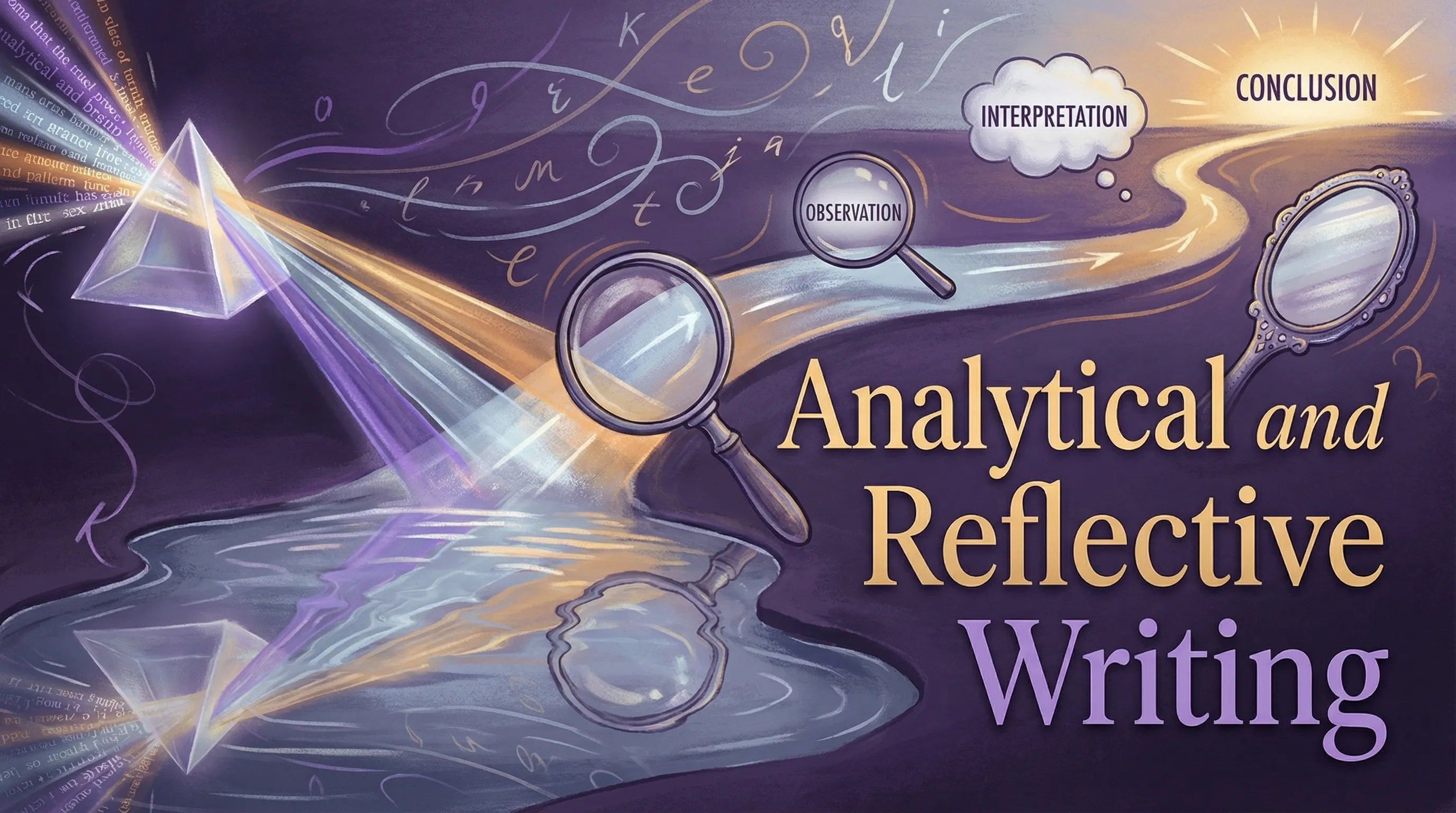
Develop skills for analytical and reflective text types.
Analysis and Reflection: Two Essential Skills
Analytical and reflective writing are two distinct but equally important skills in academic contexts. While they serve different purposes, both require deep thinking and clear communication.
Analytical writing examines something external - a text, event, or phenomenon - and breaks it down to understand how it works. The focus is on the object of analysis, and the tone is objective and evidence-based.
Reflective writing looks inward at your own experiences, thoughts, and learning processes. It asks you to consider what happened, how you felt, and what you learned.
In this chapter, you will learn frameworks for both types of writing, giving you the tools to analyze texts effectively and reflect meaningfully on your experiences.
Analysis means breaking something into parts and examining how those parts work together. Good analysis goes beyond description ("what happens") to interpretation ("what it means").
Key Principles:
- Be specific: Use concrete examples and direct quotes
- Be interpretive: Explain significance, not just facts
- Be structured: Organize around clear points
- Be evidence-based: Support every claim
Analysis vs. Summary:
Summary tells WHAT happens; analysis explains WHY it matters and HOW it works.
Summary: "The speaker describes a walk through the woods."
Analysis: "The solitary walk symbolizes a journey into the unconscious, with the 'two roads' representing conflicting choices that define human existence."
Key Verbs for Analysis:
Analyze, examine, demonstrate, reveal, suggest, convey, emphasize, highlight, undermine, reinforce, symbolize
"While Frost's 'The Road Not Taken' is often interpreted as celebrating individualism, a closer reading reveals ambivalence about choice. The speaker admits the paths 'had worn them really about the same,' yet predicts he will claim to have taken 'the one less traveled by.' This contradiction exposes the human tendency to construct narratives of uniqueness after the fact. Frost's use of the future tense - 'I shall be telling this with a sigh' - suggests the speaker knows he will mythologize this moment."
Notice:
- Direct quotes integrated smoothly
- Interpretation beyond surface meaning
- Analytical verbs: "reveals," "exposes," "suggests"
Transform these summary statements into analytical statements:
"In the story, the main character dies at the end."
"The author uses dark imagery."
Write an analytical paragraph (150-200 words) about a text you have studied. Include a clear analytical point, at least one quote, and explanation of significance.
Reflective writing examines your own experiences and learning. It uses first person ("I") and requires critical thinking about what happened and what it means.
The Gibbs Reflective Cycle (1988):
1. Description: What happened? (Factual account)
2. Feelings: What were you thinking and feeling?
3. Evaluation: What was good and bad?
4. Analysis: Why did things happen this way?
5. Conclusion: What else could you have done?
6. Action Plan: What will you do next time?
Key Principle: Good reflection moves from description to analysis to action. Simply describing what happened is not reflection.
Reflective Phrases:
- "This experience taught me..."
- "I realize now that..."
- "Looking back, I would..."
- "In the future, I will..."
Using the Gibbs Cycle, write a reflective paragraph about a challenging learning experience. Address at least four of the six stages.
Evaluate these reflective statements. Which shows deeper reflection?
"The project was difficult because my partners did not work."
"This taught me I need to plan better. Next time, I will make a schedule."
Summary: Analytical and Reflective Writing
Analytical Writing:
- Examines external objects (texts, events)
- Objective, evidence-based
- Goes beyond summary to interpretation
- Key verbs: analyze, suggest, reveal, demonstrate
Reflective Writing:
- Examines internal experiences
- Personal, honest, first-person
- Follows Gibbs Cycle framework
- Moves from description to analysis to action
Both require critical thinking and depth - analysis digs beneath texts, reflection digs beneath experience.
Choose a text you have studied. Write:
a) An analytical paragraph examining one aspect
b) A reflective paragraph about what you learned from studying it
Write a 300-400 word semester reflection on your development as a writer, using all six stages of the Gibbs Cycle.
Sources and Further Reading
- Gibbs, G. (1988). Learning by Doing: A Guide to Teaching and Learning Methods. Oxford Polytechnic.
- McMillan, K. & Weyers, J. (2013). How to Write Essays and Assignments. Pearson.
- Purdue Online Writing Lab (OWL): owl.purdue.edu
Dette kapitlet er skrevet av Anthropics toppmodeller (Claude Opus og Claude Fable) og er foreløpig ikke manuelt gjennomgått — kvalitetskontrollen gjøres av uavhengige KI-agenter, og innmeldte feil rettes fortløpende. Funnet en feil? Meld fra, så retter vi den. Les mer om hvordan innholdet lages.