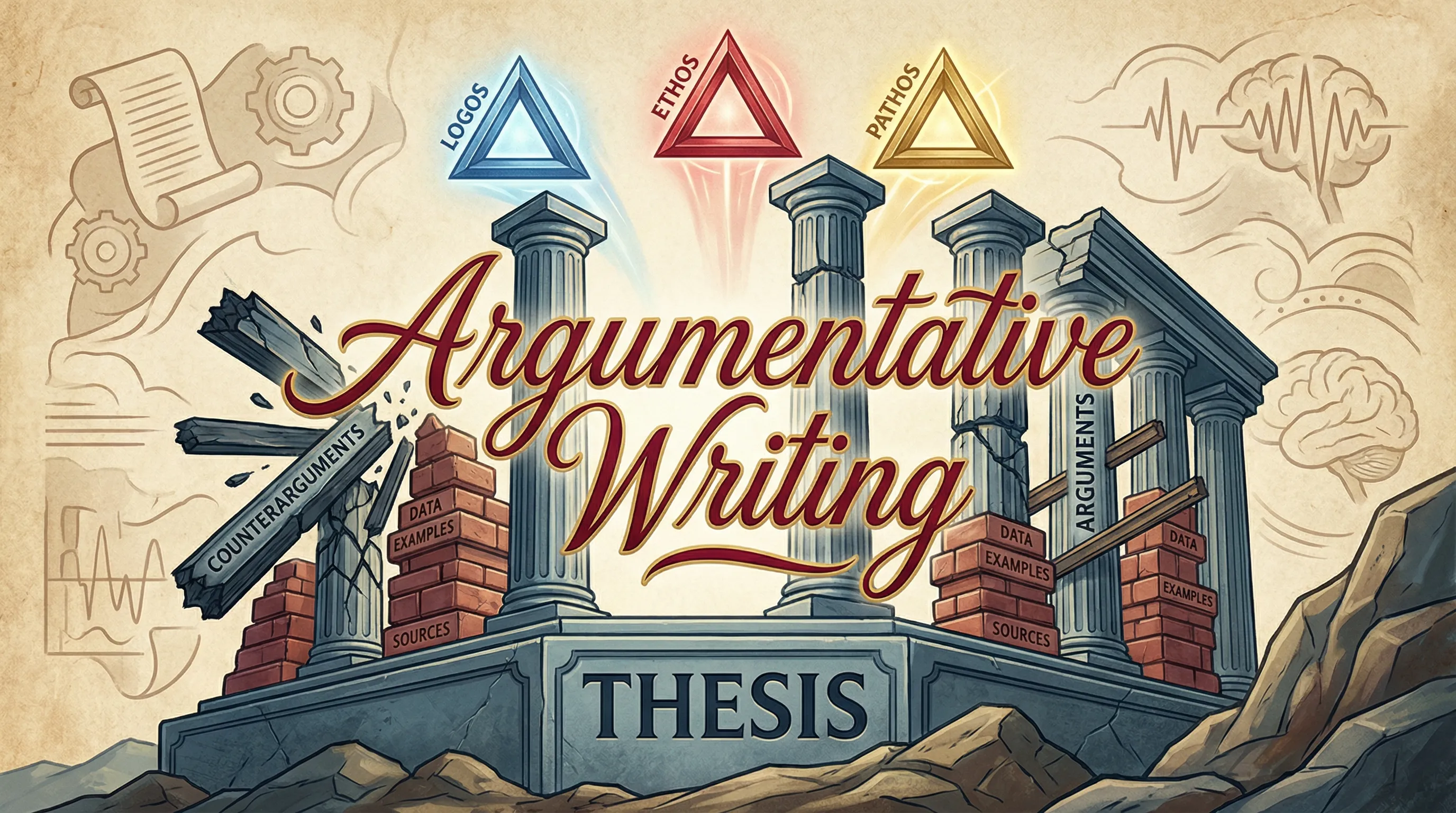
Master the art of persuasive and argumentative essays.
The Art of Argument
Argumentative writing is one of the most important skills you can develop as a student and citizen. It involves presenting a claim, supporting it with evidence and reasoning, and persuading your reader to accept your position. Unlike simply stating an opinion, effective argumentation requires you to think critically, consider multiple perspectives, and build a logical case for your viewpoint.
The ability to construct and evaluate arguments is essential not only in academic writing but also in everyday life. Whether you are writing an essay, participating in a debate, or simply trying to convince someone of your point of view, the same principles apply. You need a clear position, solid evidence, logical reasoning, and an awareness of potential objections.
In this chapter, you will learn how to structure an argumentative essay, craft effective thesis statements, develop body paragraphs using the PEEL method, address counter-arguments, and write compelling conclusions. By the end, you will have the tools to argue persuasively on any topic.
A thesis statement is a single sentence that expresses the main argument of your essay. It tells the reader what you will prove and guides the entire essay.
Characteristics of a Strong Thesis:
- Specific: Clearly states your position on a narrow topic
- Debatable: Someone could reasonably disagree with it
- Supportable: You can provide evidence for it
- Original: Offers your own insight, not just a fact
Weak vs. Strong Thesis Examples:
Topic: Social Media
Weak: "Social media is bad." (Too vague, no nuance)
Strong: "While social media enables global connection and information sharing, its documented effects on teenage mental health, including increased anxiety and depression, demonstrate that parents and schools should implement strict usage limits for minors."
Topic: Climate Change
Weak: "Climate change is a problem." (States obvious fact)
Strong: "Despite the economic costs of transitioning away from fossil fuels, governments must immediately invest in renewable energy infrastructure because the long-term costs of inaction far exceed the short-term costs of change."
Placement: The thesis typically appears at the end of your introduction, after you have provided context and captured the reader's attention.
Topic: Technology in Education
"When students in a rural village in Kenya can access the same lectures as students at Harvard, something revolutionary has happened. Technology has transformed education from a privilege of geography and wealth into a possibility for anyone with an internet connection. However, this digital revolution comes with significant risks. While technology offers unprecedented access to educational resources and personalized learning opportunities, schools must balance these benefits against the dangers of screen addiction, the digital divide, and the loss of human connection in learning. This essay argues that technology should be integrated thoughtfully into education, with strict guidelines to maximize benefits while minimizing harm."
Analysis of this introduction:
- Hook: Opens with compelling image of global access
- Context: Briefly explains the transformation
- Nuance: Acknowledges both benefits and risks
- Thesis: Clear, specific, debatable claim with direction for the essay
Write a thesis statement for each topic. Make sure each thesis is specific, debatable, and supportable.
Topic: School uniforms
Topic: Homework
Topic: Social media age limits
Evaluate these thesis statements. Identify what makes each weak or strong, then improve the weak ones.
"Pollution is harmful to the environment."
"Although video games are often criticized for promoting violence, research suggests that strategic games can improve problem-solving skills and should be incorporated into educational settings with appropriate supervision."
P - Point (Topic Sentence):
The first sentence states the main idea of the paragraph. It should clearly relate to your thesis and tell the reader what this paragraph will prove.
E - Evidence:
Provide specific support for your point:
- Statistics and data from reliable sources
- Expert quotes and research findings
- Concrete examples and case studies
- Historical evidence or precedents
Always cite your sources!
E - Explanation (Analysis):
This is the most important part! Explain:
- How the evidence supports your point
- Why it matters
- What it means in the context of your argument
Never assume the connection is obvious - spell it out.
L - Link:
Connect back to your thesis and/or transition to the next point. This keeps your argument coherent and shows how each paragraph contributes to the whole.
Common Mistake: Providing evidence without analysis. Evidence does not speak for itself - you must explain its significance.
Write a complete PEEL paragraph on ONE of these topics. Label each section (Point, Evidence, Explanation, Link) clearly.
Option 1: Schools should start later in the morning
Option 2: Plastic bags should be banned
Addressing Counter-Arguments: For each thesis statement, identify the strongest counter-argument and write a concession-rebuttal response.
Thesis: "Zoos should be abolished because keeping wild animals in captivity is inherently cruel."
Thesis: "University education should be free for all students."
Summary: Argumentative Writing
Key Elements of Effective Arguments:
1. Strong Thesis Statement:
- Specific, debatable, and supportable
- Placed at the end of the introduction
- Guides the entire essay
2. PEEL Body Paragraphs:
- Point: Clear topic sentence
- Evidence: Specific, cited support
- Explanation: Analysis of significance (the most important part!)
- Link: Connection to thesis and transition
3. Counter-Arguments:
- Acknowledge opposing views
- Concede valid points
- Rebut with stronger reasoning
4. Effective Introduction:
- Hook the reader
- Provide context
- Build to your thesis
5. Strong Conclusion:
- Restate thesis in new words
- Synthesize main points
- Broader implications or call to action
Remember: Argumentation is not about "winning" - it is about thinking carefully, engaging with evidence, and communicating clearly. The best arguments acknowledge complexity while still taking a clear position.
Plan an argumentative essay on a topic of your choice. Create an outline including:
- Hook idea
- Background context (2-3 sentences)
- Thesis statement
- Three body paragraph topic sentences
- One counter-argument and your rebuttal
- Conclusion approach
Write a complete argumentative essay (500-700 words) on ONE of these topics:
a) Should voting be mandatory?
b) Should junk food be banned in schools?
c) Should students be allowed to grade their teachers?
Include: introduction with hook and thesis, at least two PEEL body paragraphs, a counter-argument paragraph, and a conclusion.
Sources
- Graff, G. & Birkenstein, C. (2018). "They Say / I Say": The Moves That Matter in Academic Writing. W. W. Norton.
- Wingate, U. (2012). "Argument! helping students understand what essay writing is about." Journal of English for Academic Purposes, 11(2), 145-154.
- UDIR (2020). Læreplan i engelsk (ENG01-04). Utdanningsdirektoratet. https://www.udir.no/lk20/eng01-04
- Toulmin, S. E. (2003). The Uses of Argument. Cambridge University Press.
Dette kapitlet er skrevet av Anthropics toppmodeller (Claude Opus og Claude Fable) og er foreløpig ikke manuelt gjennomgått — kvalitetskontrollen gjøres av uavhengige KI-agenter, og innmeldte feil rettes fortløpende. Funnet en feil? Meld fra, så retter vi den. Les mer om hvordan innholdet lages.