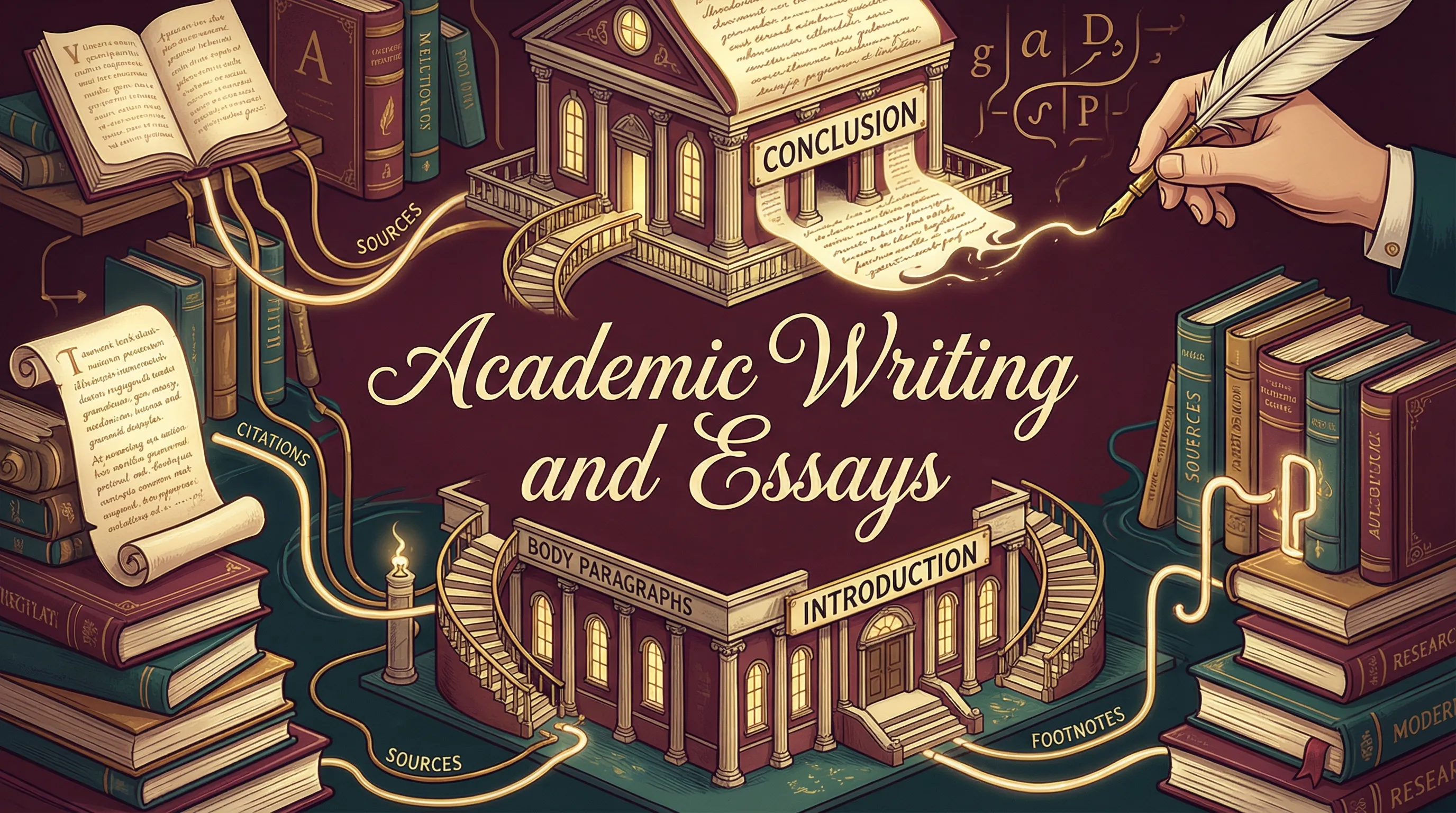
Master academic writing conventions and essay structure.
Academic Writing Essentials
Academic writing is a specialized form of communication used in educational and scholarly contexts. It follows specific conventions that distinguish it from other types of writing. Whether you are writing essays, research papers, or reports, the principles of academic writing remain consistent.
Understanding academic writing is not just about following rules - it is about joining a conversation. When you write academically, you participate in a dialogue with other thinkers, building on their ideas and contributing your own insights. This requires precision, clarity, and intellectual honesty.
In this chapter, you will learn the key characteristics of academic writing, how to structure essays effectively, how to integrate and cite sources properly, and how to develop your academic voice while maintaining the objectivity that academic contexts require.
- Avoid contractions, slang, and casual expressions
- Use precise vocabulary and technical terms
- Maintain professional tone throughout
Objective Tone:
- Present evidence rather than opinions
- Use hedging language ("suggests," "may indicate")
- Avoid emotional or biased language
Evidence-Based:
- Support all claims with evidence
- Cite sources for facts and ideas from others
- Distinguish between your ideas and others' ideas
Clear Structure:
- Introduction with thesis statement
- Organized body paragraphs
- Logical flow between sections
- Conclusion that synthesizes main points
Academic Conventions:
- Third person preferred (some disciplines allow first person)
- Present tense for general truths, past for specific studies
- Formal transitional phrases
Non-Academic:
"Social media is totally messing up teenagers. Everyone knows it's bad for them, and parents really need to do something about it."
Academic:
"Research suggests that excessive social media use may have adverse effects on adolescent mental health (Smith, 2022). While the relationship between social media and psychological well-being is complex, several studies indicate that users who spend more than three hours daily on platforms such as Instagram report higher levels of anxiety (Jones et al., 2021). These findings support the argument that parents and educators should implement reasonable usage guidelines."
Key Differences:
- Hedging language ("suggests," "may have")
- Citations for claims
- Specific details instead of generalizations
- Formal vocabulary
- Objective presentation
Rewrite these informal sentences in academic style:
"Climate change is a huge problem and we need to fix it now."
"Kids who read more do better in school - it's obvious."
Identify what makes each sentence inappropriate for academic writing and suggest an improvement:
"Shakespeare was an amazing writer and everyone loves his plays."
"The experiment didn't work because we messed up."
- Give credit to original authors
- Avoid plagiarism (presenting others' ideas as your own)
- Allow readers to verify and explore your sources
- Demonstrate the breadth and quality of your research
- Join the academic conversation
In-Text Citation (APA Style):
- Author's name and year: (Smith, 2022)
- With quote: "Direct quote" (Smith, 2022, p. 45)
- Author as subject: Smith (2022) argues that...
- Multiple authors: (Smith & Jones, 2022) or (Smith et al., 2022)
Reference List Entry Examples:
Book: Smith, J. (2022). Book title. Publisher.
Article: Jones, A. (2021). Article title. Journal Name, 15(2), 23-45.
Website: World Health Organization. (2023). Report title. https://url.com
Paraphrasing vs. Quoting:
- Paraphrase: Restate ideas in your own words (still cite!)
- Quote: Use exact words with quotation marks (cite with page)
- Rule: Paraphrase more than you quote - it shows understanding
Practice citing. Given this source information, write:
a) A sentence with a direct quote
b) A paraphrase of the same information
Source: "Students who participate in regular physical activity show improved concentration and academic performance." From "Exercise and Learning" by Maria Garcia, published 2023, page 78.
Plagiarism Check: Identify which of these would be considered plagiarism and explain why.
Original: "Social media has fundamentally altered how teenagers communicate." Your text: "Social media has fundamentally changed how teens communicate."
Original: "Social media has fundamentally altered how teenagers communicate." Your text: "According to Smith (2022), "social media has fundamentally altered how teenagers communicate" (p. 12).
Original: "Social media has fundamentally altered how teenagers communicate." Your text: "The ways in which young people interact have been transformed by digital platforms (Smith, 2022)."
Summary: Academic Writing
Key Characteristics:
- Formal register (no contractions or slang)
- Objective tone with hedging language
- Evidence-based claims with citations
- Clear, logical structure
Citation Essentials:
- Always cite ideas from others
- Paraphrase more than quote
- Include both in-text citations and reference list
- Follow a consistent style (APA, MLA, etc.)
Avoiding Plagiarism:
- Direct quotes need quotation marks + citation
- Paraphrases must significantly change wording + citation
- Even common knowledge from a specific source needs citation
Remember: Academic writing is about joining a conversation with other scholars. You show respect for their ideas by citing them properly, and you contribute your own analysis and insights.
Find an article on a topic that interests you. Practice academic writing skills by:
a) Writing a paraphrase of one key point (with citation)
b) Including one direct quote (with citation)
c) Writing your own analysis of the source in academic style
Write an academic paragraph (200-250 words) on ONE of these topics:
a) The impact of technology on education
b) The importance of learning a second language
c) The effects of social media on society
Include at least one properly formatted citation (you may create a fictional but realistic source).
Sources
- Oshima, A. & Hogue, A. (2019). Academic Writing. Pearson Education.
- Swales, J. M. & Feak, C. B. (2012). Academic Writing for Graduate Students. University of Michigan Press.
- UDIR (2020). Læreplan i engelsk (ENG01-04). Utdanningsdirektoratet. https://www.udir.no/lk20/eng01-04
- Bailey, S. (2017). Academic Writing: A Handbook for International Students. Routledge.
Dette kapitlet er skrevet av Anthropics toppmodeller (Claude Opus og Claude Fable) og er foreløpig ikke manuelt gjennomgått — kvalitetskontrollen gjøres av uavhengige KI-agenter, og innmeldte feil rettes fortløpende. Funnet en feil? Meld fra, så retter vi den. Les mer om hvordan innholdet lages.