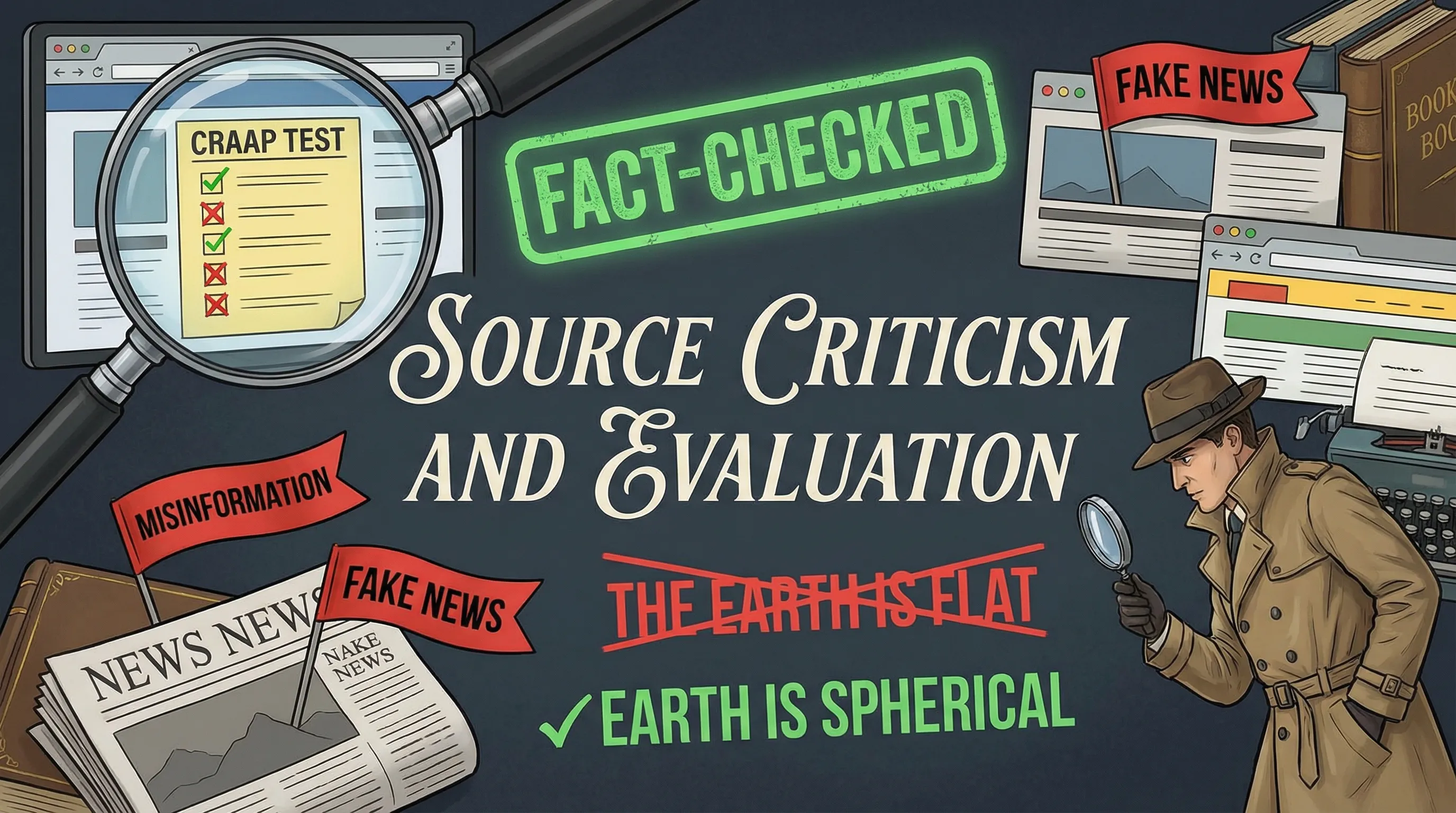
Develop critical thinking skills for evaluating sources.
Critical Source Evaluation
In an era of information abundance, the ability to distinguish reliable sources from unreliable ones is perhaps the most important intellectual skill you can develop. Every day, you encounter claims, statistics, and arguments from countless sources. Some of these are rigorously researched and carefully fact-checked; others are misleading, biased, or simply fabricated. Your success as a student, professional, and citizen depends on your ability to tell the difference.
Source criticism is not about cynicism or distrusting everything you read. Rather, it is about developing systematic methods for evaluating credibility. Just as a scientist follows protocols to ensure valid results, a critical reader follows principles to ensure they are building their understanding on a solid foundation of reliable information.
In this chapter, you will learn two powerful frameworks for evaluating sources: the CRAAP Test and Lateral Reading. You will also develop skills for identifying red flags that signal potentially unreliable information, and you will practice applying these tools to real-world sources.
The CRAAP Test provides a systematic approach to evaluating any source. Each letter represents a criterion to consider:
C - Currency (Timeliness)
- When was the information published or last updated?
- Is the information current enough for your topic?
- Do all links and references work?
- For rapidly changing fields, currency is critical; for historical topics, older sources may be valuable.
R - Relevance (Appropriateness)
- Does this information directly relate to your research question?
- Is the depth and complexity appropriate for your level?
- Who is the intended audience (general public, experts, children)?
- Would you be comfortable citing this source in academic work?
A - Authority (Credibility of Source)
- Who is the author, and what are their qualifications?
- What organization published this, and what is their reputation?
- Is contact information provided?
- What gives this source the right to speak on this topic?
A - Accuracy (Reliability of Content)
- Is the information supported by evidence?
- Can claims be verified through other sources?
- Has the content been peer-reviewed or edited?
- Are there obvious errors in spelling, grammar, or facts?
P - Purpose (Reason for Existence)
- Why does this source exist? To inform? To persuade? To sell? To entertain?
- Is the information presented objectively, or is there obvious bias?
- Are there political, commercial, or ideological motivations?
- Is it clearly labeled as fact, opinion, or analysis?
Scoring: Rate each criterion 1-5 (1 = poor, 5 = excellent). Sources scoring below 15/25 warrant extra scrutiny.
CRAAP Analysis:
| Criterion | Score | Explanation |
|---|---|---|
| Currency | 4/5 | Frequently updated; check "View history" for recent edits |
| Relevance | 4/5 | Comprehensive overview; appropriate for initial research |
| Authority | 3/5 | Multiple anonymous editors; no single expert author |
| Accuracy | 4/5 | Claims cited; can verify through footnotes; peer-edited |
| Purpose | 5/5 | Purely informational; no commercial or political agenda |
Total: 20/25
Conclusion: Wikipedia is useful for getting an overview and finding primary sources through footnotes, but should not be cited directly in academic work. Instead, use its references to find the original sources.
Compare with: A blog post titled "Why Climate Scientists Are Lying to You"
| Criterion | Score | Explanation |
|---|---|---|
| Currency | 3/5 | Posted last month |
| Relevance | 2/5 | Conspiracy angle, not academic |
| Authority | 1/5 | Anonymous author, no credentials |
| Accuracy | 1/5 | No sources cited, contradicts scientific consensus |
| Purpose | 1/5 | Clear agenda to discredit scientists |
Total: 8/25 - Not a reliable source
Apply the CRAAP test to this source description:
"An article titled 'The Truth About Vaccines' published on a website called HealthFreedomNow.com. The author is listed only as 'Dr. Mike.' The article claims that vaccines cause autism, citing a 1998 study. The website sells 'natural immunity boosters' and has pop-up advertisements throughout."
Rate Currency (1-5) and explain your reasoning.
Rate Authority (1-5) and explain your reasoning.
Rate Purpose (1-5) and explain your reasoning.
What is your overall assessment? Would you use this source? Why or why not?
Find a source on a topic of your choice and complete a full CRAAP evaluation. Your analysis should be thorough and evidence-based.
Provide the source citation (title, author, URL or publication).
Rate and explain each CRAAP criterion (Currency, Relevance, Authority, Accuracy, Purpose).
Calculate the total score and write a 2-3 sentence conclusion about the source's reliability.
Why Lateral Reading Works:
Unreliable sources often appear professional and cite references. Vertical reading can be deceived by these appearances. Lateral reading bypasses the source's self-presentation to find independent verification.
The Lateral Reading Process:
1. Open new tabs immediately
- Don't waste time reading the full source first
- The source wants you to engage with its content
2. Search for the author or organization
- "[Author name]" + credentials
- "[Organization name]" + reputation OR controversy
3. Check what experts say
- Search for expert commentary on the source
- Look for academic or journalistic assessments
4. Find fact-checks
- Use fact-checking sites: Snopes, PolitiFact, FactCheck.org
- Search: "[claim]" + fact check
5. Verify specific claims
- Find the original study or data cited
- Check if claims are represented accurately
Red Flags That Require Lateral Reading:
- No author identified or pseudonymous author
- Emotional or sensational language
- No sources or citations provided
- Claims that seem too shocking to be true
- Requests to "share before they take this down"
- Domain names that mimic legitimate news sites
- Unusual top-level domains (.co instead of .com, etc.)
Practice lateral reading with a current news story or viral claim. Document your process:
What was the original claim or source you encountered?
What did you search for, and what did you find? (List at least 3 lateral searches)
Based on your lateral reading, what is your assessment of the original source's reliability?
Identify the red flags in each scenario and explain what lateral reading steps you would take:
A Facebook post shares an article from "ABCnews.com.co" with the headline "BREAKING: Major Celebrity Secretly Arrested."
A YouTube video titled "What They Don't Want You to Know About [Topic]" has 2 million views and hundreds of comments saying "finally the truth!"
An article cites "a Harvard study" but provides no link or specific reference.
Summary: Source Criticism and Evaluation
Key Takeaways:
1. The CRAAP Test
Systematically evaluate sources using five criteria:
- Currency: Is the information timely?
- Relevance: Does it fit your needs?
- Authority: Who created it and why should you trust them?
- Accuracy: Is it supported by evidence?
- Purpose: Why does this source exist?
2. Lateral Reading
Don't trust a source's self-presentation. Instead:
- Open new tabs immediately
- Search for what others say ABOUT the source
- Check author/organization reputation
- Find fact-checks for specific claims
- Verify cited evidence
3. Red Flags
Be alert to warning signs:
- Anonymous or pseudonymous authors
- Sensational or emotional language
- Missing citations
- Claims too extreme to believe
- Domains mimicking legitimate sites
- Commercial interests mixed with information
4. Integration
Combine CRAAP Test (internal analysis) with Lateral Reading (external verification) for comprehensive source evaluation.
Conduct a full source evaluation combining both methods. Choose a source related to a controversial topic (e.g., health claims, political issues, environmental debates). Write a 400-500 word evaluation report that includes:
A complete CRAAP analysis with scores and explanations for each criterion
Documentation of your lateral reading process (at least 4 searches with findings)
A final verdict: Is this source reliable? Would you cite it? For what purposes?
Create a "Source Evaluation Quick Reference Card" that could fit on one page. Your card should:
Summarize the CRAAP Test with 2-3 key questions for each criterion
List 5-7 lateral reading steps in order
Include a "Red Flags Checklist" with at least 8 warning signs
Add a decision flowchart: If a source fails X criteria, then do Y
Sources
- Blastland, M. & Dilnot, A. (2007). The Tiger That Isn't: Seeing Through a World of Numbers. Profile Books.
- Breakstone, J. et al. (2021). "Lateral reading: College students learn to evaluate internet sources." Harvard Kennedy School Misinformation Review, 2(1).
- UDIR (2020). Læreplan i engelsk (ENG01-04). Utdanningsdirektoratet. https://www.udir.no/lk20/eng01-04
- IFLA (2017). How to Spot Fake News. International Federation of Library Associations.
Dette kapitlet er skrevet av Anthropics toppmodeller (Claude Opus og Claude Fable) og er foreløpig ikke manuelt gjennomgått — kvalitetskontrollen gjøres av uavhengige KI-agenter, og innmeldte feil rettes fortløpende. Funnet en feil? Meld fra, så retter vi den. Les mer om hvordan innholdet lages.