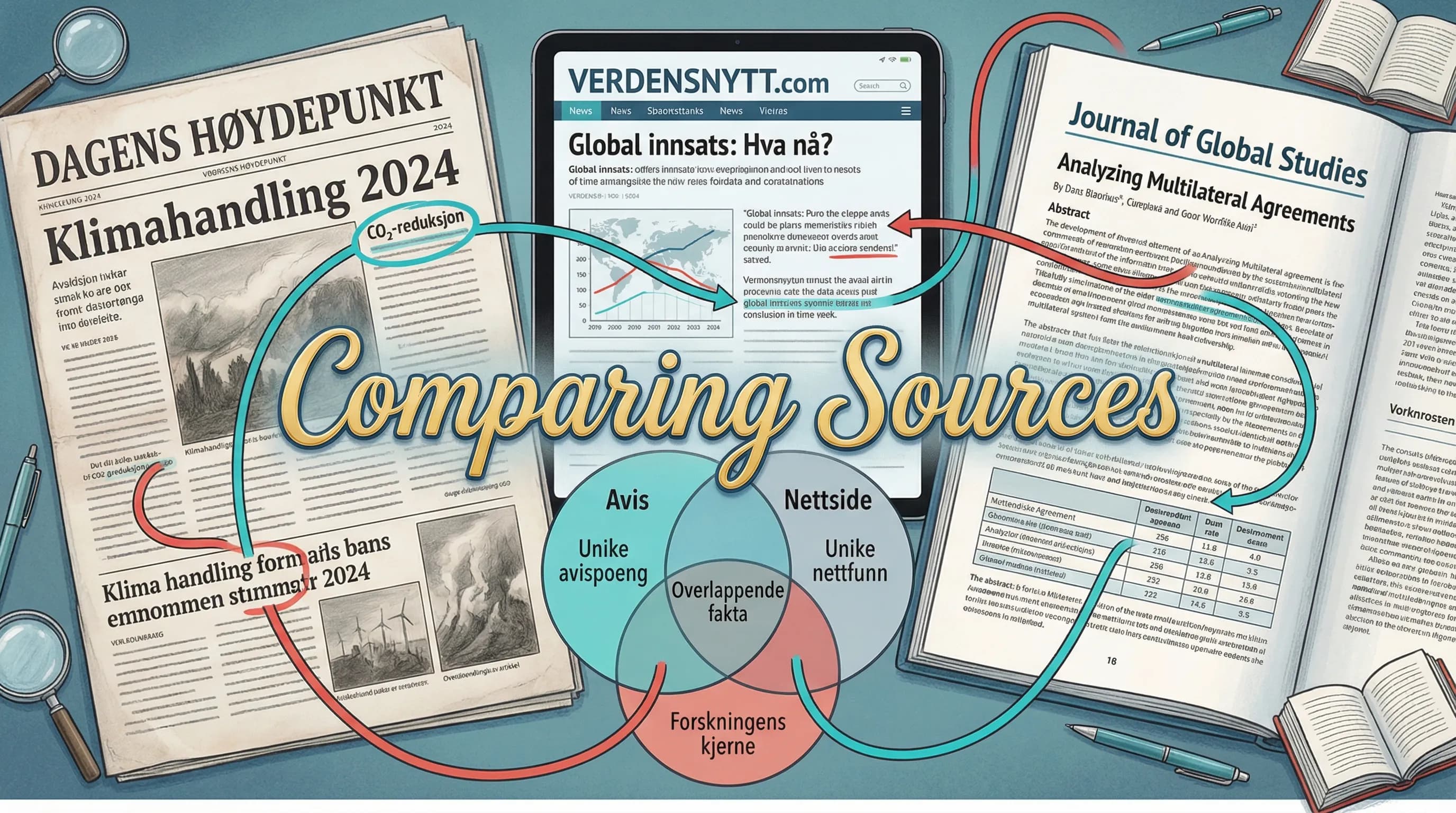
Learn to compare and evaluate different sources on the same topic.
Why Compare Sources?
In an age of abundant information, rarely does a single source tell the complete story. Every text is shaped by its author's perspective, purpose, and limitations. When you compare multiple sources on the same topic, you gain a richer, more nuanced understanding than any single source could provide. This comparative approach is fundamental to academic research, journalism, and informed citizenship.
Comparing sources helps you identify patterns and discrepancies. When multiple independent sources agree on a fact, that fact is more likely to be accurate. When sources disagree, those disagreements reveal areas of uncertainty or controversy that deserve closer examination. Learning to navigate these differences is a crucial skill for the information age.
In this chapter, you will develop systematic methods for comparing sources. You will learn to identify what different sources include and exclude, analyze how perspective shapes presentation, evaluate the quality of evidence across sources, and synthesize information from multiple texts into your own understanding.
A systematic approach to comparing sources examines four key dimensions: content, perspective, evidence, and purpose.
Content Analysis:
- What information is included in each source?
- What is conspicuously absent or omitted?
- Are the basic facts consistent across sources?
- What claims are made, and how do they differ?
- How much detail does each source provide?
Perspective Analysis:
- Who is the author and what is their background?
- What viewpoint or position does the source reflect?
- What assumptions does the author make?
- Who is the intended audience?
- How might the author's identity shape the content?
Evidence Evaluation:
- What types of evidence does each source use?
- Are sources and references provided?
- Is data presented accurately and fairly?
- Can the claims be independently verified?
- How recent and relevant is the evidence?
Purpose Examination:
- Is the source primarily informing, persuading, or entertaining?
- Is the presentation balanced or one-sided?
- What action or response does the source encourage?
- Who benefits from this message being spread?
Using this framework consistently helps you move beyond surface-level reading to deeper critical analysis.
"Electric vehicle sales reached a record 14 million units globally in 2023, representing 18% of all new car sales. China led the market with 8.1 million EV sales, followed by Europe with 3.2 million. However, growth rates slowed compared to 2022, raising questions about whether the industry can meet ambitious climate targets."
Source B (Electric Vehicle Magazine):
"2023 was another triumphant year for electric vehicles, with 14 million units sold worldwide! China's dominance proves that bold government policy works. While some naysayers point to slower growth rates, this ignores the remarkable achievement of EVs capturing nearly one-fifth of the global market."
Comparison Analysis:
| Dimension | Source A | Source B |
|---|---|---|
| Content | Includes statistics and raises concerns | Same statistics, downplays concerns |
| Perspective | Neutral, balanced | Pro-EV advocacy |
| Evidence | Numbers with context | Numbers as celebration |
| Purpose | Inform objectively | Promote EV adoption |
Both sources agree on the basic facts (14 million units, 18% market share), but their framing differs significantly. Source A presents both achievement and concern; Source B dismisses concerns as "naysaying."
Use the Source Comparison Framework to analyze these two descriptions of the same historical event:
Source 1: "The Boston Tea Party of 1773 was a principled act of resistance against unjust taxation. American colonists, frustrated by British tyranny and the infamous 'taxation without representation,' courageously destroyed tea shipments to protest their lack of political voice."
Source 2: "In 1773, a group of colonists in Boston destroyed approximately 342 chests of tea worth about 10,000 pounds. The British government responded by passing the Coercive Acts, escalating tensions that would lead to armed conflict two years later."
Analyze the content: What facts are included in each? What is emphasized or omitted?
Analyze the perspective: What viewpoint does each source reflect? Identify at least three words that reveal perspective.
Which source would be more appropriate for an academic essay? Explain your reasoning.
Find two news articles about the same recent event from different sources (e.g., one from a US outlet and one from a European outlet, or one from a traditional newspaper and one from a digital-native publication). Apply the comparison framework:
Identify the basic facts both sources agree on.
Note what information appears in one source but not the other.
Analyze differences in word choice and framing. Give specific examples.
The Synthesis Process:
1. Gather and read sources carefully
- Identify the key claims in each source
- Note areas of agreement and disagreement
- Mark important quotes and data
2. Identify patterns and themes
- What topics appear across multiple sources?
- Where do sources reinforce each other?
- Where do they contradict each other?
3. Evaluate and prioritize
- Which sources are most reliable?
- Which evidence is strongest?
- How should contradictions be resolved?
4. Integrate into your own analysis
- Don't just summarize each source separately
- Organize by theme, not by source
- Use your own voice to connect ideas
Synthesis vs. Summary:
- Summary: Condenses ONE source into fewer words
- Synthesis: Combines MULTIPLE sources into a new unified understanding
Signal Phrases for Synthesis:
- "While Source A argues... Source B suggests..."
- "Several sources agree that..."
- "The evidence points to..."
- "Despite differing on X, both sources acknowledge..."
Read the following summaries of three sources about social media and mental health. Then write a synthesis paragraph (100-150 words) that combines their insights:
Source A (Medical Journal): Research involving 5,000 adolescents found a correlation between more than 3 hours of daily social media use and increased symptoms of depression. However, causation could not be established.
Source B (Psychology Today): While concerns about social media are valid, researchers emphasize that online platforms also provide crucial support networks for isolated teens, particularly LGBTQ+ youth.
Source C (Tech Industry Report): Social media companies have implemented new features such as time limits and well-being prompts. Usage patterns vary significantly by age and region.
Write a synthesis paragraph that integrates all three sources.
Explain how your paragraph differs from simply summarizing each source in sequence.
Identify which of the following represents TRUE synthesis versus simple source-by-source summary:
"Smith (2020) argues that renewable energy is cost-effective. Jones (2021) claims that fossil fuels remain necessary. Brown (2022) suggests a gradual transition."
"While experts disagree on the pace of energy transition, with some advocating rapid change (Smith, 2020) and others urging caution (Jones, 2021), most acknowledge that some form of transition is necessary (Brown, 2022)."
Explain the key differences between summary and synthesis approaches.
Summary: Comparing Sources
Key Takeaways:
1. The Source Comparison Framework
Systematically analyze sources across four dimensions:
- Content: What is included and omitted
- Perspective: Author's viewpoint and assumptions
- Evidence: Quality and type of support
- Purpose: Intended effect on the reader
2. Identifying Bias and Framing
Even factually accurate sources can present information in ways that favor particular interpretations. Watch for:
- Emotionally charged language
- Selective emphasis
- Omission of relevant context
3. Synthesis Skills
Move beyond summary to synthesis:
- Organize by theme, not source
- Identify patterns and contradictions
- Create new understanding from combined sources
- Use your own analytical voice
4. Practical Application
Comparing sources is essential for:
- Academic research
- Informed decision-making
- Evaluating news and media
- Developing critical thinking
Choose a controversial topic (e.g., school uniforms, social media age limits, climate policy). Find three sources with different perspectives. Write a 400-500 word analysis that:
Identifies the main argument of each source
Compares their use of evidence
Synthesizes the sources to present a balanced view of the topic
Concludes with your own informed perspective, supported by the strongest evidence from your sources
Create a "Source Comparison Checklist" that you can use for future research projects. Your checklist should:
Include at least 15 questions organized by the four framework dimensions (Content, Perspective, Evidence, Purpose)
Add a "Synthesis Section" with prompts for combining sources
Include space for notes and a final evaluation rating system
Sources
- Wineburg, S. (2018). Why Learn History (When It's Already on Your Phone). University of Chicago Press.
- Caulfield, M. (2019). Web Literacy for Student Fact-Checkers. PressBooks.
- UDIR (2020). Læreplan i engelsk (ENG01-04). Utdanningsdirektoratet. https://www.udir.no/lk20/eng01-04
- Bazerman, C. (1995). The Informed Writer: Using Sources in the Disciplines. Houghton Mifflin.
Dette kapitlet er skrevet av Anthropics toppmodeller (Claude Opus og Claude Fable) og er foreløpig ikke manuelt gjennomgått — kvalitetskontrollen gjøres av uavhengige KI-agenter, og innmeldte feil rettes fortløpende. Funnet en feil? Meld fra, så retter vi den. Les mer om hvordan innholdet lages.