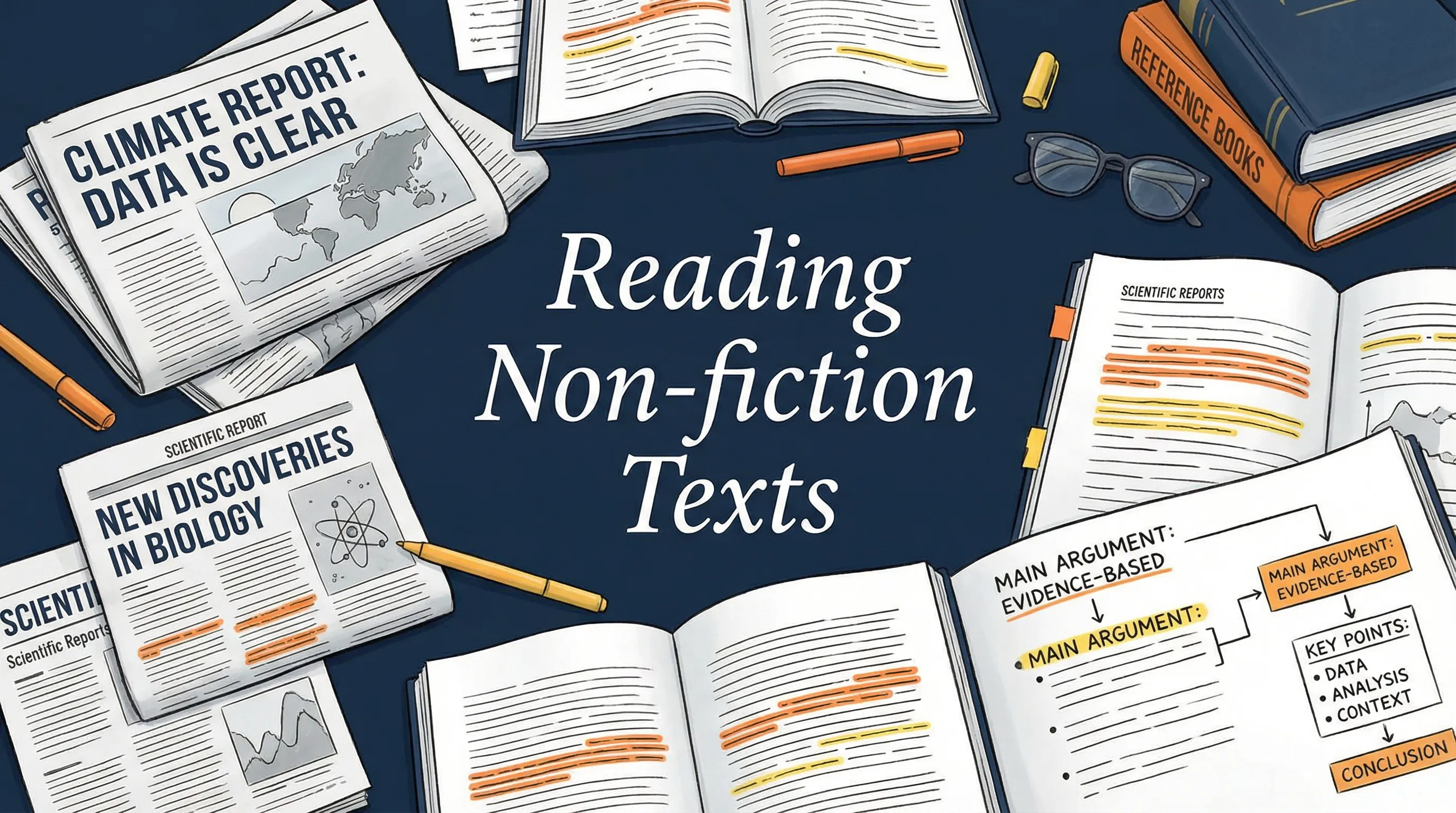
Develop strategies for reading and understanding non-fiction.
Understanding Non-fiction
Non-fiction texts are designed to inform, argue, explain, or persuade readers about real-world topics. Unlike fiction, which invites us into imaginary worlds, non-fiction demands that we engage critically with facts, evidence, and arguments. This makes reading non-fiction a fundamentally different experience that requires its own set of strategies and skills.
The ability to read and understand non-fiction is essential in today's information-rich society. From news articles and scientific reports to political speeches and social media posts, we encounter non-fiction every day. Developing strong non-fiction reading skills helps you become a more informed citizen, a better student, and a more critical thinker.
In this chapter, we will explore the diverse world of non-fiction texts and develop practical strategies for reading them effectively. You will learn how to identify different text types, recognize organizational patterns, apply active reading techniques, and extract meaning from complex informational texts.
Non-fiction encompasses a wide range of text types, each with its own conventions and purposes.
Informative Texts:
- News articles: Report on current events; aim for objectivity and timeliness
- Encyclopedias and textbooks: Provide comprehensive, organized information
- Scientific reports: Present research findings with methodology and data
- Technical documentation: Explain how systems or products work
Argumentative Texts:
- Opinion pieces and editorials: Present a perspective on an issue
- Essays: Develop ideas through structured argumentation
- Reviews: Evaluate works, products, or experiences
- Political speeches: Persuade audiences toward a position
Narrative Non-fiction:
- Biographies and autobiographies: Tell true life stories
- Memoirs: Focus on personal experiences and reflections
- Travel writing: Describe journeys and places
- Creative non-fiction: Uses literary techniques for factual content
Functional Texts:
- Instructions and manuals: Guide readers through processes
- Legal documents: Establish rights, obligations, and agreements
- Business communications: Facilitate professional interactions
Understanding which type of text you are reading helps you adjust your reading strategy accordingly.
"The Arctic ice sheet has shrunk by 13% per decade since 1979, according to NASA satellite data. Scientists warn that if current trends continue, the Arctic could experience ice-free summers by 2050."
Analysis:
- Text type: News article / scientific report
- Purpose: To inform readers about climate change data
- Key features: Statistics, expert sources, factual claims
- Reading approach: Look for evidence quality, check sources
Compare with this opening:
"I still remember the day I first set foot on the ice. The silence was overwhelming - not empty, but full, as if the frozen landscape was holding its breath."
Analysis:
- Text type: Memoir / creative non-fiction
- Purpose: To share personal experience
- Key features: First-person narration, sensory details
- Reading approach: Consider the author's perspective, look for themes
Identify the type of non-fiction text each excerpt comes from and explain your reasoning:
"To install the software, first ensure your system meets the minimum requirements. Then download the installer from our website."
"The proposed legislation fails to address the root causes of inequality."
"Born in 1929 in Atlanta, Georgia, Martin Luther King Jr. would become one of the most influential leaders of the American civil rights movement."
Find examples of three different types of non-fiction texts. For each text, identify:
What type of non-fiction text is it? What features helped you identify it?
What is the main purpose of the text?
Who is the intended audience, and how do you know?
Active reading transforms you from a passive receiver of information into an engaged, critical thinker.
Before Reading (Preview):
- Survey the text: Read title, headings, introduction, and conclusion first
- Consider your purpose: Why are you reading this?
- Activate prior knowledge: What do you already know about this topic?
During Reading (Process):
- Annotate actively: Highlight key points, write margin notes
- Identify structure: Notice how the text is organized
- Monitor comprehension: Pause regularly to check understanding
After Reading (Reflect):
- Summarize: Write the main points in your own words
- Evaluate: How convincing was the argument?
- Connect: How does this relate to other things you know?
Common Text Structures:
- Chronological: Events in time order (signal words: first, then, finally)
- Compare/Contrast: Similarities and differences (signal words: however, similarly)
- Cause/Effect: Reasons and results (signal words: because, therefore)
- Problem/Solution: Issue and proposed fix (signal words: to address this)
- Description: Characteristics of a topic (signal words: for example, such as)
The SQ3R Method: Survey - Question - Read - Recite - Review
Apply the SQ3R method to a non-fiction article (at least 500 words). Document each step:
Survey: What did you notice from previewing the text?
Question: Write 3-5 questions you want the text to answer.
Recite: Summarize the main points in your own words.
Identify the organizational structure of these text excerpts:
"Climate change leads to rising sea levels, which causes coastal flooding. As a result, millions may need to relocate."
"While traditional classrooms offer face-to-face interaction, online learning provides flexibility."
"The industrial revolution began in Britain in the late 18th century. By the mid-19th century, it had spread to Europe."
Summary: Reading Non-fiction Texts
Key Takeaways:
1. Non-fiction Text Types
Non-fiction includes informative texts (news, reports), argumentative texts (editorials, essays), narrative non-fiction (biographies, memoirs), and functional texts (instructions, documents).
2. Active Reading Strategies
Effective reading involves three phases:
- Before: Preview, set purpose, activate knowledge
- During: Annotate, identify structure, monitor comprehension
- After: Summarize, evaluate, connect
3. Text Structure Recognition
Common patterns include chronological, compare/contrast, cause/effect, problem/solution, and description. Signal words help identify these structures.
4. The SQ3R Method
Survey, Question, Read, Recite, Review provides a structured approach to improve comprehension and retention.
Read a feature article from a reputable publication. Write a reading response (300-400 words) including:
A summary of the article's main argument (2-3 sentences)
Identification of text type and structure with evidence
Analysis of how the author supports their points
Your evaluation of the article's effectiveness
Create a "Non-fiction Reading Toolkit" for your studies. Include:
A checklist of 8-10 questions to ask before, during, and after reading
A guide to five text structures with signal words for each
A set of 6+ annotation symbols with explanations
Sources
- Grabe, W. & Stoller, F. L. (2020). Teaching and Researching Reading. Routledge.
- Day, R. R. & Bamford, J. (1998). Extensive Reading in the Second Language Classroom. Cambridge University Press.
- Nuttall, C. (2005). Teaching Reading Skills in a Foreign Language. Macmillan.
- UDIR (2020). Læreplan i engelsk (ENG01-04). Utdanningsdirektoratet. https://www.udir.no/lk20/eng01-04
Dette kapitlet er skrevet av Anthropics toppmodeller (Claude Opus og Claude Fable) og er foreløpig ikke manuelt gjennomgått — kvalitetskontrollen gjøres av uavhengige KI-agenter, og innmeldte feil rettes fortløpende. Funnet en feil? Meld fra, så retter vi den. Les mer om hvordan innholdet lages.