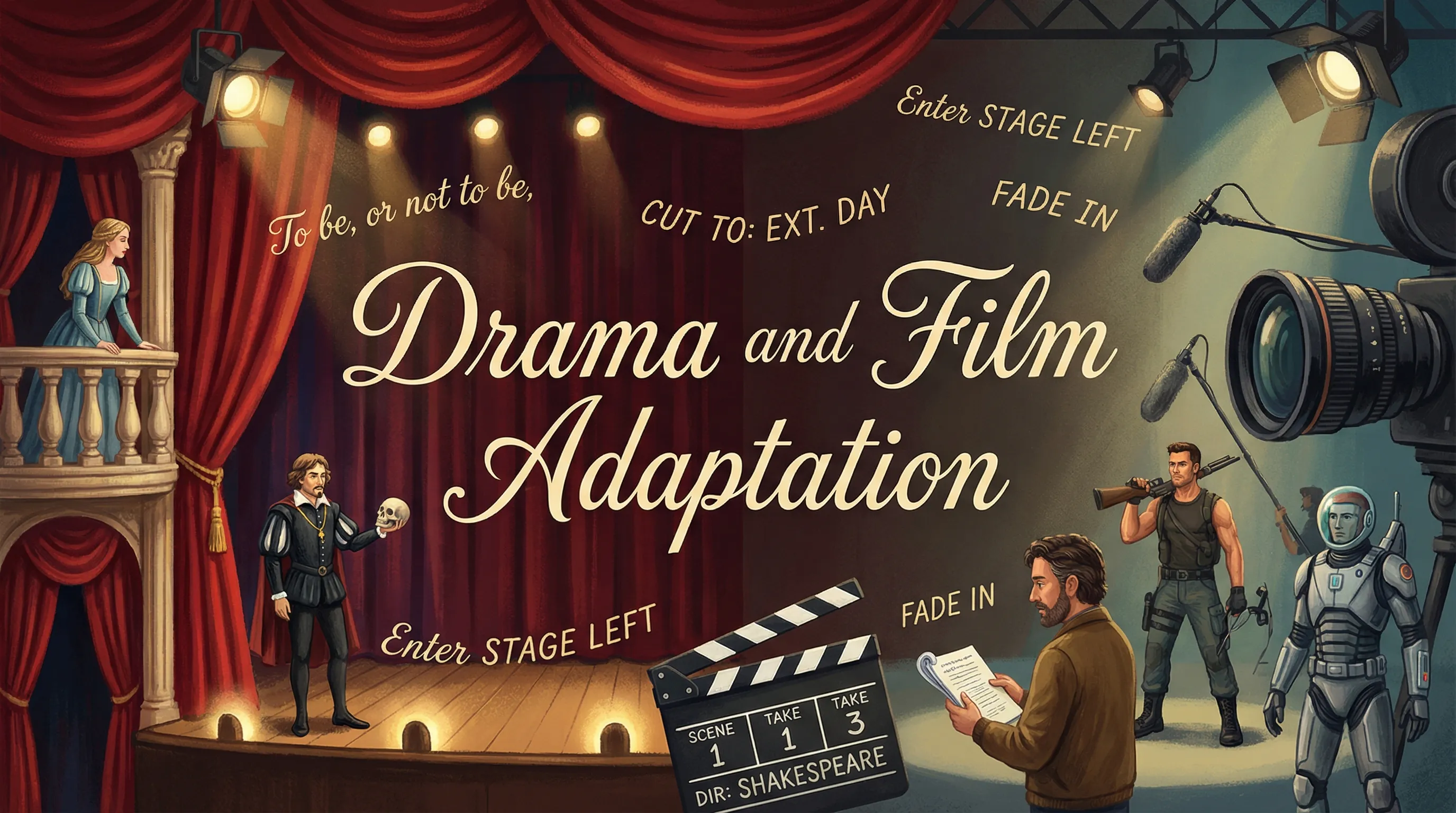
Explore dramatic texts and their film adaptations.
From Page to Stage to Screen
Drama exists in multiple forms - as written text, live performance, and film. Each medium has unique conventions and possibilities.
Understanding Drama:
Drama is written to be performed. The script is just a blueprint.
When Comparing Adaptations:
- What is added or removed?
- How do visual elements change meaning?
- What interpretation does the director offer?
- How does the medium affect the experience?
- Dialogue: What characters say
- Stage directions: Instructions for performance
- Monologue: Long speech by one character
- Soliloquy: Character speaking thoughts aloud, alone
- Aside: Character speaks to audience, others can't hear
Dramatic Structure:
- Acts: Major divisions
- Scenes: Smaller divisions within acts
- Tragedy: Ends in disaster for protagonist
- Comedy: Ends happily, often with marriage
Dramatic Techniques:
- Dramatic irony: Audience knows more than characters
- Comic relief: Humor in a serious play
- Deus ex machina: Sudden unlikely resolution
- Close-up: Face or detail (shows emotion)
- Medium shot: Waist up (conversation)
- Long shot: Full body/setting (context)
- Extreme long shot: Landscape (isolation, scope)
Camera Angles:
- Low angle: Looking up (power, threat)
- High angle: Looking down (vulnerability)
- Eye level: Neutral, equal
Editing:
- Cut: Instant change
- Dissolve: Gradual transition
- Montage: Series of shots showing passage of time
Sound:
- Diegetic: Sound within the story world
- Non-diegetic: Added sound (soundtrack)
- Score: Background music
Compare a scene from a play/book with its film adaptation. Answer:
What is preserved from the original?
What is changed or added?
How do film techniques affect meaning?
Which version do you prefer and why?
Read a scene from a Shakespeare play (or watch a performed version). Identify three examples of dramatic techniques (soliloquy, aside, dramatic irony, stage directions).
Film analysis: Watch a scene from an English-language film and analyze how cinematic techniques create meaning.
What camera angles and shots are used?
How does music or sound contribute to the mood?
What is the lighting like, and what mood does it create?
Write a short dramatic scene (1-2 pages) with dialogue, stage directions, and at least one dramatic technique (dramatic irony, foreshadowing, or subplot).
Discuss the challenges and opportunities of adapting literature to film. Use a specific example you know.
What can film do that books cannot?
What can books do that film cannot?
Write a film review (200-300 words) of an English-language film. Discuss narrative, performance, cinematography, and theme.
Summary
Key Points:
1. Drama uses dialogue, stage directions, and dramatic techniques (soliloquy, aside, dramatic irony) to tell stories through performance.
2. Film adds visual and auditory dimensions: camera angles, lighting, music, editing, and acting all contribute to meaning.
3. Adaptation from text to film involves creative choices about what to keep, change, and add. Both mediums have unique strengths.
4. Analyzing both mediums requires understanding their specific conventions and how technique creates meaning.
5. Shakespeare remains foundational to English drama and continues to be adapted for modern audiences.
Key Vocabulary:
- Soliloquy - a speech in which a character reveals thoughts to the audience
- Dramatic irony - when the audience knows something the characters do not
- Cinematography - the art of camera work and visual composition in film
- Mise-en-scene - everything visible in a frame (set, costumes, lighting, actors)
Sources and Further Reading
- Bordwell, D. & Thompson, K. (2017). Film Art: An Introduction. McGraw-Hill.
- Crystal, D. & Crystal, B. (2002). Shakespeare's Words. Penguin.
- British Film Institute - Film Education: bfi.org.uk/education
Dette kapitlet er skrevet av Anthropics toppmodeller (Claude Opus og Claude Fable) og er foreløpig ikke manuelt gjennomgått — kvalitetskontrollen gjøres av uavhengige KI-agenter, og innmeldte feil rettes fortløpende. Funnet en feil? Meld fra, så retter vi den. Les mer om hvordan innholdet lages.