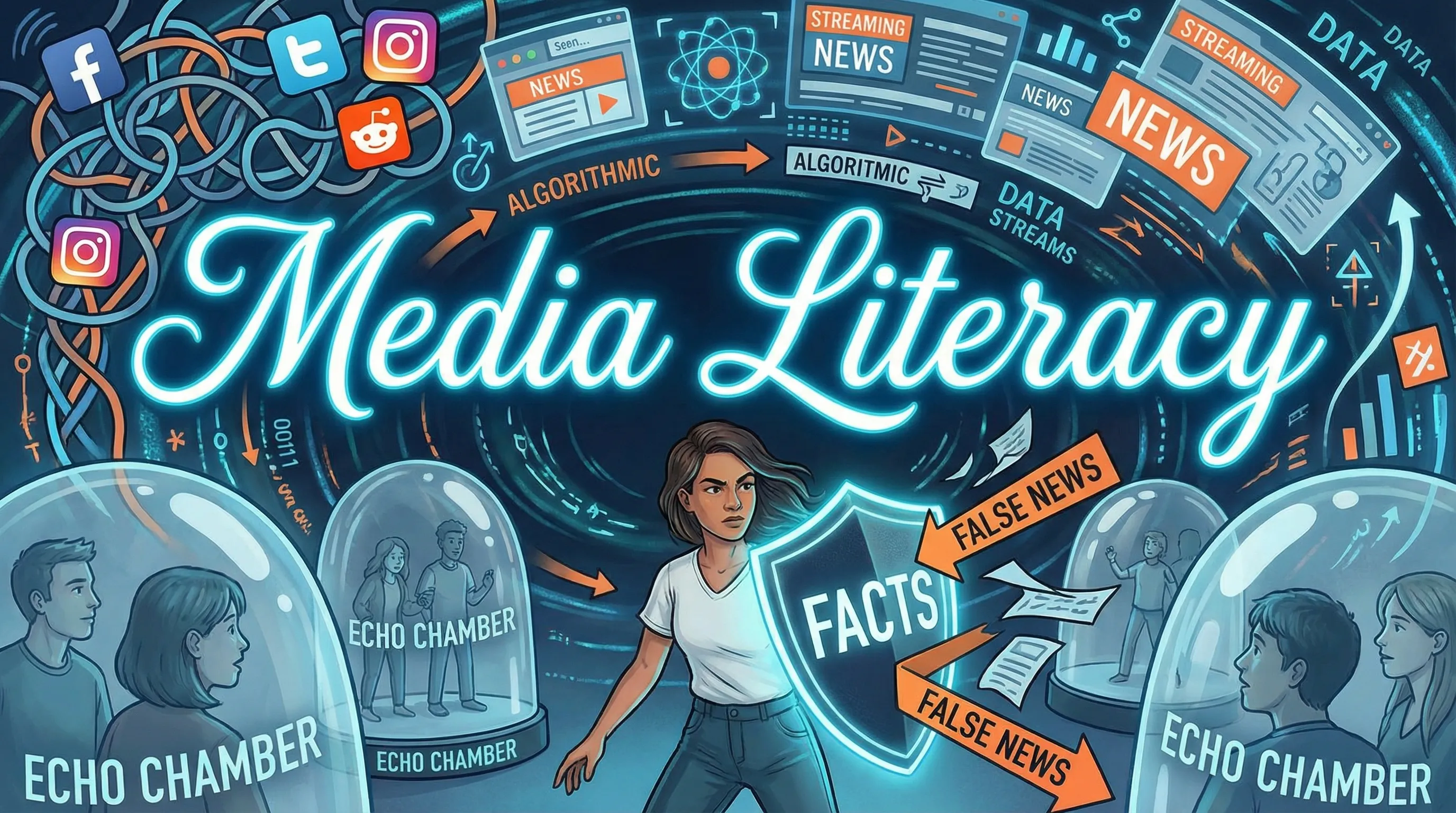
Navigate and critically evaluate media in the digital age.
Navigating Today's Media Landscape
We live in an unprecedented era of information abundance. Every day, billions of messages compete for your attention across social media feeds, news websites, podcasts, videos, and messaging apps. Some of this content is carefully researched and fact-checked; some is opinion presented as fact; some is deliberately designed to mislead. The ability to navigate this landscape wisely is perhaps the defining skill of the 21st century citizen.
Media literacy goes beyond simply identifying "fake news." It means understanding how all media is constructed, recognizing the techniques used to capture attention, analyzing how different audiences might interpret the same message, and being aware of what is absent from any given representation. Media literate individuals don't just consume content passively; they engage critically, asking questions about source, purpose, and effect.
In this chapter, you will develop a deeper understanding of how media messages are constructed and why. You will learn to identify different types of misinformation and the techniques used to spread them. You will also build practical skills for navigating social media and news consumption in ways that keep you informed without being manipulated.
Understanding the different types of problematic content helps you recognize them in the wild.
Key Distinction:
- Misinformation: False or inaccurate information spread without intent to deceive (the person sharing it believes it's true)
- Disinformation: False information deliberately created and spread to deceive (propaganda, manipulation)
- Malinformation: True information shared to cause harm (leaked private information, out-of-context facts)
Common Types of Problematic Content:
1. Fabricated Content (Fake News)
Completely false stories designed to look like legitimate journalism. Often uses professional-looking websites with names similar to real outlets.
2. Manipulated Content
Real images, videos, or quotes that have been altered or taken out of context. Includes "deepfakes" created using AI technology.
3. Misleading Content
Uses real information in misleading ways: cherry-picked statistics, cropped photos, or misleading headlines that don't match the article.
4. Imposter Content
Fake accounts pretending to be real people, organizations, or news sources. Common on social media.
5. Satire/Parody Mistaken as Real
Humorous content intended as satire that gets shared as if it were genuine news.
6. Clickbait
Sensationalized headlines designed to generate clicks, often misrepresenting the actual content.
7. Conspiracy Theories
Unfounded explanations for events that resist evidence and rely on hidden actors with malicious intent.
8. Propaganda
Information designed to promote a particular political agenda, often mixing truth with spin.
A website called "DenverGuardian.com" published a story claiming an FBI agent investigating Hillary Clinton was found dead. The website looked professional but had no history, no staff, and the story was completely invented.
How to spot it: Check the domain, look for other articles, search for corroboration.
Example 2: Manipulated Content
A photo showed a massive crowd at a political rally. Investigation revealed it was actually from a different event years earlier.
How to spot it: Reverse image search, check the metadata, look for corroboration.
Example 3: Misleading Content
Headline: "Scientists Confirm: Coffee Causes Cancer"
Article content: A study found a very weak correlation between heavy coffee consumption and one type of cancer, with researchers saying more study is needed.
How to spot it: Always read beyond the headline, check the actual claims.
Example 4: Satire Mistaken as Real
An article from The Onion (a satire site) about a politician's ridiculous statement gets shared on social media as if it were real news.
How to spot it: Check the source; satire sites usually have disclaimers.
Classify each scenario as a type of misinformation and explain what makes it that type:
A tweet shows a video of a politician apparently saying something racist, but the audio has been edited to change the meaning.
Your grandmother shares an article claiming a common medicine is dangerous, citing "studies" that don't actually exist.
A news article has a headline saying "Unemployment Hits Record High" but the article explains unemployment rose 0.1% while still being historically low.
Find a real example of each type and document it:
A clickbait headline: Copy the headline and explain what makes it clickbait.
A misleading use of statistics: Explain how the numbers are presented in a misleading way.
An example of imposter content OR satire that could be mistaken as real: Explain why it might fool people.
Social media platforms are not neutral channels for information. Their design fundamentally shapes what we see and how we interact with content.
Algorithmic Curation:
- Platforms use algorithms to decide what content you see
- Engagement (likes, comments, shares) drives visibility
- Content that triggers strong emotional reactions spreads faster
- This can amplify sensational or divisive content
The Filter Bubble Effect:
- Algorithms show you content similar to what you've engaged with before
- Over time, you see less content that challenges your existing views
- This can create an echo chamber where beliefs are reinforced, not tested
Attention Economy:
- Platforms compete for your attention; more time = more ad revenue
- Content is optimized for engagement, not accuracy
- Notifications and infinite scroll are designed to keep you on the platform
Social Validation:
- High engagement (likes, shares) creates perceived credibility
- We're influenced by what our social networks share and approve
- "Going viral" doesn't mean "being accurate"
Speed vs. Accuracy:
- Social media rewards being first, not being right
- Corrections and retractions rarely spread as far as the original claim
- The 24-hour news cycle pressures even legitimate outlets
Practical Strategies:
1. Be aware that your feed is curated, not comprehensive
2. Actively seek out diverse sources and perspectives
3. Don't assume viral = verified
4. Take a breath before sharing emotionally charged content
5. Consider following accounts that challenge your assumptions
Analyze your own social media experience:
Scroll through one of your social media feeds for 5 minutes. Categorize what you see: entertainment, news, ads, friends' posts, etc. What percentage is each?
Identify 3 posts that seem designed to trigger emotional reactions. What emotions do they target? What techniques do they use?
Consider your filter bubble: Based on your feed, what perspectives or topics might you be missing?
Apply media literacy questions to analyze this viral social media post:
"BREAKING: Scientists have discovered that [popular food item] can prevent COVID-19! Big Pharma doesn't want you to know this! Share before they delete it! [Image of a scientist with a quote that can't be verified]"
Identify at least 5 red flags in this post.
What emotional triggers is this post using?
What steps would you take to verify this claim before sharing?
Summary: Media Literacy
Key Takeaways:
1. Types of Problematic Content
- Misinformation: False content spread without intent to deceive
- Disinformation: False content deliberately created to deceive
- Types include: fabricated content, manipulated media, misleading framing, imposter accounts, misunderstood satire, clickbait, conspiracy theories, propaganda
2. Social Media Dynamics
- Algorithms curate your feed based on engagement
- Filter bubbles limit exposure to diverse perspectives
- Emotional content spreads faster than accurate content
- Viral does not equal verified
3. Critical Questions for All Media
- Who created this and why?
- What techniques are used to grab attention?
- What perspectives are missing?
- How can this be verified?
- Why am I being asked to share this?
4. Practical Strategies
- Pause before sharing emotionally charged content
- Actively seek diverse sources
- Be aware that your feed is curated
- Verify before you amplify
- Recognize manipulation techniques
Conduct a "Media Literacy Audit" of your information diet over one week. Write a 400-500 word reflection that includes:
An inventory of your main information sources (social media platforms, news apps, websites, podcasts, etc.) and approximately how much time you spend with each.
An analysis of the diversity (or lack thereof) in your sources: political perspectives, geographic origins, types of content.
At least two examples of questionable content you encountered and how you responded.
A plan for improving your media literacy: What will you do differently?
Create a "Media Literacy Guide for Beginners" designed for a younger sibling, parent, or friend who struggles with misinformation. Your guide should:
Explain in simple terms why media literacy matters (2-3 paragraphs)
Provide a checklist of 8-10 questions to ask before sharing content
Include 3-5 concrete examples of misinformation types with tips for spotting each
List reliable fact-checking resources and explain how to use them
Sources
- Buckingham, D. (2019). The Media Education Manifesto. Polity Press.
- Hobbs, R. (2020). Mind Over Media: Propaganda Education for a Digital Age. W. W. Norton.
- UDIR (2020). Læreplan i engelsk (ENG01-04). Utdanningsdirektoratet. https://www.udir.no/lk20/eng01-04
- UNESCO (2021). Media and Information Literacy Curriculum for Teachers. UNESCO Publishing.
Dette kapitlet er skrevet av Anthropics toppmodeller (Claude Opus og Claude Fable) og er foreløpig ikke manuelt gjennomgått — kvalitetskontrollen gjøres av uavhengige KI-agenter, og innmeldte feil rettes fortløpende. Funnet en feil? Meld fra, så retter vi den. Les mer om hvordan innholdet lages.