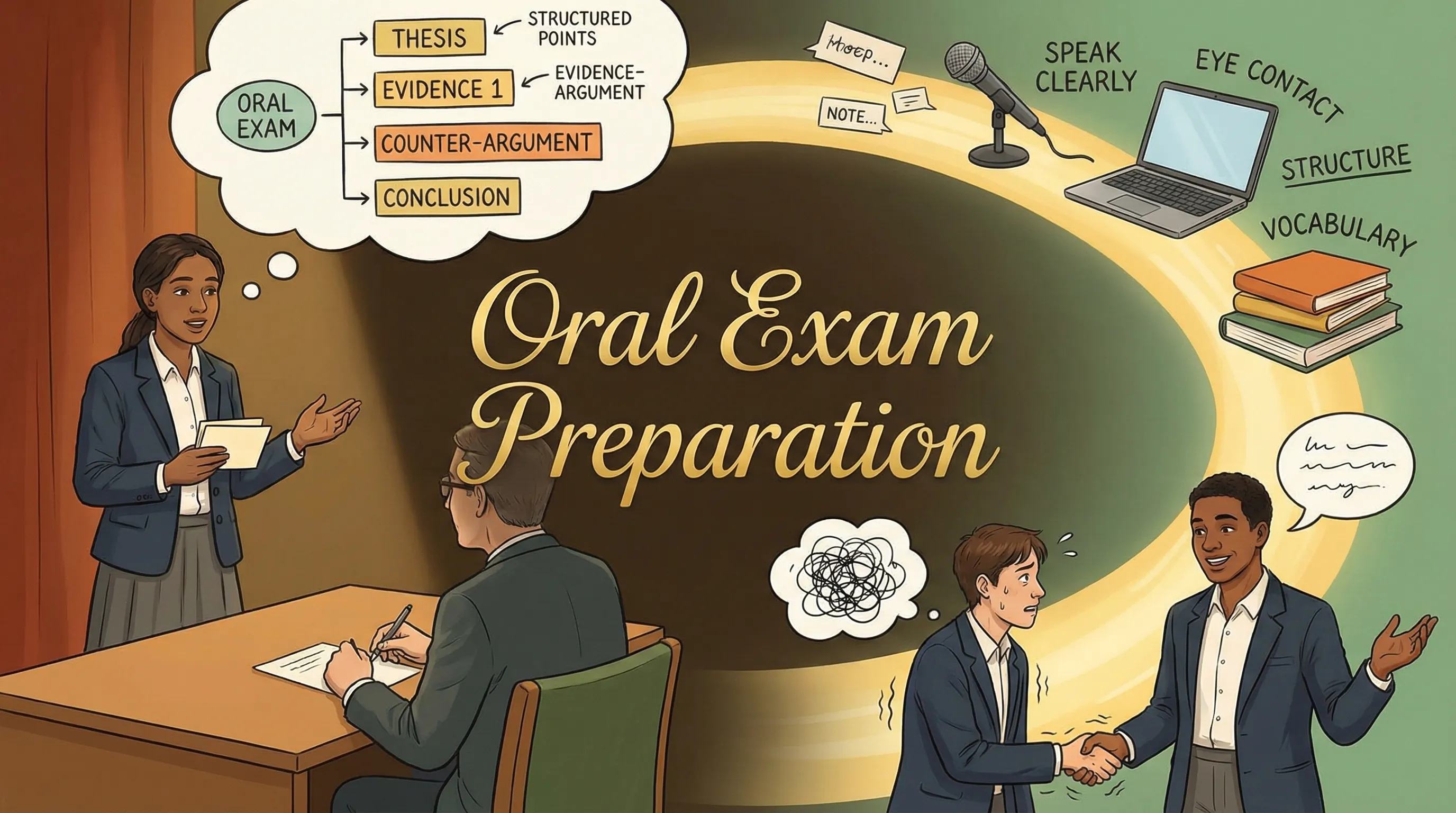
Prepare for the oral exam with effective strategies.
Oral Exam Success
The oral exam tests your ability to communicate effectively in speech.
Typical Format:
- Preparation time (usually 30-45 min)
- Presentation (5-10 min)
- Conversation with examiners (10-15 min)
- Total: ~30 min
You'll Be Assessed On:
- Content and knowledge
- Language (vocabulary, grammar, pronunciation)
- Communication (fluency, interaction)
- Structure and coherence
- Clear introduction stating your topic
- 2-3 main points
- Conclusion that ties it together
Delivery:
- Speak clearly and at a reasonable pace
- Make eye contact
- Use notes, but don't read
- Use visuals if allowed
Language:
- Use topic-specific vocabulary
- Vary sentence structures
- Use discourse markers (firstly, however, in conclusion)
- It's OK to pause to think
Handling Questions:
- Listen carefully
- Ask for clarification if needed
- It's OK to say "I'm not sure, but I think..."
- Engage in dialogue, don't give one-word answers
Practice oral exam preparation:
Choose a topic related to the English curriculum (e.g., an English-speaking country, a literary text, a social issue).
Create a brief outline (3-4 points) for a presentation.
Practice giving the presentation. Time yourself.
Prepare answers for likely follow-up questions.
Discourse markers are essential for a well-structured oral presentation. Sort the following discourse markers into categories (introduction, adding points, contrasting, concluding): "To begin with", "Furthermore", "On the other hand", "In conclusion", "Moreover", "However", "First of all", "To sum up", "Nevertheless", "In addition". Then write a short paragraph using at least five of them.
Practise handling follow-up questions. Read this sample exam topic: "Discuss how immigration has shaped modern British society." Write down five questions that an examiner might ask after your presentation, and prepare brief answers (2-3 sentences each) for each question.
Record yourself giving a 3-minute presentation on one of the following topics. Listen to the recording and evaluate your own performance based on the assessment criteria (content, language, communication, structure):
a) The importance of learning a second language
b) A comparison of two English-speaking countries
c) How social media affects the English language
Simulate a full oral exam with a classmate. One person plays the student and the other the examiner. The student prepares for 15 minutes, gives a 5-minute presentation, and then answers follow-up questions for 5 minutes. Choose from these topics:
a) "The American Dream — myth or reality?"
b) "How has the British Empire shaped the modern world?"
c) "Analyse a literary text you have read this year."
Afterward, the examiner gives feedback using the assessment criteria.
Reflect on the differences between written and oral communication in English. Write a text (200-300 words) discussing: What are you better at — speaking or writing in English? Why? What specific strategies can you use to improve your weaker skill? How does preparing for an oral exam differ from preparing for a written exam?
Summary
In this chapter you have learned:
- Oral exam format: Typically involves preparation time, a presentation, and a conversation with examiners
- Presentation skills: Use a clear structure, make eye contact, speak from notes rather than reading, and use discourse markers
- Handling questions: Listen carefully, ask for clarification if needed, and engage in genuine dialogue
- Assessment criteria: Content, language quality, communication ability, and structure are all evaluated
- Practice strategies: Recording yourself, simulating exam conditions, and peer feedback are effective preparation methods
Key Concepts
| Concept | Explanation |
|---|---|
| Discourse markers | Words and phrases that structure your speech (firstly, however, in conclusion) |
| Eye contact | Looking at the audience to establish connection and engagement |
| Follow-up questions | Questions examiners ask to explore your understanding further |
| Spontaneous production | The ability to speak fluently without a prepared script |
Sources
- UDIR (2020). Retningslinjer for muntlig eksamen. Utdanningsdirektoratet.
- Hughes, R. (2011). Teaching and Researching Speaking. Pearson Education.
- Luoma, S. (2004). Assessing Speaking. Cambridge University Press.
- Hasselgreen, A. (2005). "Assessing the language of young learners." Language Testing, 22(1), 1-25.
Dette kapitlet er skrevet av Anthropics toppmodeller (Claude Opus og Claude Fable) og er foreløpig ikke manuelt gjennomgått — kvalitetskontrollen gjøres av uavhengige KI-agenter, og innmeldte feil rettes fortløpende. Funnet en feil? Meld fra, så retter vi den. Les mer om hvordan innholdet lages.