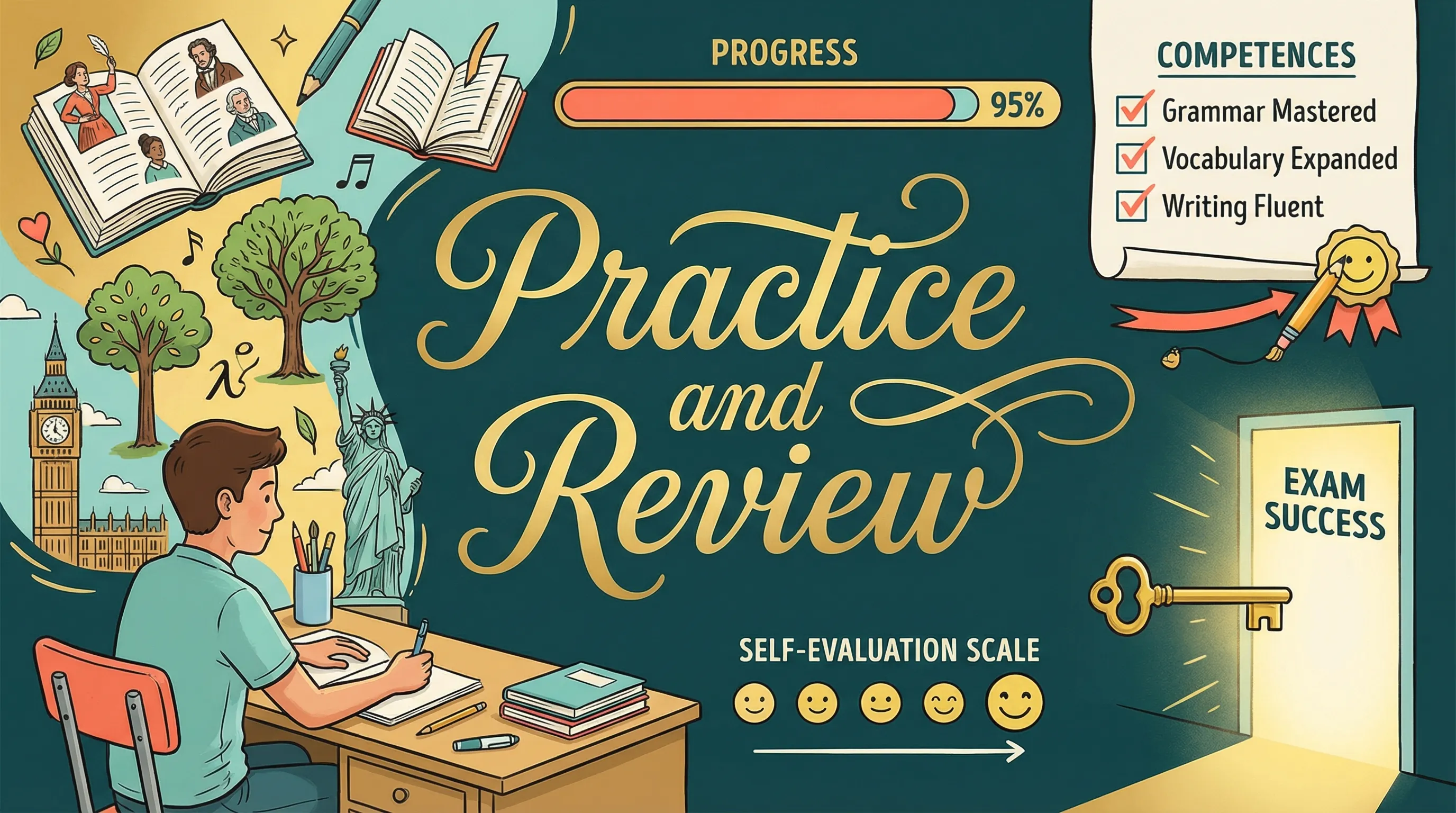
Review key concepts and practice for exams.
Final Review and Practice
This chapter helps you review key concepts and practice exam-style tasks.
Review Checklist:
- Language learning strategies
- Grammar and text structure
- Reading and literary analysis
- Writing different text types
- English-speaking countries and cultures
- Critical source evaluation
- Oral communication skills
- Express yourself clearly in speech and writing
- Adapt to purpose, audience, and situation
- Use varied vocabulary and structures
Language:
- Use grammar correctly
- Apply text structure knowledge
- Show vocabulary range
- Communicate despite some errors
Culture:
- Knowledge of English-speaking countries
- Understanding of diversity
- Historical perspectives
- Analysis of cultural expressions
Sources:
- Critical evaluation
- Compare perspectives
- Use sources responsibly
- Cite properly
Create a study plan for the final weeks before exams:
Identify your three weakest areas from the course.
For each area, list specific activities to improve.
Create a weekly schedule for review.
Plan how to get feedback on practice tasks.
Write a complete practice essay (400-600 words) on ONE of these topics:
a) "Discuss the advantages and disadvantages of English as a global language."
b) "Analyze how a film, book, or song you studied reflects issues in English-speaking society."
c) "Compare and contrast two English-speaking countries you have learned about."
Grammar review. Identify and correct the grammatical errors in each sentence, then explain the grammar rule that applies:
a) "She has went to London many times."
b) "If I would have known, I would have come earlier."
c) "The informations we received were very useful."
d) "He suggested me to apply for the job."
e) "Despite of the rain, they continued playing."
Source evaluation practice. You are writing an essay about immigration in the United States. Evaluate the reliability and usefulness of the following sources (rate each 1-5 and explain your reasoning):
a) A Wikipedia article on "Immigration to the United States"
b) A speech by a politician arguing for stricter immigration laws
c) A peer-reviewed academic article from the Journal of Migration Studies (2023)
d) A personal blog post by someone who immigrated to the US in 2015
e) Data from the US Census Bureau on immigration statistics
Comprehensive review: Choose a topic that connects at least three different sections of this textbook (e.g., language history + cultural expressions + a specific English-speaking country). Write a text (300-400 words) that demonstrates knowledge from all three areas. Clearly reference which chapters your knowledge comes from.
Final reflection. Write a personal text (300-500 words) reflecting on your learning journey in English VG1. Address the following:
a) What are the most important things you have learned this year?
b) How has your understanding of the English-speaking world changed?
c) What skills have you developed that will be useful beyond school?
d) What would you like to explore further?
Use concrete examples from the course to support your reflections.
Summary
In this chapter you have reviewed:
- Key competence areas: Communication, language, culture, and source evaluation are the four pillars of English VG1
- Grammar and accuracy: Correct use of verb forms, conditionals, countable/uncountable nouns, and prepositions
- Source evaluation: Assessing reliability by considering authority, accuracy, objectivity, currency, and purpose
- Cross-curricular connections: The ability to connect knowledge across different topics demonstrates deep understanding
- Reflective learning: Thinking about your own learning process helps consolidate knowledge and identify areas for further development
Key Concepts
| Concept | Explanation |
|---|---|
| Synthesis | Combining knowledge from different areas into a coherent whole |
| Metacognition | Awareness of your own thinking and learning processes |
| Source criticism | Evaluating the reliability and usefulness of information sources |
| Cross-curricular thinking | Connecting ideas across different topics and subjects |
Sources
- UDIR (2020). Læreplan i engelsk (ENG01-04). Utdanningsdirektoratet. https://www.udir.no/lk20/eng01-04
- Skulstad, A. S. (2020). "English in Norway." In S. Breidbach, L. Küster & B. Schmenk (Eds.), Sloganizations in Language Education Discourse. Multilingual Matters.
- Grabe, W. & Stoller, F. L. (2020). Teaching and Researching Reading. Routledge.
- Nation, I. S. P. (2022). Learning Vocabulary in Another Language. Cambridge University Press.
Dette kapitlet er skrevet av Anthropics toppmodeller (Claude Opus og Claude Fable) og er foreløpig ikke manuelt gjennomgått — kvalitetskontrollen gjøres av uavhengige KI-agenter, og innmeldte feil rettes fortløpende. Funnet en feil? Meld fra, så retter vi den. Les mer om hvordan innholdet lages.