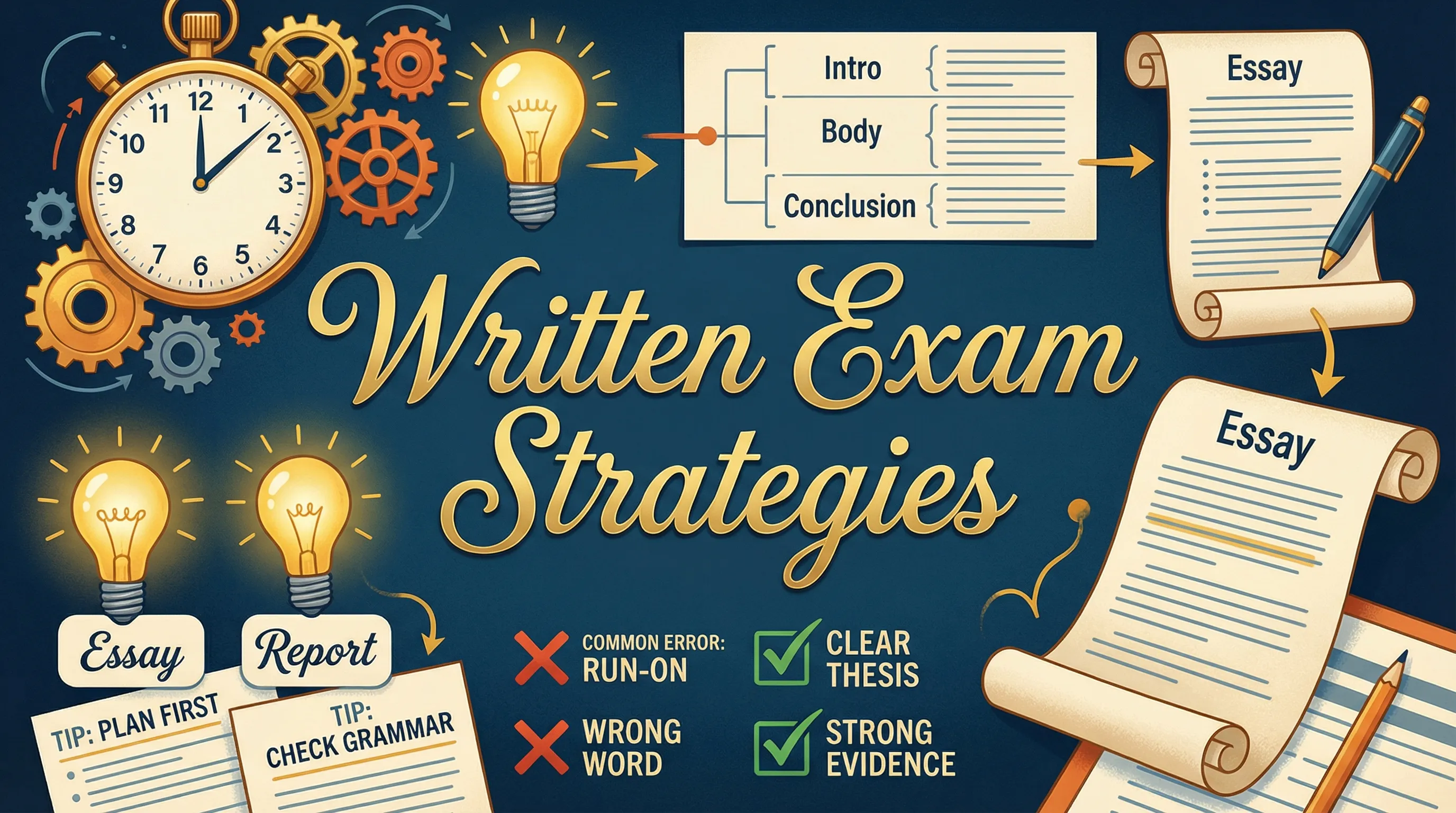
Develop strategies for the written exam.
Written Exam Success
The written exam tests your ability to communicate effectively in writing.
Typical Format:
- Part 1: Short answer tasks (e.g., comparing sources)
- Part 2: Long text (essay, article, narrative)
- 5 hours total
- Digital resources allowed (not AI)
- 30 min: Read tasks, plan approach
- 1 hour: Part 1 short tasks
- 30 min: Plan Part 2
- 2.5 hours: Write Part 2
- 30 min: Review and edit
Planning Your Long Text:
1. Analyze the task carefully
2. Brainstorm ideas
3. Create outline with main points
4. Decide on structure and approach
5. Write introduction last (after you know what you're introducing!)
Common Mistakes to Avoid:
- Not answering the actual question
- Running out of time
- Not using paragraphs
- Ignoring word count guidelines
- Not proofreading
Practice task analysis. Read this exam question and answer:
"Write an argumentative essay discussing whether social media has more positive or negative effects on teenagers. Use sources and personal reflection."
What text type is required?
What content is required?
What should the structure be?
Write an outline for a Part 2 essay on the following topic: "English has become the world's lingua franca. Discuss the advantages and disadvantages of having one dominant global language." Your outline should include: an introduction with a clear thesis statement, at least three body paragraphs with topic sentences, and a conclusion.
Practise the Part 1 format. Read the two short texts below and write a comparison (200-250 words):
Text A: "Schools should ban mobile phones completely. Students are constantly distracted, grades are falling, and cyberbullying is easier when phones are always available."
Text B: "Mobile phones are essential learning tools in modern education. Students can access information instantly, collaborate on projects, and develop digital literacy skills they need for the future."
Compare the two texts: What are their main arguments? How do they use language to persuade? Which is more convincing, and why?
Proofreading practice. The following paragraph contains 8 common errors (grammar, spelling, punctuation, word choice). Find and correct all of them:
"Their are many reasons why people learns english today. It is the most importent language for international communication. If you doesnt speak english, it is hard to travel, to do buisness, and to understand popular culture. Alot of young people learn english threw social media and gaming."
Write a complete practice essay (400-600 words) on ONE of the following topics, following the time management strategy described in this chapter:
a) "Discuss how the spread of English affects linguistic diversity worldwide."
b) "Analyse a literary text you have read this year and explain how it reflects issues in English-speaking society."
c) "Compare the education system in Norway with that of an English-speaking country you have studied."
Peer assessment exercise. Exchange your essay from exercise 5 with a classmate. Using the grade characteristics from chapter 12.1, write a detailed assessment (150-200 words) of your classmate's essay. Comment on: content and relevance, structure and coherence, vocabulary and grammar, use of sources, and depth of reflection. Suggest a grade and give specific advice for improvement.
Summary
In this chapter you have learned:
- Exam format: The written exam typically has two parts — short-answer tasks (Part 1) and a long text (Part 2) — over 5 hours
- Time management: Allocate time for reading, planning, writing, and reviewing
- Task analysis: Always identify the text type, required content, and expected structure before writing
- Planning: Create an outline before writing your long text — consider writing the introduction last
- Common pitfalls: Not answering the question, running out of time, poor paragraphing, and not proofreading
Key Concepts
| Concept | Explanation |
|---|---|
| Task analysis | Breaking down the exam question to understand what is required |
| Outline | A structured plan for your essay with thesis, topic sentences, and conclusion |
| Proofreading | Systematically checking your text for errors before submitting |
| Discourse markers | Words and phrases that structure your text (however, furthermore, in conclusion) |
Sources
- UDIR (2020). Eksamensveiledning engelsk ENG01-04. Utdanningsdirektoratet.
- UDIR (2024). Eksempler på eksamensoppgaver i engelsk. Utdanningsdirektoratet.
- Hamp-Lyons, L. & Heasley, B. (2006). Study Writing: A Course in Writing Skills for Academic Purposes. Cambridge University Press.
- Oshima, A. & Hogue, A. (2019). Academic Writing. Pearson Education.
Dette kapitlet er skrevet av Anthropics toppmodeller (Claude Opus og Claude Fable) og er foreløpig ikke manuelt gjennomgått — kvalitetskontrollen gjøres av uavhengige KI-agenter, og innmeldte feil rettes fortløpende. Funnet en feil? Meld fra, så retter vi den. Les mer om hvordan innholdet lages.