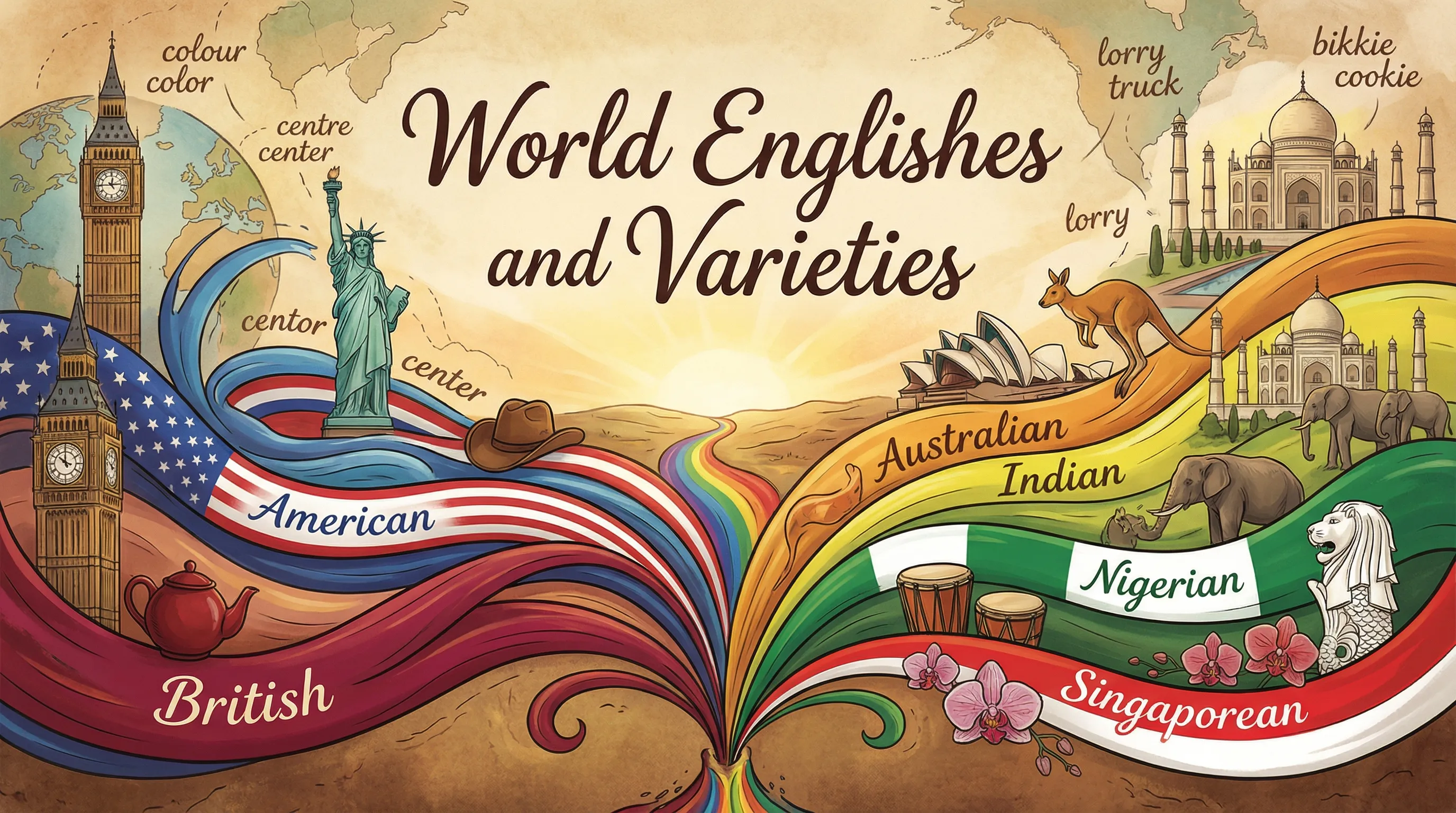
Explore different varieties of English around the world.
The Many Englishes of the World
One of the most fascinating aspects of English as a global language is its incredible diversity. There is no single "correct" English - instead, there are many Englishes, each shaped by the cultures, languages, and histories of the communities that speak them. From the streets of Mumbai to the farms of Texas, from Singapore hawker centers to London pubs, English takes on different forms while remaining recognizably English.
Linguists now speak of "World Englishes" (plural) to recognize this diversity. Each variety has its own systematic patterns of vocabulary, pronunciation, and grammar. These are not "mistakes" or "corruptions" of some imagined "pure" English - they are legitimate language systems that serve their communities effectively.
Understanding World Englishes is essential for effective global communication. You will encounter speakers from many different English backgrounds, and recognizing the validity of different varieties helps you communicate respectfully and effectively. It also raises interesting questions: Who decides what is "correct" English? Can a non-native speaker's English be as valid as a native speaker's?
American English began diverging from British English in the 17th century as colonists brought their regional dialects to North America. Isolation, contact with other languages, and deliberate choices (like Noah Webster's spelling reforms) created distinct varieties.
Spelling Differences:
| British | American | Origin |
|---|---|---|
| colour, honour | color, honor | Webster simplified French -our |
| centre, metre | center, meter | Webster changed French -re |
| realise, organise | realize, organize | -ize reflects Greek origins |
| travelled, cancelled | traveled, canceled | American drops double consonants |
| defence, licence | defense, license | Different Latin traditions |
Vocabulary Differences:
| British | American | Category |
|---|---|---|
| flat | apartment | Housing |
| lift | elevator | Buildings |
| boot | trunk | Cars |
| bonnet | hood | Cars |
| petrol | gas/gasoline | Transportation |
| motorway | highway/freeway | Transportation |
| pavement | sidewalk | Streets |
| queue | line | Daily life |
| biscuit | cookie | Food |
| chips | fries | Food |
| crisps | chips | Food |
| aubergine | eggplant | Food |
| holiday | vacation | Time off |
| mobile (phone) | cell (phone) | Technology |
Grammar Differences:
| British | American |
|---|---|
| Have you got a pen? | Do you have a pen? |
| I've just eaten. | I just ate. |
| At the weekend | On the weekend |
| In hospital | In the hospital |
| Monday to Friday | Monday through Friday |
The "r" Sound:
- American English is "rhotic" - the /r/ is pronounced in all positions (car, bird, mother)
- British RP is "non-rhotic" - the /r/ is dropped after vowels (ca', bi'd, motha')
- This is one of the most noticeable differences
Vowel Sounds:
- "bath, dance, can't" - British uses long /a:/, American uses short /ae/
- "hot, stop, body" - British uses rounded vowel, American uses unrounded
- "tomato" - British /te-MAH-toe/, American /te-MAY-toe/
Stress Patterns:
| Word | British | American |
|---|---|---|
| advertisement | adVERtisement | ADvertisement |
| laboratory | laBORatory | LABoratory |
| controversy | conTROVersy | CONtroversy |
| schedule | SHEDule | SKEDule |
Letter Pronunciation:
- "z" - British "zed", American "zee"
- "h" - British often "haitch", American always "aitch"
Remember: Neither is more "correct" - they are equally valid systems.
"Translate" these sentences between British and American English. Pay attention to vocabulary, spelling, and grammar.
British: "I'll take the lift to the first floor to get to my flat."
American: "I put my bags in the trunk, got some gas, and drove on the highway to the city center."
British: "I've just organised my holiday. We're going to queue for the theatre."
Which variety (British or American) do these spellings and words come from?
theater, favorite, realize
lift, lorry, fortnight
fall (season), gotten, sidewalk
whilst, amongst, towards
India has more English speakers than any other country except possibly the United States. Indian English has distinctive features:
Vocabulary:
- "prepone" (opposite of postpone) - now gaining global use
- "would-be" (fiance/fiancee)
- "do the needful" (take necessary action)
- "What is your good name?" (polite inquiry)
- "cousin brother/sister" (specifying gender)
Grammar:
- Present continuous for states: "I am knowing him"
- Different prepositions: "discuss about," "cope up with"
- Tag questions: "You are coming, isn't it?"
- Plural forms: "furnitures," "informations"
Nigerian English:
With over 200 million people, Nigeria is Africa's most populous nation and has one of the largest English-speaking populations.
Features:
- Influenced by Pidgin and local languages
- "Chop" (eat), "dash" (give as gift/bribe)
- "Senior/Junior" for age-based respect
- "I wan go" (I want to go) from Pidgin influence
Singaporean English (Singlish):
A distinctive variety influenced by Chinese, Malay, and Tamil.
Characteristic particles:
- "lah" (emphasis/softening): "No problem lah!"
- "meh" (skepticism): "Can meh?"
- "lor" (resignation): "Like that lor."
Distinctive expressions:
- "Can!" (yes, it's possible)
- "Cannot!" (it's not possible/not allowed)
- "Where got?" (that's not true!)
- "Got or not?" (is there any?)
Important: These are not "incorrect" English - they are systematic varieties with their own rules.
Match these World English expressions with their "Standard English" equivalents:
Indian English: "Please do the needful"
Singlish: "Can or not?"
Indian English: "I am having two brothers"
Nigerian English: "I will flash you"
Research task: Choose one variety of English (Australian, South African, Caribbean, Irish, Scottish, etc.) and find out:
What historical factors shaped this variety?
List 5 distinctive words or expressions from this variety.
What pronunciation features distinguish this variety?
Discussion: "All varieties of English are equally valid." Do you agree? Consider these scenarios:
A Nigerian using "I will flash you" in an international business meeting - is this appropriate?
Should international exams (IELTS, Cambridge) accept answers in any variety of English?
Should Norwegian schools teach British, American, or accept any variety?
Comparative Essay: Choose TWO varieties of English (e.g., British vs Australian, American vs Indian) and write a comparison (400-500 words) covering vocabulary, pronunciation, and grammar differences. Include specific examples.
Summary
In this chapter you have learned:
- World Englishes: English is not one language but many varieties, each with systematic features shaped by local languages and cultures
- British vs American English: Differences in spelling (colour/color), vocabulary (boot/trunk), grammar (have got/have gotten), and pronunciation
- Post-colonial Englishes: Indian English, Nigerian English, Singaporean English, and others have developed their own legitimate rules and vocabulary
- Attitudes to variety: No single variety is inherently "correct" — appropriateness depends on context and audience
Key Concepts
| Concept | Explanation |
|---|---|
| World Englishes | The many distinct varieties of English spoken around the world |
| Code-switching | Alternating between two or more languages or varieties in conversation |
| Nativisation | The process by which English adapts to local linguistic and cultural contexts |
| Standard language ideology | The belief that one variety is inherently superior to others |
Sources
- Jenkins, J. (2009). World Englishes: A Resource Book for Students. Routledge.
- Kirkpatrick, A. (2010). The Routledge Handbook of World Englishes. Routledge.
- Trudgill, P. & Hannah, J. (2017). International English: A Guide to Varieties of English Around the World. Routledge.
- UDIR (2020). Læreplan i engelsk (ENG01-04). Utdanningsdirektoratet. https://www.udir.no/lk20/eng01-04
Dette kapitlet er skrevet av Anthropics toppmodeller (Claude Opus og Claude Fable) og er foreløpig ikke manuelt gjennomgått — kvalitetskontrollen gjøres av uavhengige KI-agenter, og innmeldte feil rettes fortløpende. Funnet en feil? Meld fra, så retter vi den. Les mer om hvordan innholdet lages.