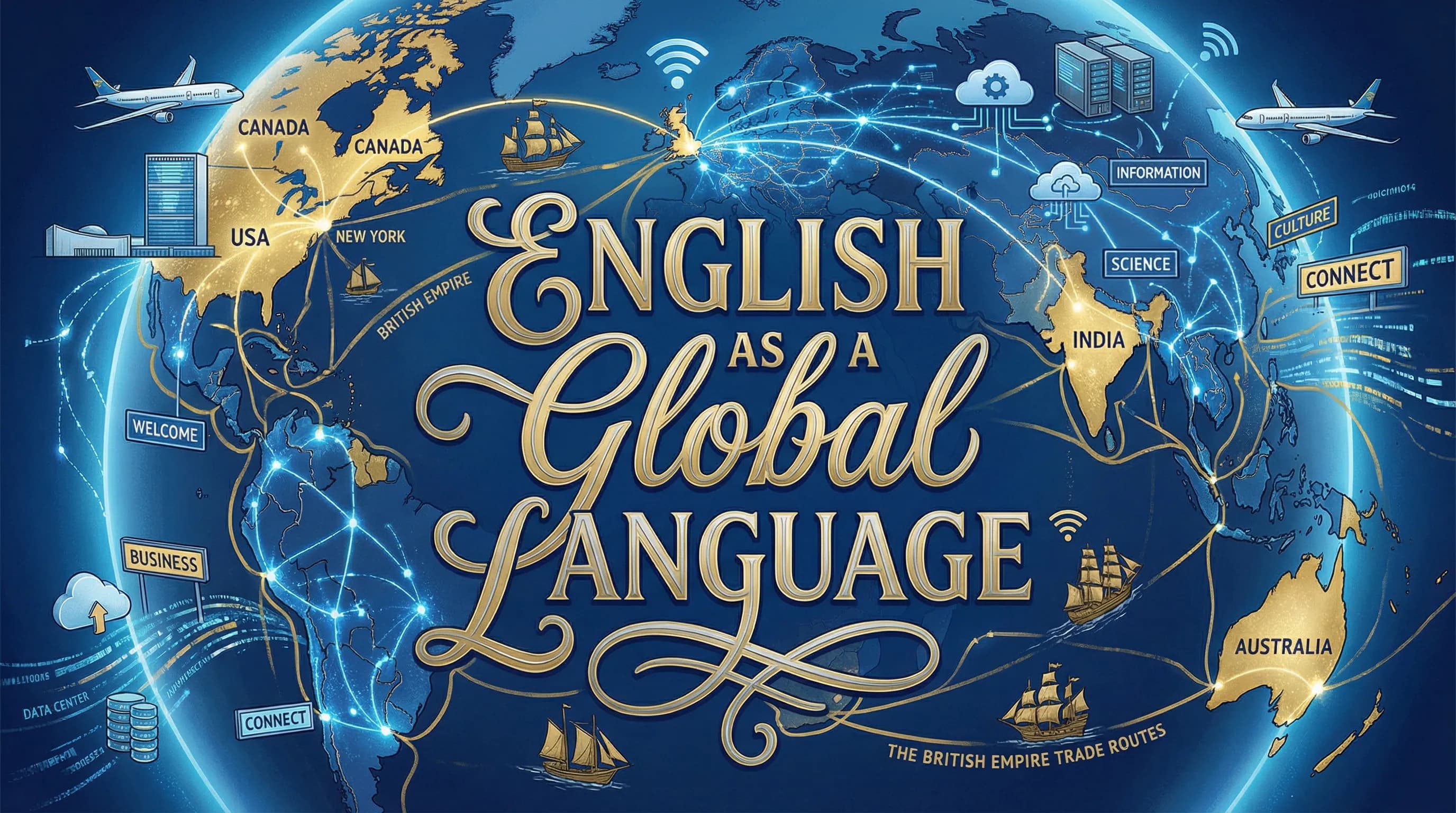
Understand why English became the world's lingua franca.
The Rise of Global English
No language in history has achieved the global reach that English has today. Approximately 1.5 billion people use English regularly, making it by far the world's most widely spoken language when we count both native and non-native speakers. What is remarkable is that native speakers are now a minority - roughly 400 million compared to over a billion who speak English as a second or foreign language.
The spread of English is not a natural phenomenon but the result of specific historical, political, and economic forces. Two waves of expansion - British colonialism from the 17th to 20th centuries, followed by American global dominance in the 20th and 21st centuries - created the conditions for English to become the world's default language for international communication.
Today, English serves as the working language of international organizations, academic research, global business, aviation, maritime communication, and the internet. Understanding how and why English achieved this status helps us think critically about questions of power, identity, and the future of global communication.
At its height in 1920, the British Empire controlled roughly 25% of the world's land and population. Wherever British rule went, English followed as the language of administration, education, and power.
Key Territories and Their Legacy:
- North America: English became dominant despite French and Spanish competition
- India & South Asia: English became the language of government and higher education
- Africa: Nigeria, Kenya, South Africa, and many others adopted English
- Southeast Asia: Singapore, Malaysia, Hong Kong
- Caribbean: Jamaica, Trinidad, Barbados
- Pacific: Australia, New Zealand, numerous islands
How English Spread:
- Colonial administration required English
- Education systems used English
- Legal and business systems operated in English
- Christian missionaries taught in English
- Local elites adopted English for advancement
The Pattern:
English was imposed from above but often adopted from below by those seeking education, employment, and power. This created lasting English-speaking institutions that survived decolonization.
After World War II, the United States emerged as the world's dominant economic, military, and cultural power. This shifted the center of gravity of English from Britain to America.
How American Influence Spread English:
Economic Power:
- The US dollar became the global reserve currency
- American companies expanded worldwide (Coca-Cola, McDonald's, Apple, Google)
- Business people worldwide learned English to work with American firms
Military and Political Influence:
- US military bases in dozens of countries
- American role in international organizations (UN, NATO, World Bank)
- Cold War competition spread American influence
Technology and Innovation:
- Silicon Valley dominance: the internet is primarily in English
- American tech companies set global standards
- Scientific research increasingly published in English
Popular Culture:
- Hollywood films dominate global cinema
- American music (jazz, rock, hip-hop) spread worldwide
- Television shows, streaming services, social media
- American English became "cool" and modern
The Result: By 2000, American English had become the default model for English language learning in many countries, especially in business contexts.
Analyze the spread of English in your own life. Answer these questions:
Where does English appear in your daily life? (products, entertainment, technology, etc.)
Which variety of English (British or American) do you encounter more often? Why do you think that is?
Are there areas where Norwegian is being replaced by English terms? Give examples.
Map the British Empire: Research and create a timeline or map showing key British colonial territories and when they gained independence. Note which countries retained English as an official language.
Inner Circle (~400 million speakers):
Countries where English is the primary native language:
- United Kingdom, United States, Canada, Australia, New Zealand, Ireland
- These countries set traditional "standards" for English
- Native speakers grow up speaking English at home
Outer Circle (~400 million speakers):
Former colonies where English is an official or important second language:
- India, Pakistan, Bangladesh, Nigeria, Ghana, Kenya, Singapore, Philippines, Malaysia, South Africa
- English used in government, education, media, business
- Distinct local varieties have developed (Indian English, Nigerian English, etc.)
- Many speakers grow up bilingual or multilingual
Expanding Circle (~700+ million speakers):
Countries where English is learned as a foreign language:
- China, Japan, South Korea, Germany, France, Norway, Brazil, Russia
- English used for international communication
- No colonial history with English
- Speakers learn English through education, not community
Key Implications:
- Native speakers are now a minority of total English users
- The majority of English conversations worldwide are between non-native speakers
- Who has the authority to define "correct" English?
- Traditional inner-circle "ownership" of English is challenged
Classify these countries into the correct circle (Inner, Outer, or Expanding):
Japan
Singapore
Australia
India
Norway
Critical Thinking: The Three Circles model has been criticized. Discuss:
Why might placing "native speakers" at the center be problematic?
Where do immigrants and diaspora communities fit?
Is the model still useful despite its limitations?
Debate: "The spread of English is beneficial for the world." Prepare arguments for BOTH sides of this debate.
Arguments FOR English as a global language (at least 3 points)
Arguments AGAINST or concerns about English dominance (at least 3 points)
Your own position: What do you think?
Essay: "English in Norway - Help or Threat?" Write a short essay (300-400 words) analyzing the role of English in Norwegian society. Consider both benefits and potential concerns for Norwegian language and culture.
Summary
In this chapter you have learned:
- English as a lingua franca: English is used by approximately 1.5 billion people worldwide, the majority of whom are non-native speakers
- Kachru's three circles: The Inner Circle (native speakers), the Outer Circle (former colonies), and the Expanding Circle (countries learning English as a foreign language)
- Why English spread: Colonialism, economic power, science, technology, pop culture, and the internet all contributed
- English in Norway: Norway belongs to the Expanding Circle, with high English proficiency but ongoing debate about its impact on Norwegian
Key Concepts
| Concept | Explanation |
|---|---|
| Lingua franca | A language used for communication between speakers of different native languages |
| Kachru's circles | A model showing three levels of English use globally |
| Inner Circle | Countries where English is the primary language (UK, US, Australia, etc.) |
| Outer Circle | Countries where English has an official role due to colonial history (India, Nigeria, etc.) |
| Expanding Circle | Countries where English is learned as a foreign language (Norway, Japan, etc.) |
Sources and Further Reading
- Crystal, D. (2003). English as a Global Language. Cambridge University Press.
- Kachru, B.B. (1990). The Alchemy of English: The Spread, Functions and Models of Non-Native Englishes. University of Illinois Press.
- British Council: britishcouncil.org/english
Dette kapitlet er skrevet av Anthropics toppmodeller (Claude Opus og Claude Fable) og er foreløpig ikke manuelt gjennomgått — kvalitetskontrollen gjøres av uavhengige KI-agenter, og innmeldte feil rettes fortløpende. Funnet en feil? Meld fra, så retter vi den. Les mer om hvordan innholdet lages.