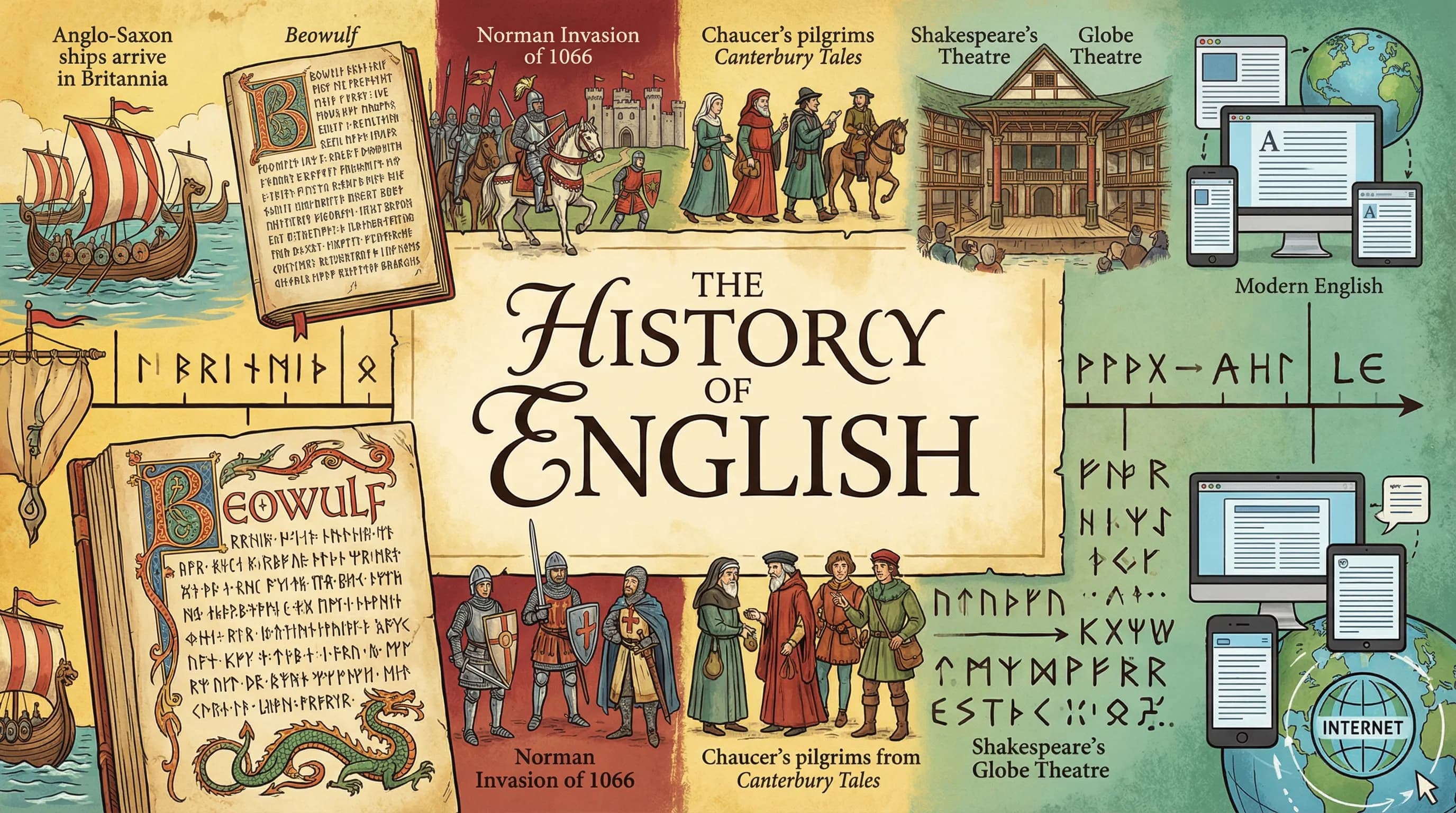
Explore the development of English from Old English to today.
The Story of English
English is one of the most remarkable success stories in the history of human language. From humble beginnings as a collection of Germanic dialects spoken by a few thousand invaders on a small island, it has evolved into the world's most widely used language. Today, English connects more than 1.5 billion speakers across every continent, serving as the primary language of international business, science, diplomacy, and popular culture.
The journey of English spans approximately 1,500 years and includes dramatic transformations. The language of Beowulf is virtually unrecognizable to modern readers, yet it is the direct ancestor of the English you are reading now. Understanding this history helps us appreciate why English has such unusual spelling, why we have so many synonyms from different origins, and how language continues to evolve in our own time.
Timeline Overview:
- 450-1100: Old English (Anglo-Saxon Period)
- 1100-1500: Middle English (Norman Influence)
- 1500-1700: Early Modern English (Renaissance and Standardization)
- 1700-present: Modern English (Global Expansion)
Around 450 AD, Germanic tribes known as the Angles, Saxons, and Jutes began migrating to Britain from what is now Denmark and northern Germany. They displaced the native Celtic-speaking Britons, establishing kingdoms and bringing their languages, which merged into what we call Old English or Anglo-Saxon.
Linguistic Characteristics:
- Highly inflected: Word endings indicated grammatical function (subject, object, possession)
- Four grammatical cases: Nominative, accusative, genitive, dative
- Grammatical gender: Nouns were masculine, feminine, or neuter
- Complex verb conjugations: Many strong verb forms
- Written first in runes, then in the Latin alphabet after Christianization
Sample Old English (Beowulf opening):
"Hwæt! We Gardena in geardagum, þeodcyninga, þrym gefrunon."
Translation: "Listen! We have heard of the might of the kings of the Spear-Danes in days of old."
Key Influences on Old English:
- Celtic languages: Primarily place names (Thames, London, Dover)
- Latin: Religious and scholarly terms via Christianity (church, school, master)
- Old Norse: Extensive influence from Viking invasions (793-1066), giving us everyday words like sky, egg, they, want, and window
The Vikings contributed over 2,000 words to English, many extremely common:
Body and Actions:
- skin, skull, leg
- take, give, get, hit, call, want
- die, raise, scream
Everyday Objects:
- window (wind + eye), knife, egg, cake
- sky, husband, sister
Grammar Words:
- they, them, their (replacing Old English pronouns)
- both, same, though, until
Why so influential? Unlike French later, Norse and Old English were similar enough that people from both groups could partially understand each other. The languages mixed in daily conversation, especially in the Danelaw (Viking-controlled areas of England).
Place Names: Many English towns ending in -by (village), -thorpe (farm), or -thwaite (clearing) have Norse origins: Derby, Grimsby, Scunthorpe, Braithwaite.
Identify whether each word has Old Norse or Old English origins based on the patterns described above.
sky / heaven
shirt / skirt
get / obtain
The Old English word "hus" became "house." Based on this pattern, what do you think these Old English words became in Modern English?
boc
scip
fisc
stan
When William of Normandy conquered England, French became the language of the ruling class, government, and law. For about 300 years, English was considered a language of peasants while the elite spoke French.
Massive Changes to English:
- Vocabulary explosion: Approximately 10,000 French words entered English
- Grammar simplification: Complex inflections disappeared; word order became more important
- Spelling conventions: French scribes introduced new spelling patterns
French Words by Domain:
- Government: parliament, court, judge, jury, prison, crime
- Military: army, battle, captain, soldier, enemy, peace
- Food (for the table): beef, pork, mutton, poultry, sauce, roast
- Art & Culture: beauty, art, music, poetry, romance, literature
- Religion: religion, prayer, miracle, saint, mercy
The Class Divide in Vocabulary:
A striking pattern emerged: English-speaking peasants raised animals, but French-speaking nobles ate them:
- cow (OE) → beef (Fr)
- pig (OE) → pork (Fr)
- sheep (OE) → mutton (Fr)
- calf (OE) → veal (Fr)
Sample Middle English (Chaucer, 1390s):
"Whan that Aprille with his shoures soote, The droghte of March hath perced to the roote"
Translation: "When April with its sweet showers has pierced the drought of March to the root"
These word pairs show French (Norman) vs Anglo-Saxon origins. Identify which is which and explain how social class affected this pattern.
begin / commence
freedom / liberty
ask / question (verb)
kingly / royal
English often has multiple words for similar concepts because of its multiple language influences. Match the Anglo-Saxon, French, and Latin synonyms.
Match: help, aid, assist
Match: rise, mount, ascend
Match: ask, question, interrogate
Research Project: Choose ONE major event in English language history (e.g., Viking invasions, Norman Conquest, printing press, Great Vowel Shift) and create a mini-presentation (5 minutes) explaining how it changed English.
What happened and when?
What specific changes did it cause to English?
What evidence of this change can we still see in modern English?
Essay: "English is a Germanic language with a French vocabulary and Latin influences." Do you agree with this statement? Write a short essay (300-400 words) arguing your position with specific examples from this chapter.
Summary
In this chapter you have learned:
- Old English (450-1100): A Germanic language brought to Britain by the Angles, Saxons, and Jutes, heavily influenced by Norse through Viking settlements
- Middle English (1100-1500): Transformed by the Norman Conquest, which introduced thousands of French and Latin words
- Early Modern English (1500-1700): Standardised through the printing press and enriched by the Renaissance and global exploration
- Modern English (1700-present): Continuously evolving through colonialism, industrialisation, and globalisation
- Key insight: English is a uniquely hybrid language with Germanic grammar but heavily Romance vocabulary
Key Concepts
| Concept | Explanation |
|---|---|
| Old English | The earliest form of English (449-1100), a Germanic language |
| Norman Conquest | The 1066 invasion that brought French influence to English |
| Great Vowel Shift | A major change in pronunciation (1400-1700) that explains English spelling irregularities |
| Standardisation | The process of establishing consistent spelling and grammar rules |
Sources
- Baugh, A. C. & Cable, T. (2013). A History of the English Language. Routledge.
- Crystal, D. (2004). The Stories of English. Penguin Books.
- McCrum, R. et al. (2002). The Story of English. Penguin Books.
- UDIR (2020). Læreplan i engelsk (ENG01-04). Utdanningsdirektoratet. https://www.udir.no/lk20/eng01-04
Dette kapitlet er skrevet av Anthropics toppmodeller (Claude Opus og Claude Fable) og er foreløpig ikke manuelt gjennomgått — kvalitetskontrollen gjøres av uavhengige KI-agenter, og innmeldte feil rettes fortløpende. Funnet en feil? Meld fra, så retter vi den. Les mer om hvordan innholdet lages.