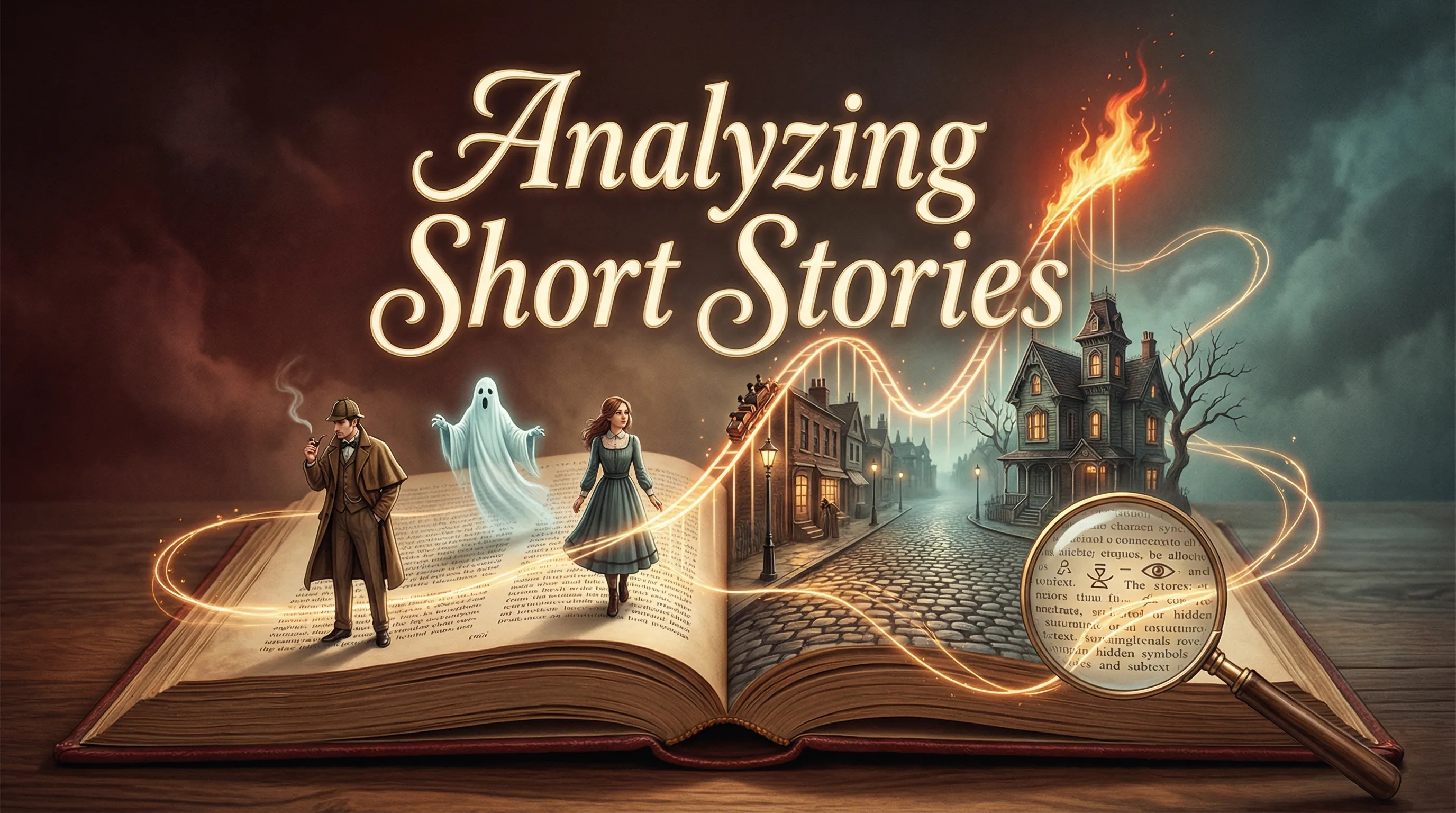
Develop skills for analyzing short fiction.
The Art of the Short Story
Short stories pack a complete narrative into a compact form. Every word must earn its place.
Elements of Short Stories:
1. Plot - What happens
2. Character - Who it happens to
3. Setting - Where and when it happens
4. Theme - What it means
5. Point of view - Who tells the story
6. Style - How it's told
1. Exposition: Introduction of characters, setting, situation
2. Rising Action: Events that build tension
3. Climax: The turning point, highest tension
4. Falling Action: Events after the climax
5. Resolution/Denouement: How things are resolved
Other Plot Elements:
- Conflict: The central struggle (person vs. person, self, society, nature, technology)
- Complication: Problems that arise
- Suspense: Uncertainty that keeps readers engaged
- Twist: Unexpected turn of events
- Protagonist: Main character
- Antagonist: Character opposing protagonist
- Round character: Complex, develops over story
- Flat character: One-dimensional, doesn't change
- Dynamic: Changes through the story
- Static: Remains the same
Methods of Characterization:
Direct: Author tells us about the character
"John was a kind and generous man."
Indirect (STEAL):
- Speech: What they say
- Thoughts: What they think
- Effect on others: How others react
- Actions: What they do
- Looks: Physical appearance
Read a short story of your choice (or one assigned by your teacher). Analyze it by answering these questions:
What is the central conflict?
At what point does the climax occur?
Is the main character round or flat? Dynamic or static?
What theme(s) does the story explore?
Character analysis using the STEAL method. Choose a character from a short story and find evidence for each category.
Speech: What does the character say, and what does it reveal?
Thoughts: What does the character think?
Effect on others: How do other characters react to them?
Actions: What does the character do?
Theme identification. For a short story you have read, identify the theme and explain how it is developed through the story.
State the theme in one sentence (e.g., "The story explores how prejudice can destroy communities").
Find at least two examples from the story that develop this theme.
How does the ending reinforce or complicate the theme?
Compare two short stories you have read on a specific element (character, theme, narrative technique, or setting).
What element are you comparing, and what are the two stories?
How does each story handle this element?
What effect does the difference have on the reader?
Write a literary analysis paragraph (150-200 words) about a short story, focusing on how the author uses ONE literary technique (symbolism, irony, foreshadowing, or point of view) to develop the theme.
Creative response. Choose a short story and write a continuation or alternative ending (200-300 words). Then explain how your version changes the theme or meaning.
Summary
Key Points:
1. Short stories are compact narratives where every element serves a purpose. Analysis requires attention to plot, character, setting, theme, point of view, and style.
2. Plot structure typically follows Freytag's Pyramid: exposition, rising action, climax, falling action, resolution.
3. Character analysis can be done using the STEAL method: Speech, Thoughts, Effect on others, Actions, and Looks.
4. Theme is the underlying message or universal truth, distinct from the topic. Strong analysis connects specific evidence to thematic claims.
5. Literary analysis uses the PEE structure: Point, Evidence, Explanation.
Key Vocabulary:
- Protagonist/Antagonist - main character and their opponent
- Dynamic/Static character - one who changes vs one who remains the same
- Foreshadowing - hints about what will happen later
- Irony - when reality differs from expectation
Sources and Further Reading
- DiYanni, R. (2007). Literature: Approaches to Fiction, Poetry, and Drama. McGraw-Hill.
- Mays, K. (2017). The Norton Introduction to Literature. Norton.
- Prentice Hall Literature: Gold Level (textbook commonly used in VG1).
Dette kapitlet er skrevet av Anthropics toppmodeller (Claude Opus og Claude Fable) og er foreløpig ikke manuelt gjennomgått — kvalitetskontrollen gjøres av uavhengige KI-agenter, og innmeldte feil rettes fortløpende. Funnet en feil? Meld fra, så retter vi den. Les mer om hvordan innholdet lages.