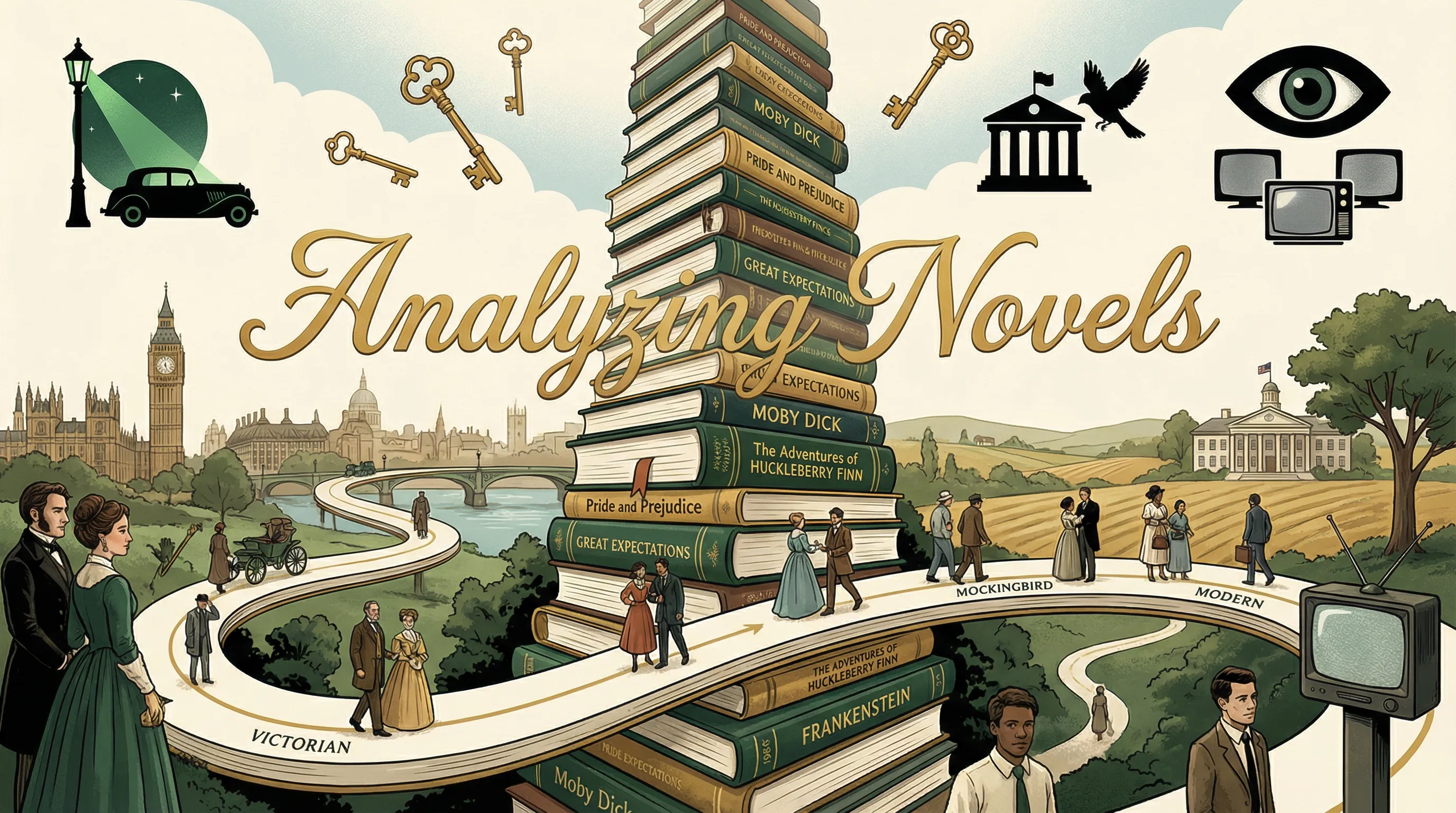
Explore longer fiction and novel analysis techniques.
Reading and Analyzing Novels
Novels offer depth that short stories cannot - complex character development, multiple plotlines, and rich thematic exploration.
Approaching a Novel:
1. Read actively - take notes, mark passages
2. Consider the historical/social context
3. Track character development
4. Identify recurring themes and motifs
5. Pay attention to the author's style
Narrator is a character in the story
"I walked into the room and saw her standing there."
- Limited to narrator's knowledge
- Creates intimacy
- Can be unreliable
Third Person Limited:
External narrator focusing on one character
"She walked into the room and saw him standing there."
- Access to one character's thoughts
- More objective than first person
Third Person Omniscient:
All-knowing narrator
"She walked in, nervous. He stood there, equally anxious."
- Can see into multiple characters' minds
- God-like perspective
Second Person:
Addresses "you" (rare)
"You walk into the room and see her standing there."
- Place: Physical location
- Time: Historical period, season, time of day
- Social environment: Cultural context, social norms
- Atmosphere: Mood created by the setting
Functions of Setting:
- Creates mood and atmosphere
- Reflects characters' inner states
- Provides context for the plot
- Can symbolize themes
- May create conflict
Example:
A Gothic novel set in a decaying mansion creates:
- Atmosphere of mystery and dread
- Symbolizes the family's decline
- Reflects psychological darkness
- Creates physical dangers for characters
For a novel you are reading or have read, complete this analysis template:
Title and Author:
Point of view and its effect:
Main themes (at least 2):
One significant symbol or motif:
How setting contributes to the story:
Track the development of the main character in a novel you have read.
How is the character introduced at the beginning?
What key events cause the character to change?
How is the character different at the end?
Analyze the opening chapter of a novel. How does the author establish character, setting, mood, and expectations?
Historical and social context. Research the time period when your novel was written or set, and explain how context influences the text.
What social or historical issues does the novel reflect?
How would the novel be different if it were set today?
Write a book review (250-350 words) of a novel you have read, covering plot, characters, themes, and your personal response.
Compare the novel to its film adaptation (if one exists) or discuss how you would adapt it for film.
What would be the biggest challenges in adapting the novel to film?
What scenes would be most effective on screen, and why?
Summary
Key Points:
1. Novel analysis requires attention to character development, point of view, setting, themes, motifs, and historical context.
2. Point of view (first person, third person limited, omniscient) shapes the reader's understanding and creates different effects.
3. Setting includes physical location, time period, social environment, and atmosphere, all of which contribute to meaning.
4. Character development in novels is more complex than in short stories, allowing for gradual transformation through multiple events.
5. Historical and social context enriches understanding of why characters behave as they do and what the author is commenting on.
Key Vocabulary:
- Motif - a recurring element that develops a theme
- Unreliable narrator - a narrator whose account cannot be fully trusted
- Bildungsroman - a novel about a character's growth from youth to maturity
- Subtext - meaning that is implied rather than stated directly
Sources and Further Reading
- Eagleton, T. (2008). How to Read Literature. Yale University Press.
- Foster, T. (2014). How to Read Novels Like a Professor. Harper Perennial.
- SparkNotes and LitCharts for study guides on specific novels.
Dette kapitlet er skrevet av Anthropics toppmodeller (Claude Opus og Claude Fable) og er foreløpig ikke manuelt gjennomgått — kvalitetskontrollen gjøres av uavhengige KI-agenter, og innmeldte feil rettes fortløpende. Funnet en feil? Meld fra, så retter vi den. Les mer om hvordan innholdet lages.