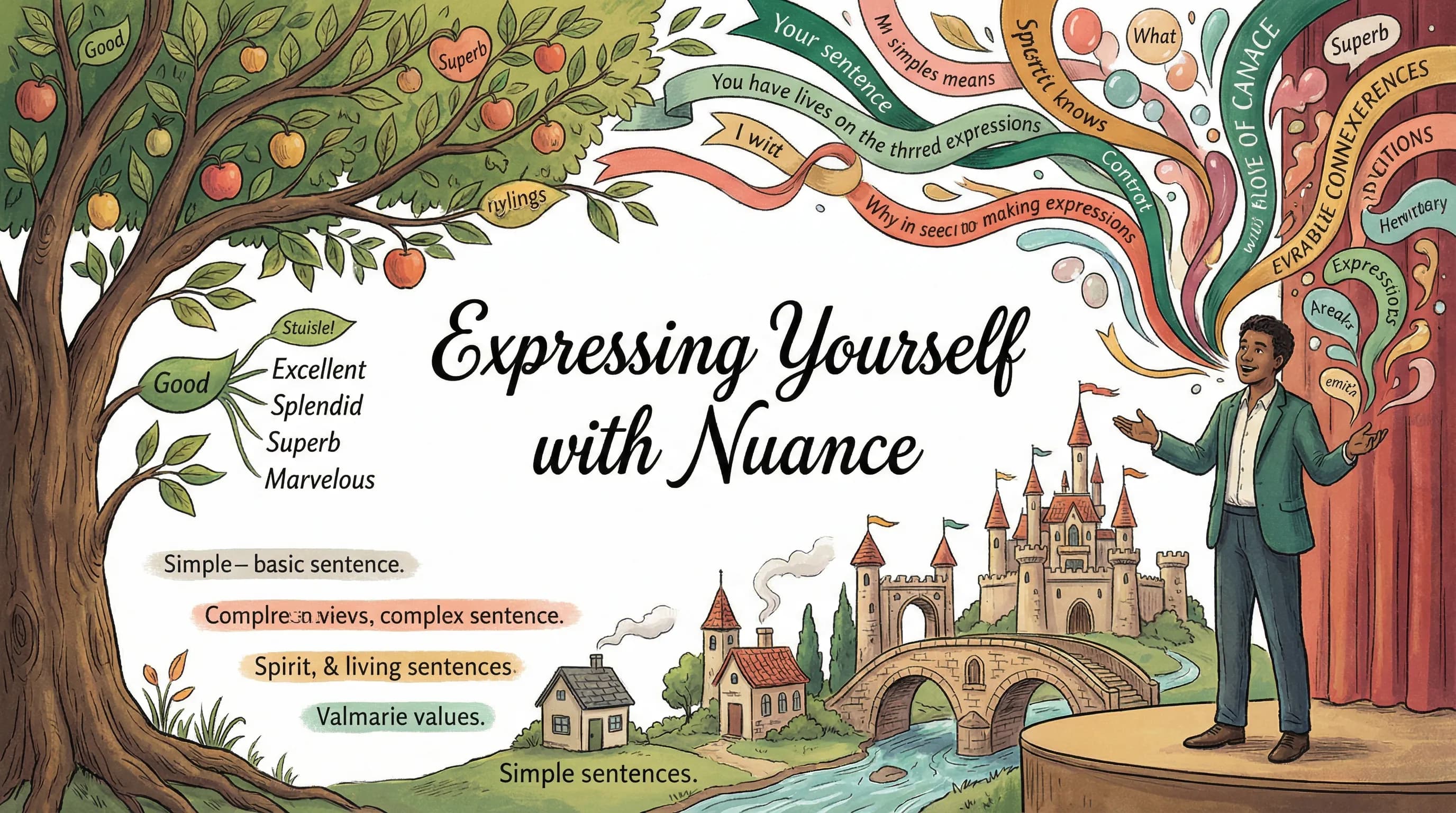
Learn to express yourself with precision, fluency and varied sentence structures.
Speaking with Nuance and Precision
Speaking English well isn't just about being grammatically correct - it's about expressing exactly what you mean with the right tone, style, and level of detail.
What is Nuanced Expression?
- Showing subtle differences in meaning
- Choosing words that match your intent precisely
- Adapting your language to the situation
- Using varied vocabulary and structures
Components of Fluent Speech:
1. Accuracy - correct grammar and vocabulary
2. Fluency - smooth, continuous speech
3. Coherence - logical, organized ideas
4. Appropriateness - right style for the context
Hedging Words:
- Modal verbs: might, may, could, would
- Adverbs: perhaps, possibly, probably, apparently
- Phrases: it seems that, it appears that, tends to
Examples:
| Direct | Hedged |
|---|---|
| This is wrong | This might be incorrect |
| Social media causes depression | Social media may contribute to depression |
| Everyone knows | Many people believe |
| This proves | This suggests |
When to Hedge:
- Academic writing (showing uncertainty)
- Polite disagreement
- Making requests
- Discussing sensitive topics
Varying your sentence structure makes your speech more engaging and easier to follow.
Sentence Types:
- Simple: One independent clause
"The climate is changing."
- Compound: Two independent clauses joined by a conjunction
"The climate is changing, and we must act."
- Complex: Independent + dependent clause
"Although some deny it, the climate is changing."
- Compound-complex: Multiple clauses
"While scientists agree on the facts, politicians debate solutions, and progress remains slow."
Techniques for Variety:
- Start with different parts of speech
- Vary sentence length
- Use questions and exclamations
- Include transitional phrases
Rewrite these direct statements using hedging language to make them more nuanced:
Video games make children violent.
This solution will work.
The author is criticizing society.
Combine these simple sentences into more complex, varied structures:
The book was long. It was interesting. I finished it quickly.
Social media connects people. It can also isolate them. This is a paradox.
Adapt the following message for three different audiences. The message is: "We need to change the school lunch menu because students are not eating healthy food."
Write this as a formal letter to the school principal.
Write this as a social media post to fellow students.
Write this as part of a debate speech.
Nuance practice: Replace the underlined word with a more precise synonym that better fits the context.
The movie was "nice." (You want to express that it was emotionally moving)
The food was "bad." (You want to say it tasted terrible)
She "said" that she disagreed. (You want to show she was angry)
He "walked" into the room. (You want to show he was confident)
Expressing degrees of certainty. Rank these statements from most certain to least certain and explain the differences.
Rank: "It will rain tomorrow" / "It might rain tomorrow" / "It could rain tomorrow" / "It is likely to rain tomorrow" / "It may rain tomorrow"
Write your own set of five sentences about a school topic, using different degrees of certainty.
Prepare and deliver a 2-minute speech on a topic you care about. Focus on using varied sentence structures, precise vocabulary, and appropriate hedging.
Choose a topic and write an outline with 3 main points.
Write the speech, using at least three different sentence types (simple, compound, complex).
Record yourself delivering the speech, then evaluate: Did you speak fluently? Did you use varied vocabulary?
Summary
Key Points:
1. Nuanced expression means conveying precise meaning by choosing the right words, tone, and structure for each situation.
2. Hedging softens claims and shows awareness of complexity (may, might, it seems that). It is essential for academic and polite communication.
3. Sentence variety (simple, compound, complex, compound-complex) makes communication more engaging and allows you to express relationships between ideas.
4. Audience awareness means adapting your register, vocabulary, and tone to fit the context (formal letter vs. social media vs. debate speech).
5. Precise vocabulary means choosing specific words rather than vague ones (strode instead of walked, poignant instead of nice).
Key Vocabulary:
- Hedging - softening language to show uncertainty or politeness
- Register - level of formality in language use
- Coherence - logical connection between ideas
- Nuance - a subtle difference in meaning or expression
- Discourse markers - words that organize speech (firstly, however, in conclusion)
Sources and Further Reading
- Thornbury, S. (2005). How to Teach Speaking. Longman.
- Hughes, R. (2011). Teaching and Researching Speaking. Routledge.
- BBC Learning English - Speaking Skills: bbc.co.uk/learningenglish
Dette kapitlet er skrevet av Anthropics toppmodeller (Claude Opus og Claude Fable) og er foreløpig ikke manuelt gjennomgått — kvalitetskontrollen gjøres av uavhengige KI-agenter, og innmeldte feil rettes fortløpende. Funnet en feil? Meld fra, så retter vi den. Les mer om hvordan innholdet lages.