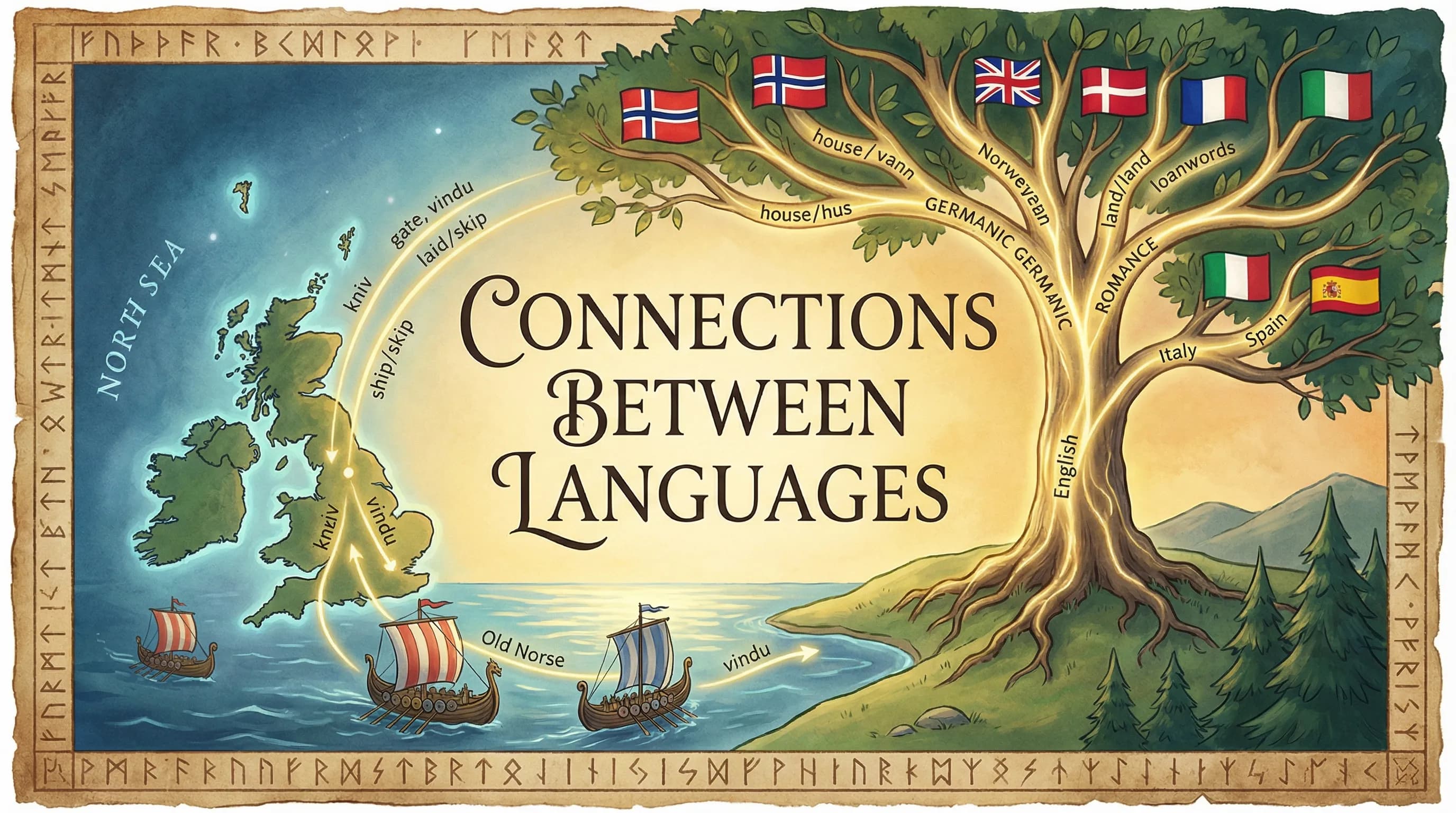
Use knowledge of connections between English and other languages you know in your own language learning.
English and Norwegian: Language Cousins
English and Norwegian are both Germanic languages, which means they share a common ancestor. This gives Norwegian speakers a significant advantage when learning English!
The Germanic Language Family:
- North Germanic: Norwegian, Swedish, Danish, Icelandic
- West Germanic: English, German, Dutch
- (East Germanic: Gothic - extinct)
Why This Matters:
- Many basic words are similar
- Some grammar structures are parallel
- Understanding language history helps vocabulary learning
- You can use Norwegian knowledge strategically
Norwegian-English Cognates:
| Norwegian | English |
|---|---|
| vann | water |
| hus | house |
| mann | man |
| fisk | fish |
| grønn | green |
| mor | mother |
| natt | night |
| lang | long |
False Friends (Beware!):
Words that look similar but have different meanings:
| Norwegian | Looks like | Actually means |
|---|---|---|
| gift | gift | married/poison |
| barn | barn | child |
| fart | fart | speed |
| bra | bra | good |
| blank | blank | shiny |
The Vikings had a major impact on English! From 793-1066 AD, Scandinavians settled in England and left thousands of words.
Everyday Norse Words in English:
- they, them, their (replaced Old English forms)
- sky, skin, skill, skirt
- egg, leg, neck
- take, give, get, want
- husband, window, knife
- happy, ugly, wrong, weak
Place Names:
- Names ending in -by (farm/town): Derby, Whitby
- Names ending in -thorpe (village): Scunthorpe
- Names ending in -thwaite (clearing): Braithwaite
Grammar:
- The pronouns they/them/their
- The verb "are" (from Norse)
- Word order similarities
How can knowing Norwegian help you understand new English words?
When you encounter an unfamiliar English word, check if it has a Germanic (Norwegian) equivalent:
Example 1: "forefather"
- "fore" = Norwegian "for-" (before)
- "father" = Norwegian "far"
- Meaning: ancestor (forfader)
Example 2: "understand"
- "under" = Norwegian "under"
- "stand" = Norwegian "stå"
- Same structure as Norwegian "forstå"
Example 3: "handbook"
- "hand" = Norwegian "hånd"
- "book" = Norwegian "bok"
- Same as Norwegian "håndbok"
Tip: Many basic, concrete English words have Norwegian cognates, while more abstract vocabulary often comes from Latin/French.
Match these English words with their Norwegian cognates:
bread
dream
silver
daughter
These English words came from Old Norse (Viking language). Try to guess their meanings based on similar Norwegian words:
slaughter
awkward
skull
ransack
Research and write a short paragraph (100-150 words) about how the Viking Age influenced the English language. Include at least 5 specific examples of Norse loanwords.
False friends can cause confusion. Explain the difference in meaning between these Norwegian-English look-alikes.
Norwegian "gift" vs English "gift"
Norwegian "barn" vs English "barn"
Norwegian "eventuelt" vs English "eventually"
Norwegian "engasjert" vs English "engaged"
English has borrowed words from many languages. For each loanword, guess which language it originally came from.
tsunami
kindergarten
safari
ski
piano
Transfer strategies: Explain how knowledge of Norwegian or another language you know can help you learn each of these English words or structures.
The English word "breathtaking" compared to Norwegian "fantastisk" or "slående"
The English phrase "it rains" compared to Norwegian "det regner"
How can knowing German or French (if you study those) also help with English?
Summary
Key Points:
1. English and Norwegian are both Germanic languages that share a common ancestor, giving Norwegian speakers a natural advantage in learning English.
2. Cognates are words in different languages that share a common origin (water/vann, house/hus). Recognizing cognates is a powerful vocabulary-building strategy.
3. False friends are words that look similar but have different meanings (Norwegian "gift" = married/poison, English "gift" = present). Being aware of these prevents common errors.
4. Norse influence on English is extensive. Vikings contributed over 2,000 everyday words to English, including "they," "egg," "sky," and "window," as well as many place names.
5. Transfer strategies mean using your knowledge of Norwegian and other languages to understand and learn English more effectively. This works for both vocabulary and grammar patterns.
Key Vocabulary:
- Cognate - a word that has a common origin with a word in another language
- False friend - a word that looks similar in two languages but has different meanings
- Loanword - a word borrowed from another language
- Language family - a group of languages with a shared ancestor
- Transfer - using knowledge from one language to help learn another
Sources
- Crystal, D. (2003). The Cambridge Encyclopedia of the English Language. Cambridge University Press.
- Ringe, D. (2006). A Linguistic History of English: From Proto-Indo-European to Proto-Germanic. Oxford University Press.
- Townend, M. (2002). Language and History in Viking Age England. Brepols.
- UDIR (2020). Læreplan i engelsk (ENG01-04). Utdanningsdirektoratet. https://www.udir.no/lk20/eng01-04
Dette kapitlet er skrevet av Anthropics toppmodeller (Claude Opus og Claude Fable) og er foreløpig ikke manuelt gjennomgått — kvalitetskontrollen gjøres av uavhengige KI-agenter, og innmeldte feil rettes fortløpende. Funnet en feil? Meld fra, så retter vi den. Les mer om hvordan innholdet lages.