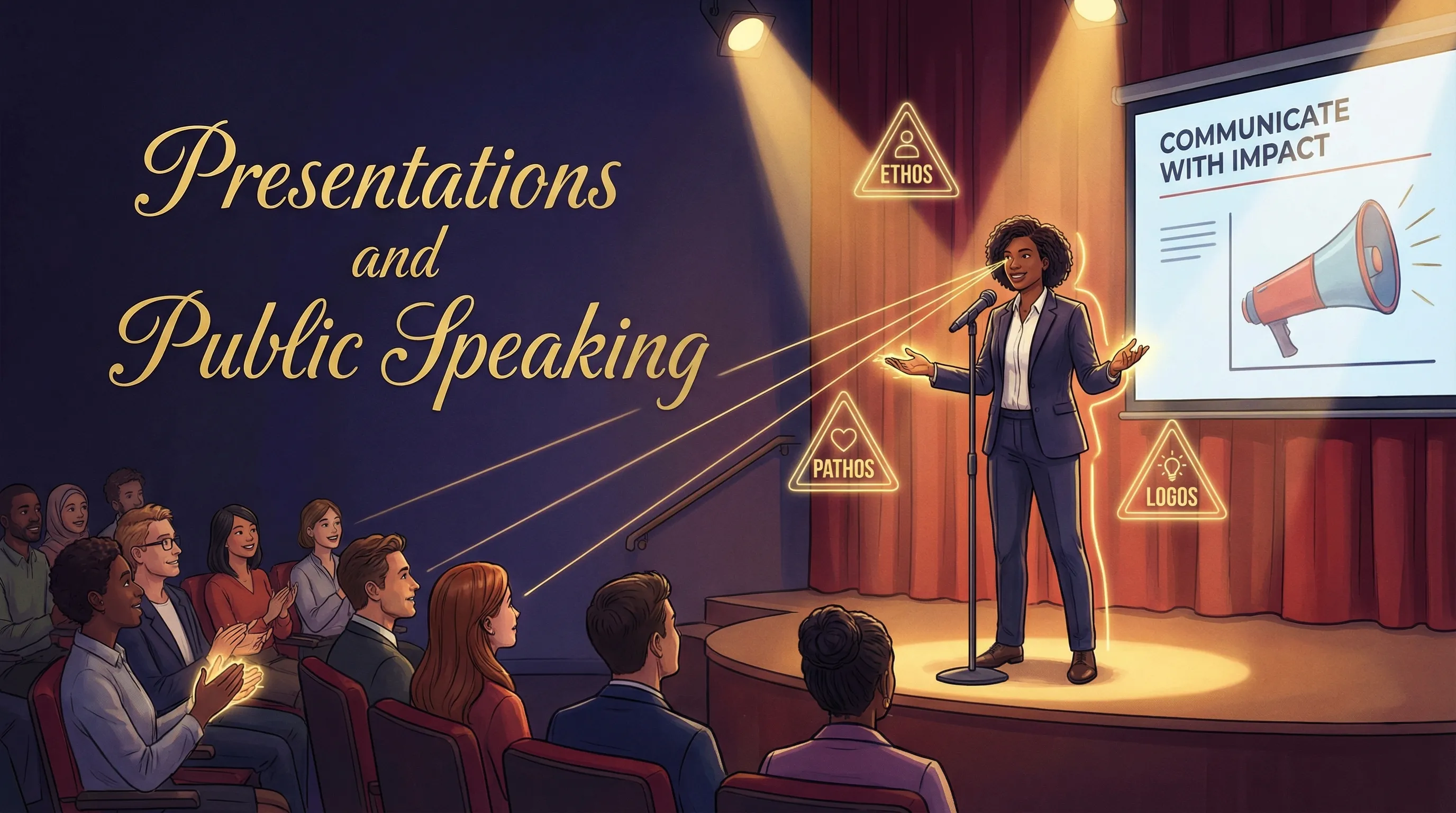
Master the art of giving engaging presentations and speeches.
Speaking to an Audience
Public speaking is a skill that can be learned. Even the most confident speakers were once nervous beginners!
Why Presentation Skills Matter:
- Essential for school and university
- Valuable in most careers
- Builds confidence
- Helps organize your thoughts
The Three Pillars of Effective Presentations:
1. Content - what you say
2. Delivery - how you say it
3. Structure - how you organize it
1. Introduction (10-15%)
- Hook: Grab attention (question, quote, statistic, story)
- Topic: State what you'll talk about
- Preview: Outline your main points
- "Tell them what you're going to tell them"
2. Body (70-80%)
- 2-4 main points
- Each point supported by evidence/examples
- Clear transitions between points
- "Tell them"
3. Conclusion (10-15%)
- Summary of main points
- Final thought or call to action
- Memorable closing
- "Tell them what you told them"
Timing Rule:
For a 10-minute presentation:
- Introduction: 1-1.5 minutes
- Body: 7-8 minutes
- Conclusion: 1-1.5 minutes
- Volume: Loud enough to be heard
- Pace: Not too fast, pause for emphasis
- Variety: Change pitch and tone
- Clarity: Articulate clearly
Body Language:
- Eye contact: Look at different parts of the audience
- Posture: Stand tall, appear confident
- Gestures: Natural, purposeful hand movements
- Movement: Move purposefully, don't pace nervously
Visual Aids:
- Keep slides simple (6 words per line, 6 lines per slide)
- Use images more than text
- Don't read from slides
- Make sure everyone can see
Managing Nerves:
- Prepare thoroughly
- Practice out loud multiple times
- Breathe deeply before starting
- Remember: the audience wants you to succeed
What are effective ways to start a presentation about climate change?
"Every minute, the equivalent of one garbage truck of plastic is dumped into our oceans. By 2050, there could be more plastic than fish in the sea."
Option 2: Provocative Question
"What will you tell your children when they ask why we didn't act on climate change when we had the chance?"
Option 3: Personal Story
"Last summer, my family visited our usual holiday spot - only to find the beach had shrunk by half due to rising sea levels. That's when climate change became personal for me."
Option 4: Quote
"As David Attenborough said, 'The moment of crisis has come in efforts to stop climate change.' Today, I want to explore what that crisis means for our generation."
Option 5: Vivid Description
"Imagine waking up to find your street flooded, your school closed indefinitely, and your favorite places underwater. For millions of people worldwide, this isn't imagination - it's reality."
Each hook immediately engages the audience and sets up the topic.
Write three different hooks for a presentation about ONE of these topics:
a) The importance of mental health
b) Why learning languages matters
c) The future of artificial intelligence
Create a presentation outline for a 5-minute talk on "The Benefits of Reading." Include:
- An attention-grabbing hook
- 3 main points with supporting details
- Transition phrases between points
- A memorable conclusion
Prepare and deliver a 3-minute presentation on a topic of your choice. Record yourself and evaluate your performance using this checklist:
- Did I grab attention at the start?
- Was my structure clear?
- Did I make eye contact?
- Did I speak at a good pace?
- Was my conclusion memorable?
Body language and delivery. Watch a short TED Talk (5-10 minutes) and analyze the speaker's delivery.
How does the speaker use body language (gestures, movement, eye contact)?
How does the speaker vary their voice (pace, volume, pauses)?
What is the most effective technique the speaker uses? How could you apply it?
Handling questions. Prepare responses to these challenging audience questions about your presentation topic.
What would you say if someone asks a question you don't know the answer to?
How would you respond if someone strongly disagrees with your main point?
What if someone asks a question that is not related to your topic?
Peer feedback. Give a short presentation (3-5 minutes) to a partner or small group, then give and receive feedback.
As a listener, write constructive feedback using this format: "One thing I liked was... One thing that could be improved is... One suggestion I have is..."
As the presenter, reflect on the feedback. What will you change for next time?
Summary
In this chapter you have learned:
- Presentation structure: A good presentation has a clear introduction, organised main body, and memorable conclusion
- Delivery techniques: Eye contact, pacing, pausing, and vocal variety make your presentation engaging
- Visual aids: Use visually clear slides with minimal text to support (not replace) your spoken message
- Handling nerves: Preparation, practice, and breathing techniques help manage anxiety
- Peer feedback: Giving and receiving constructive feedback is essential for improving presentation skills
Key Concepts
| Concept | Explanation |
|---|---|
| Hook | An attention-grabbing opening (question, anecdote, statistic) |
| Signposting | Using phrases to guide the audience through your presentation |
| Vocal variety | Varying pitch, pace, and volume to keep the audience engaged |
| Constructive feedback | Feedback that is specific, balanced, and actionable |
Sources and Further Reading
- Reynolds, G. (2019). Presentation Zen. New Riders.
- TED Talks - Presentation techniques: ted.com/playlists/574/howtomakeagreat_presentation
- Duarte, N. (2010). Resonate: Present Visual Stories that Transform Audiences. Wiley.
Dette kapitlet er skrevet av Anthropics toppmodeller (Claude Opus og Claude Fable) og er foreløpig ikke manuelt gjennomgått — kvalitetskontrollen gjøres av uavhengige KI-agenter, og innmeldte feil rettes fortløpende. Funnet en feil? Meld fra, så retter vi den. Les mer om hvordan innholdet lages.