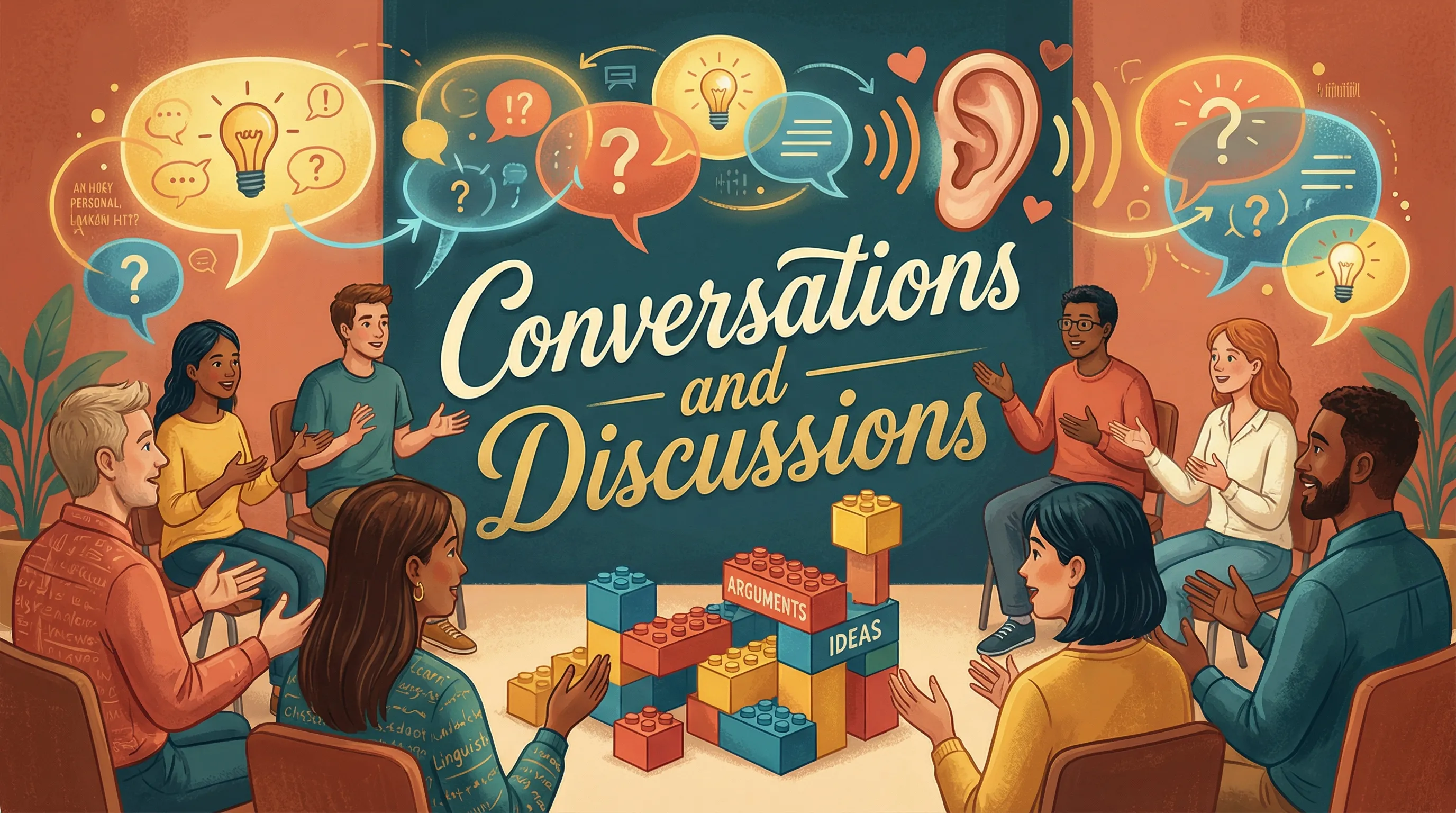
Develop skills for meaningful conversations and discussions.
The Art of Discussion
Good discussions are about more than just expressing your own views. They require listening, responding to others, and building on what has been said.
Keys to Effective Discussion:
1. Active listening - truly hearing what others say
2. Building on ideas - connecting to others' points
3. Respectful disagreement - challenging ideas, not people
4. Asking good questions - deepening the conversation
5. Staying on topic - maintaining focus
- "I completely agree with..."
- "That's a good point, and I'd add..."
- "I see what you mean about..."
- "You've raised an important point..."
Partly Agreeing:
- "I see your point, but..."
- "That's true to some extent, however..."
- "While I agree that..., I also think..."
- "You make a valid point, although..."
Disagreeing Politely:
- "I see it differently..."
- "I'm not sure I agree because..."
- "That's one perspective, but..."
- "I understand why you think that, but..."
Asking for Clarification:
- "Could you explain what you mean by...?"
- "Can you give an example of...?"
- "Are you saying that...?"
- "What do you mean when you say...?"
- "So, if I understand correctly, you're saying..."
- "To summarize your point..."
- "Your main argument seems to be..."
- "What I hear you saying is..."
Building on Others' Ideas:
- "Building on what [name] said..."
- "To add to that point..."
- "That connects to something I've been thinking..."
- "Taking that idea further..."
Introducing New Perspectives:
- "Another way to look at this is..."
- "Have we considered...?"
- "What about the perspective of...?"
- "There's also the question of..."
How should students interact in a discussion about social media?
Anna: "I think social media is mostly positive. It helps us stay connected with friends and discover new interests."
Ben: "That's a good point, Anna. Building on that, I'd say it also gives young people a voice on important issues. However, I see it a bit differently when it comes to mental health - there's research showing negative effects."
Clara: "I agree with Ben about the mental health concerns. Could you give an example, Ben, of what kind of effects you mean?"
Ben: "Sure - studies show increased anxiety and depression linked to social media use, especially comparing yourself to others."
Anna: "That's true to some extent, but I'd argue that it's about how you use it. Following positive accounts can actually improve mental health."
David: "To summarize what's been said - it seems we all agree social media has both benefits and risks, and that how we use it matters. Another way to look at this might be to consider whether schools should teach digital literacy..."
Notice how each speaker acknowledges others' points before adding their own perspective.
Choose appropriate phrases to complete these discussion responses:
Someone argues that homework should be banned. You partly agree. Complete: "____________, but I think some homework can be useful for practice."
You want to add to a classmate's point. Complete: "____________ what Maria said, I'd like to add that..."
You don't understand someone's argument. Complete: "____________ what you mean by 'digital natives'?"
Read the following argument and write a response that: 1) summarizes the main point, 2) acknowledges something valid, and 3) offers a different perspective.
Argument: "Schools should start later because teenagers need more sleep. Research shows that adolescent brains aren't fully awake until later in the morning, and early start times lead to worse academic performance."
In groups of 3-4, have a 10-minute discussion on ONE of these topics. Each person should use at least 3 discussion phrases (agreeing, disagreeing, building, summarizing). Record your discussion if possible.
Topics:
a) Should AI be used to help students with homework?
b) Is it better to travel or to save money?
c) Should voting age be lowered to 16?
Active listening practice. Listen to a short TED Talk or podcast episode (5-10 minutes) in English. Then complete these tasks.
Summarize the speaker's main argument in 2-3 sentences.
Identify one point you agree with and explain why.
Identify one point you would challenge and explain your alternative view.
Summarizing others' arguments is a key discussion skill. Read the two viewpoints below, then write a neutral summary that fairly represents both sides.
Viewpoint A: "Social media should be banned for under-16s because it harms mental health, promotes cyberbullying, and exposes children to inappropriate content."
Viewpoint B: "Social media helps young people develop digital literacy, maintain friendships, and access educational content."
Self-evaluation of discussion skills. Think about a recent discussion you had (in class or elsewhere) and evaluate yourself on these criteria.
Did you listen actively to others? Give an example of when you built on someone else's point.
Did you express disagreement respectfully? How?
What is one specific thing you want to improve for next time?
Summary
Key Points:
1. Active listening means truly hearing and processing what others say, not just waiting for your turn to speak.
2. Building on ideas using phrases like "Building on what you said..." and "To add to that point..." creates a collaborative discussion.
3. Respectful disagreement focuses on ideas rather than people: "I see your point, but I think..." rather than "You're wrong."
4. Summarizing others' arguments demonstrates understanding and keeps discussions productive.
5. Discussion skills improve with practice, self-reflection, and awareness of specific techniques.
Key Vocabulary:
- Active listening - fully concentrating on what is being said
- Turn-taking - the practice of alternating who speaks in a conversation
- Discourse marker - a word or phrase that organizes discussion (however, furthermore, in my view)
- Counterargument - an argument made in opposition to another argument
Sources and Further Reading
- Mercer, N. (2000). Words and Minds: How We Use Language to Think Together. Routledge.
- Fisher, R. (2009). Creative Dialogue: Talk for Thinking in the Classroom. Routledge.
- TED Talks: ted.com (excellent for practising listening and discussion)
Dette kapitlet er skrevet av Anthropics toppmodeller (Claude Opus og Claude Fable) og er foreløpig ikke manuelt gjennomgått — kvalitetskontrollen gjøres av uavhengige KI-agenter, og innmeldte feil rettes fortløpende. Funnet en feil? Meld fra, så retter vi den. Les mer om hvordan innholdet lages.