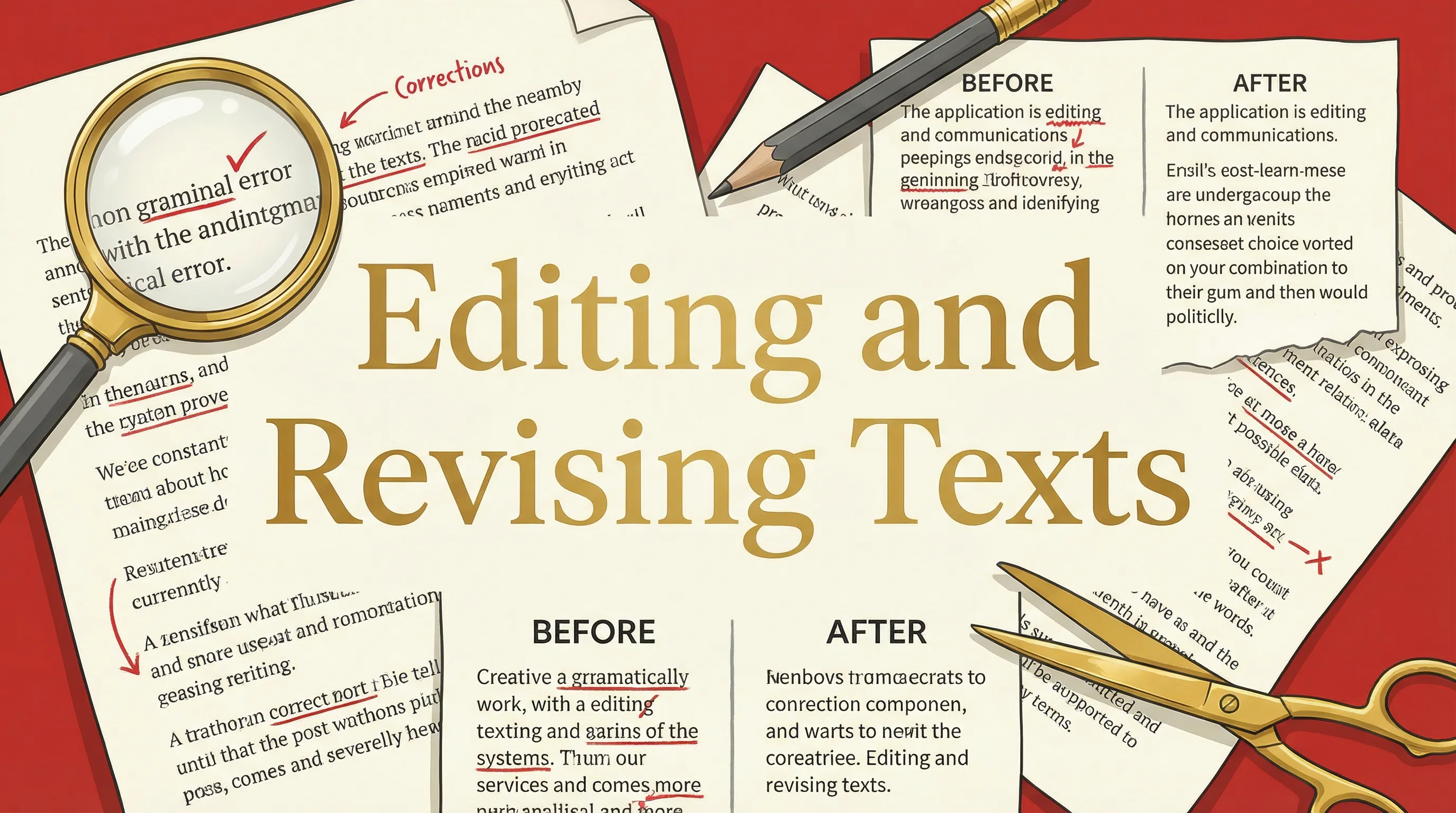
Develop skills for evaluating and improving your own writing.
The Art of Revision: Transforming Good Writing into Great Writing
"The first draft of anything is garbage." - Ernest Hemingway
This quote from one of the most celebrated writers in history reveals an important truth: even the best writers do not produce perfect texts on their first attempt. What separates amateur writers from professionals is not the quality of their first drafts, but their willingness and ability to revise.
Why Revision Matters:
Many students submit their first drafts thinking their work is complete. However, professional writers, journalists, and academics routinely revise their work multiple times before publication. Some authors revise their novels ten, twenty, or even fifty times!
Revision is not just about fixing mistakes - it is about discovering what you really want to say and finding the best way to say it. Often, the act of writing helps clarify your thinking, and revision allows you to capture that clarity.
Learning Objectives for This Chapter:
After completing this chapter, you will be able to:
- Distinguish between revising, editing, and proofreading
- Apply systematic revision strategies at different levels
- Identify and correct common grammatical errors
- Evaluate your own writing objectively
- Create and use personal checklists for improvement
- Give and receive constructive feedback on writing
The Writing Process:
1. Prewriting - Planning and brainstorming
2. Drafting - Getting ideas down on paper
3. Revising - Improving content and organization
4. Editing - Fixing grammar and sentence-level issues
5. Proofreading - Final check for errors
Most students rush through steps 3-5 or skip them entirely. This chapter will help you master these crucial stages.
These terms are often confused, but they represent different levels of review:
Revising (Big Picture):
- Is my main idea clear?
- Is my argument logical?
- Have I included enough evidence/examples?
- Is the organization effective?
- Does each paragraph have a clear purpose?
Editing (Sentence Level):
- Are my sentences clear and varied?
- Have I used precise vocabulary?
- Are there grammatical errors?
- Is my tone appropriate?
Proofreading (Surface Level):
- Spelling errors
- Punctuation mistakes
- Formatting issues
- Typos
The ARMS Strategy for Revision:
A - Add
What is missing from your text?
- More evidence or examples?
- Transitions between ideas?
- Background information for the reader?
- A stronger introduction or conclusion?
- More specific details?
R - Remove
What is unnecessary?
- Repetitive ideas?
- Irrelevant information?
- Wordy phrases that could be shortened?
- Weak or unconvincing arguments?
- Off-topic tangents?
M - Move
What is in the wrong place?
- Would a different order be more logical?
- Should your strongest point come first or last?
- Are related ideas grouped together?
- Does your conclusion actually conclude?
S - Substitute
What could be better?
- Replace vague words with specific ones
- Swap weak verbs for stronger ones
- Change passive voice to active where appropriate
- Find better transitions
- Improve unclear sentences
Additional Revision Strategies:
1. Time Distance
Put your writing aside for a day or more before revising. Fresh eyes catch more problems.
2. Read Aloud
Reading your text aloud helps you hear:
- Awkward phrasing
- Missing words
- Unclear sentences
- Repetitive patterns
- Natural rhythm (or lack thereof)
3. Reverse Outline
After writing, outline what you actually wrote (not what you planned). This reveals:
- Whether your structure is logical
- If you have drifted from your main point
- Where paragraphs lack focus
4. Peer Review
Another reader can identify:
- Confusing passages you thought were clear
- Missing information you assumed the reader would know
- Fresh perspectives on your argument
Apply the ARMS strategy to improve this paragraph:
"Social media is bad. Many people use social media. They spend hours scrolling. This is bad for mental health. Studies show this. Social media companies make money from keeping people online. The algorithms are designed to be addictive. Young people are especially affected. In conclusion, social media is problematic."
A - ADD:
- Specific statistics or study references
- Explanation of HOW it affects mental health
- Examples of the algorithms at work
- More nuanced analysis (it is not all bad)
- A more developed conclusion
R - REMOVE:
- "Many people use social media" (obvious, unnecessary)
- Redundant use of "bad" and "social media"
- "Studies show this" (vague and unhelpful)
M - MOVE:
- The business model point could come earlier to explain WHY platforms are designed this way
- "Young people especially affected" could lead to more discussion
S - SUBSTITUTE:
- "bad" → specific effects like "anxiety" or "depression"
- "This is bad" → explain the mechanism
- "problematic" → more specific conclusion
- General statements → specific examples
Revised Version:
"Social media platforms pose significant challenges to mental health, particularly among teenagers. Research from the American Psychological Association has linked excessive social media use to increased rates of anxiety, depression, and loneliness. This is not accidental; social media companies profit from user engagement, so their algorithms are specifically designed to be addictive. Features like infinite scrolling, notification alerts, and "likes" trigger dopamine responses that keep users returning. Adolescents, whose brains are still developing, are particularly vulnerable to these manipulative design choices. While social media does offer benefits such as connection and community, users must be aware of these psychological effects and set healthy boundaries with technology."
What Changed:
- Added specific research reference and explanation
- Removed vague statements
- Moved business model point to explain causation
- Substituted "bad" with specific effects
- Added nuance (acknowledging benefits)
- Created a more substantive conclusion
Apply the ARMS strategy to this paragraph. For each letter (A, R, M, S), identify at least one specific change you would make.
"Climate change is a problem. It affects the weather. Scientists agree. We need to do something. Governments should act. Individuals can help too. Recycling is good. We should use less energy. In conclusion, climate change is serious."
Read aloud and identify the problems in this text. Then rewrite it.
"The book was good. I liked the book. The characters in the book were interesting. The plot of the book kept me reading. I would recommend this book to anyone who likes books. The author wrote the book well."
1. Subject-Verb Agreement
The subject and verb must match in number.
Common traps:
- Collective nouns: "The team is/are playing" (British: are; American: is)
- Compound subjects: "Neither the teacher nor the students were ready"
- Separated subject/verb: "The book on the shelves is mine" (book is, not shelves are)
2. Pronoun Reference
Pronouns must clearly refer to a specific noun.
Unclear: "When John met Peter, he was happy" (who was happy?)
Clear: "John was happy when he met Peter"
Unclear: "The teachers told the students that they were wrong" (who was wrong?)
Clear: "The teachers told the students that the students were wrong"
3. Tense Consistency
Maintain consistent tenses within a passage unless the time frame changes.
Wrong: "She walked in and says hello"
Right: "She walked in and said hello"
Wrong: "In 1969, humans land on the moon"
Right: "In 1969, humans landed on the moon"
Sentence-Level Errors:
4. Run-on Sentences
Two independent clauses joined without proper punctuation or conjunction.
Wrong: "I went home I was tired"
Right: "I went home because I was tired"
Right: "I went home; I was tired"
Right: "I went home. I was tired."
5. Comma Splices
Two independent clauses joined only by a comma.
Wrong: "It was late, we went home"
Right: "It was late, so we went home"
Right: "It was late; we went home"
Right: "It was late. We went home."
6. Sentence Fragments
Incomplete sentences punctuated as complete ones.
Fragment: "Because I was tired."
Complete: "I left early because I was tired."
Fragment: "The book on the table."
Complete: "The book on the table is mine."
Common Spelling/Usage Errors:
7. Apostrophe Errors
- its = possessive (The cat licked its paw)
- it's = it is (It's raining)
- their = possessive (Their house)
- they're = they are (They're coming)
- there = place (over there)
- your = possessive (Your book)
- you're = you are (You're late)
8. Commonly Confused Words
- affect (verb) / effect (noun, usually)
- accept / except
- then / than
- lose / loose
- definitely (not "definately")
- separate (not "seperate")
- a lot (two words, never "alot")
9. Double Negatives
Wrong: "I don't have no money"
Right: "I don't have any money" or "I have no money"
10. Word Order with Adverbs
Wrong: "I always am tired"
Right: "I am always tired"
Wrong: "She speaks English well very"
Right: "She speaks English very well"
Find and correct all errors in this paragraph:
"Their are many students who doesnt like homework. This is because they think its boring and they dont see no point in it. The reason for this is alot of teachers fail to explain the purpose clearly. When a student asks there teacher why there doing homework the teacher often says it helps them learn. However this explanation isnt always convince. In my opinion, education would be more effective if teachers took time to explain the benefits of each assignment clearly, than students would be more motivated to complete their work."
"There are many students who do not like homework. This is because they think it's boring and they don't see any point in it. The reason for this is a lot of teachers fail to explain the purpose clearly. When a student asks their teacher why they're doing homework, the teacher often says it helps them learn. However, this explanation isn't always convincing. In my opinion, education would be more effective if teachers took time to explain the benefits of each assignment clearly; then students would be more motivated to complete their work."
Errors Corrected:
1. "Their" → "There" (place/existence, not possessive)
2. "doesnt" → "do not" (plural subject needs plural verb; missing apostrophe)
3. "its" → "it's" (it is, not possessive)
4. "dont see no point" → "don't see any point" (double negative; missing apostrophe)
5. "alot" → "a lot" (always two words)
6. "there teacher" → "their teacher" (possessive)
7. "there doing" → "they're doing" (they are)
8. Added comma after "homework" (introductory clause)
9. Added comma after "However" (sentence adverb)
10. "isnt" → "isn't" (missing apostrophe)
11. "convince" → "convincing" (adjective form needed)
12. Comma → semicolon (independent clauses)
13. "than" → "then" (sequence, not comparison)
14. Final "their" is correct (possessive)
Total: 13 errors in one paragraph!
Find and correct all the errors in each sentence. Identify what type of error each one is.
The team are playing good today, there going to win.
Everyone should bring their own lunch, there is no cafeteria here.
Its important that your on time for you're interview.
She walked into the room, sits down and started reading the book what she bought yesterday.
Me and my friends goes to the cinema last night but we didnt saw nothing good.
Create a personal revision checklist with at least 12 items, organized by category. Include items specific to errors you know you commonly make.
Summary: Key Points About Editing and Revising
The Three Stages:
1. Revising - Big picture: content, argument, organization
2. Editing - Sentence level: grammar, clarity, style
3. Proofreading - Surface level: spelling, punctuation, typos
The ARMS Strategy:
- Add what is missing
- Remove what is unnecessary
- Move what is in the wrong place
- Substitute what could be better
Revision Tips:
- Take time away from your writing before revising
- Read your work aloud
- Create a reverse outline to check structure
- Get feedback from others
Common Errors to Watch:
- Subject-verb agreement
- Pronoun reference clarity
- Tense consistency
- Run-on sentences and comma splices
- Apostrophe errors (it's/its, their/they're/there, your/you're)
- Double negatives
Remember:
- Good writing is rewriting
- Professional writers revise multiple times
- Create a personal checklist for your common errors
- Revising is about improving ideas, not just fixing mistakes
- Every error fixed makes your message clearer
This paragraph contains errors at all levels (content, structure, grammar, and mechanics). Revise it completely.
"Technology is important today. Their are many technologies. Phones, computers, tablets. These technologies help us. They also hurt us to. Too much screen time is bad, it effects are health. However technology isnt going away so we need to learn how to use it correctly. Young people especially needs to learn this. In conclusion technology is a double edged sword."
Find a piece of your own writing (an essay, paragraph, or assignment) and apply the complete revision process. Write a brief reflection on what you learned about your own writing patterns.
Sources
- Ferris, D. R. (2011). Treatment of Error in Second Language Student Writing. University of Michigan Press.
- Hyland, K. & Hyland, F. (2006). Feedback in Second Language Writing. Cambridge University Press.
- UDIR (2020). Læreplan i engelsk (ENG01-04). Utdanningsdirektoratet. https://www.udir.no/lk20/eng01-04
- Harmer, J. (2015). The Practice of English Language Teaching. Pearson Education.
Dette kapitlet er skrevet av Anthropics toppmodeller (Claude Opus og Claude Fable) og er foreløpig ikke manuelt gjennomgått — kvalitetskontrollen gjøres av uavhengige KI-agenter, og innmeldte feil rettes fortløpende. Funnet en feil? Meld fra, så retter vi den. Les mer om hvordan innholdet lages.