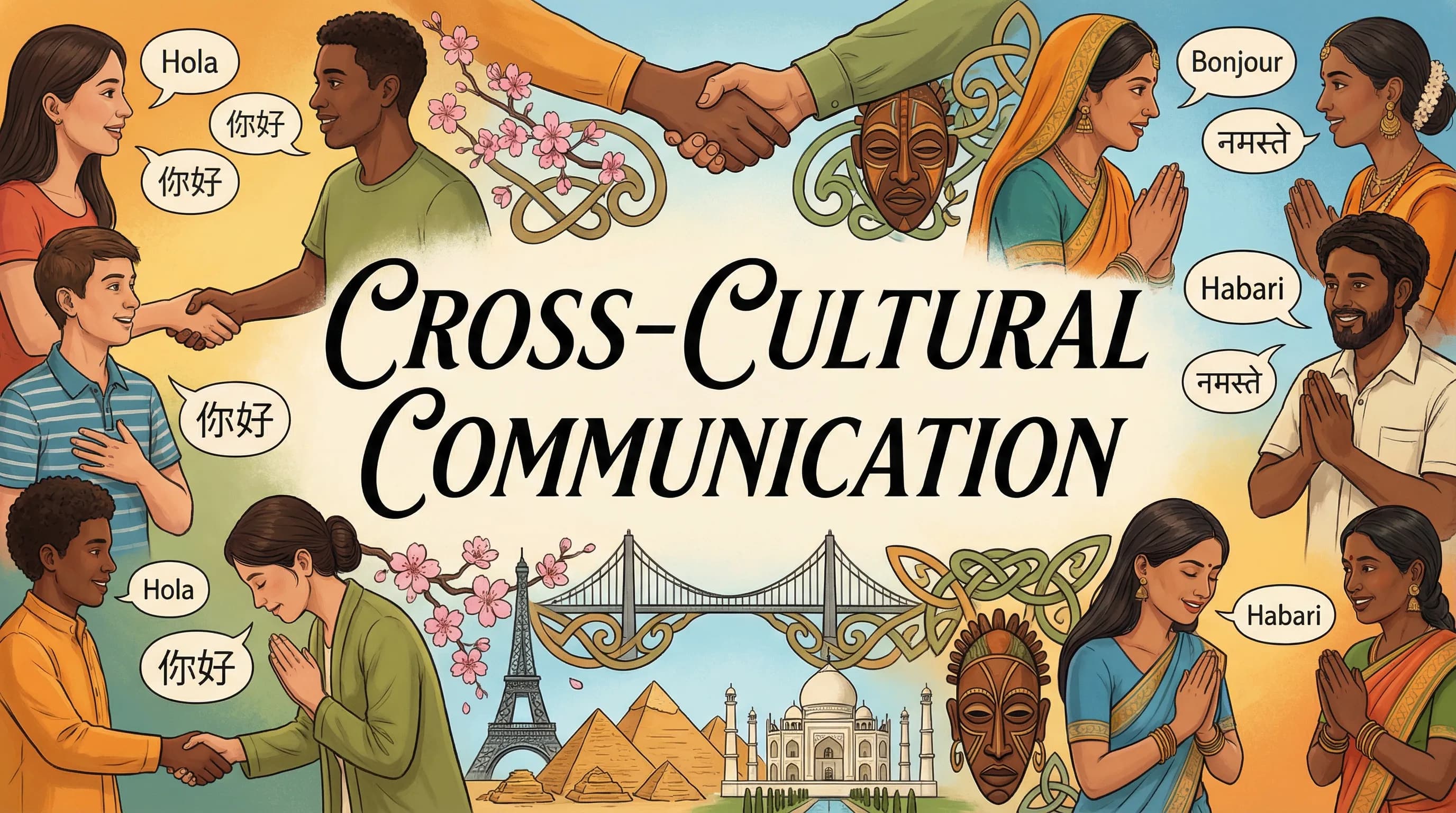
Develop skills for effective cross-cultural communication.
Communicating Across Cultures
In our globalized world, you'll communicate with people from many different cultural backgrounds. Understanding cultural differences helps avoid misunderstandings.
Key Areas of Cultural Difference:
- Communication styles (direct vs. indirect)
- Concepts of time and punctuality
- Personal space and touch
- Hierarchy and formality
- Humor and taboo topics
- Understanding your own cultural values
- Learning about other cultures
- Recognizing stereotypes vs. generalizations
Skills:
- Adapting communication style
- Active listening
- Asking clarifying questions
- Observing nonverbal cues
Attitudes:
- Curiosity and openness
- Respect for difference
- Tolerance of ambiguity
- Empathy
Avoiding Stereotypes:
- Treat people as individuals
- Generalizations can inform but shouldn't define
- Ask questions rather than assume
- Be aware of your own biases
Reflect on cross-cultural communication:
What aspects of Norwegian culture might seem unusual to someone from another country?
Have you experienced cultural misunderstandings? What happened?
How can you improve your intercultural communication skills?
Research a cultural misunderstanding between Norwegian and English-speaking cultures. Describe what happened and explain the cultural values behind the misunderstanding.
Role play: With a partner, practice a cross-cultural conversation scenario (e.g., a Norwegian student meeting an American host family for the first time). Discuss what went well and what could cause confusion.
Discuss: How has growing up with English-language media affected your understanding of other cultures? Has it created any misconceptions?
Write a guide (200-300 words) for a foreign student visiting your school, explaining Norwegian cultural norms they should know about.
Discuss: "In a globalized world, cultural differences are disappearing." Do you agree or disagree? Use specific examples from English-speaking cultures.
Summary
Key Points:
1. Cross-cultural communication requires knowledge of different cultural values and communication styles.
2. Intercultural competence involves knowledge, skills, and attitudes (curiosity, respect, empathy).
3. Stereotypes should be recognized and challenged; individuals are more than their cultural background.
4. Globalization both reduces and highlights cultural differences.
Key Vocabulary:
- Intercultural competence - the ability to communicate effectively across cultures
- Ethnocentrism - judging other cultures by the standards of one's own
- Cultural relativism - understanding cultures on their own terms
Sources and Further Reading
- Byram, M. (1997). Teaching and Assessing Intercultural Communicative Competence. Multilingual Matters.
- Hofstede, G. (2010). Cultures and Organizations. McGraw-Hill.
- The Culture Map by Erin Meyer (2014). PublicAffairs.
Dette kapitlet er skrevet av Anthropics toppmodeller (Claude Opus og Claude Fable) og er foreløpig ikke manuelt gjennomgått — kvalitetskontrollen gjøres av uavhengige KI-agenter, og innmeldte feil rettes fortløpende. Funnet en feil? Meld fra, så retter vi den. Les mer om hvordan innholdet lages.