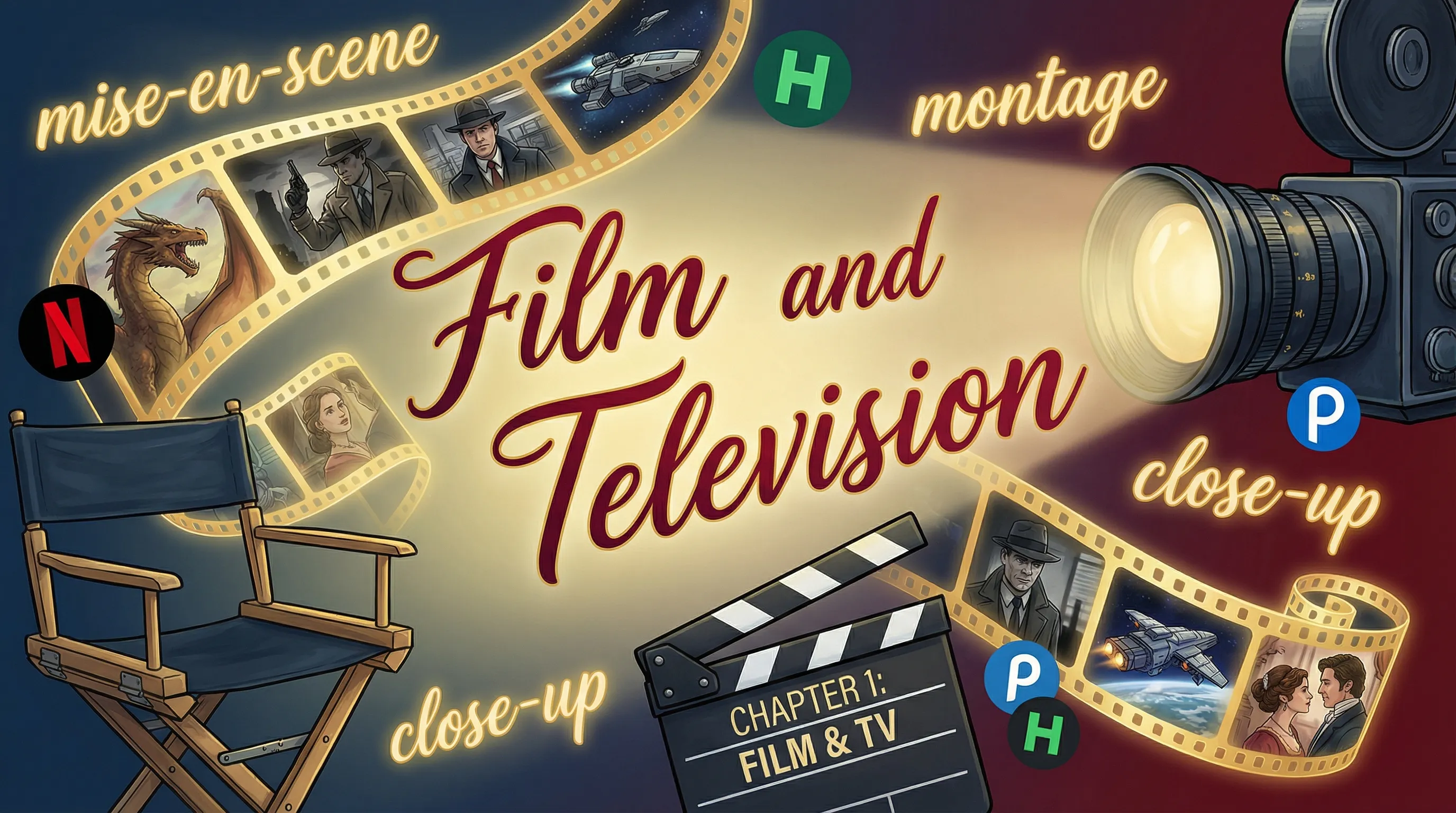
Analyze English-language film and television.
The Power of the Screen
Film and television are powerful media for storytelling, cultural expression, and shaping perspectives.
English-language Media Dominates:
- Hollywood produces most globally distributed films
- American TV series stream worldwide
- British content has global reach (BBC, etc.)
- Shapes perceptions of English-speaking cultures
- Plot structure
- Character development
- Theme and message
- Conflict and resolution
Cinematic Techniques:
- Camera angles and shots
- Lighting and color
- Sound and music
- Editing and pacing
Representation:
- How are different groups portrayed?
- Whose perspective is shown?
- What stereotypes appear?
- Who is missing?
Context:
- When was it made?
- What genre is it?
- Who is the target audience?
- What cultural impact has it had?
Analyze a film or TV series scene:
Describe what happens in the scene.
What cinematic techniques are used and why?
How does this scene contribute to the theme?
How are characters or groups represented?
Compare the representation of a particular group (e.g., teenagers, immigrants, women) in two different English-language films or TV series.
Write a film review (200-300 words) of an English-language film, covering plot, performances, cinematography, and themes.
How does American/British TV shape international perceptions of those countries? Discuss with specific examples.
Discuss the role of streaming platforms (Netflix, Disney+, etc.) in spreading English-language content globally. What are the benefits and drawbacks?
Create a "viewing guide" for a film or TV episode you recommend to classmates, including key scenes to analyze and discussion questions.
Summary
Key Points:
1. Film and television are powerful media that shape perceptions of English-speaking cultures worldwide.
2. Analysis involves examining narrative elements, cinematic techniques, representation, and context.
3. Streaming platforms have transformed global access to English-language content.
4. Critical viewing means evaluating how groups are represented and what messages are conveyed.
Key Vocabulary:
- Cinematography - camera work and visual composition
- Representation - how groups are portrayed in media
- Mise-en-scene - everything visible within a film frame
Sources and Further Reading
- Bordwell, D. & Thompson, K. (2017). Film Art: An Introduction. McGraw-Hill.
- British Film Institute: bfi.org.uk
- IMDb: imdb.com
Dette kapitlet er skrevet av Anthropics toppmodeller (Claude Opus og Claude Fable) og er foreløpig ikke manuelt gjennomgått — kvalitetskontrollen gjøres av uavhengige KI-agenter, og innmeldte feil rettes fortløpende. Funnet en feil? Meld fra, så retter vi den. Les mer om hvordan innholdet lages.