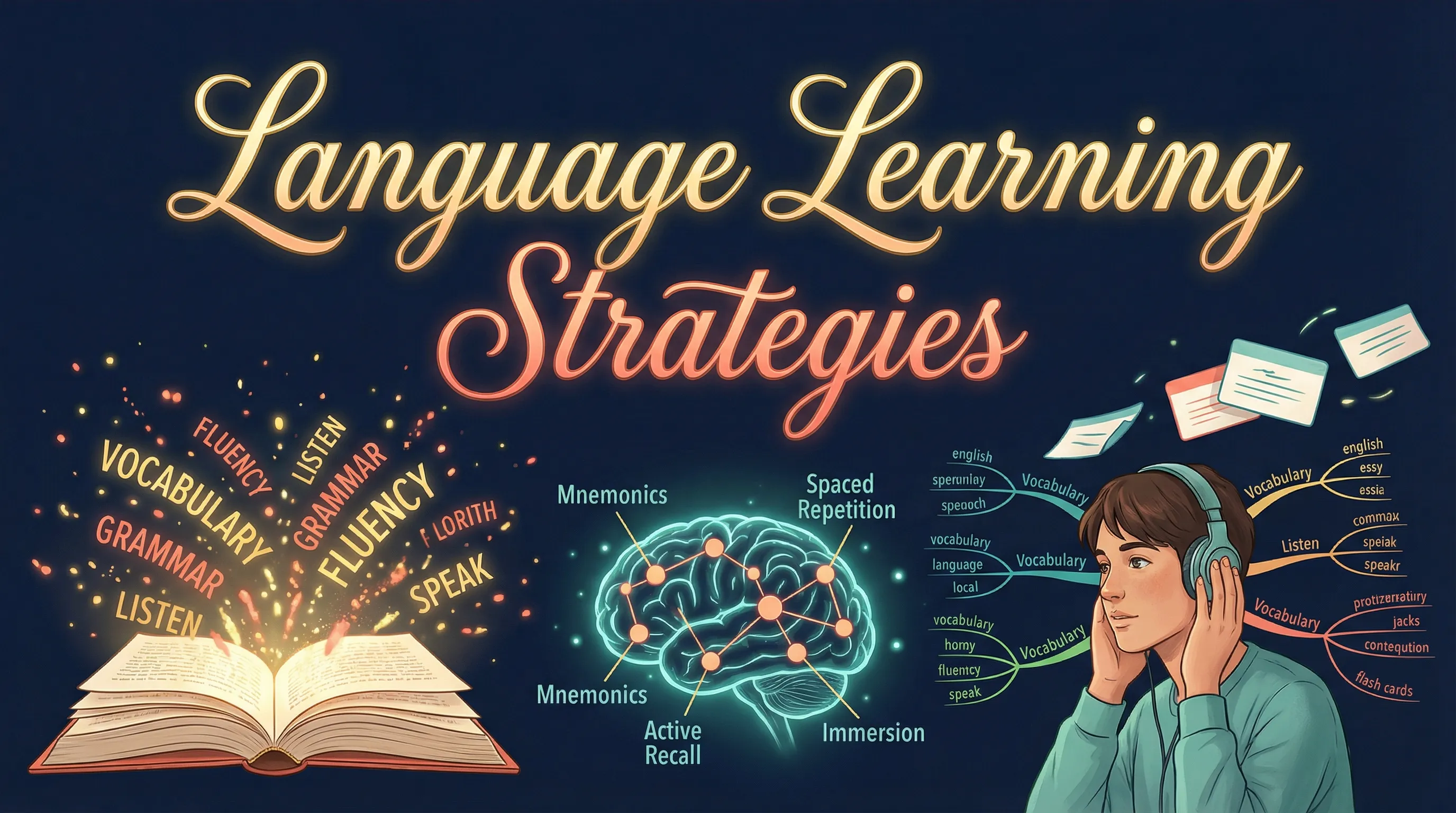
Develop effective strategies for learning English and improving your language skills.
Becoming a Strategic Language Learner
Have you ever wondered why some people seem to pick up languages effortlessly while others struggle for years? The secret isn't intelligence or natural talent—it's strategy. The most successful language learners have developed a toolkit of techniques that they apply consistently and consciously.
Think about learning English as embarking on a journey. You wouldn't set off on a long trip without a map, supplies, and a plan. Similarly, approaching language learning strategically means equipping yourself with the right tools and knowing when to use them.
Learning Goals for This Chapter:
By the end of this chapter, you will be able to:
- Identify and explain the four main types of language learning strategies
- Analyze your own learning style and preferences
- Select appropriate strategies for different learning situations
- Create a personalized learning plan based on your goals and needs
- Apply metacognitive strategies to monitor and improve your learning
The Four Pillars of Language Proficiency:
| Skill | Description | Example Activities |
|---|---|---|
| Listening | Understanding spoken English in various contexts | Podcasts, films, conversations |
| Speaking | Producing clear, fluent spoken English | Discussions, presentations, daily conversation |
| Reading | Comprehending written texts of varying complexity | Articles, novels, academic texts |
| Writing | Creating coherent written texts for different purposes | Essays, emails, creative writing |
These four skills are interconnected—improving one often helps the others. A strategic learner knows how to develop all four in a balanced way.
Language learning researchers have identified four main categories of strategies that successful learners use. Understanding these categories helps you build a complete toolkit for your learning journey.
1. Cognitive Strategies
These strategies involve directly working with the language material to understand, remember, and use it.
Key Cognitive Strategies:
- Repetition and rehearsal: Practicing words or phrases until they become automatic
- Note-taking: Writing down important information in an organized way
- Summarizing: Condensing information into key points
- Using context clues: Guessing meaning from surrounding words
- Creating associations: Linking new words to images, sounds, or personal experiences
- Categorizing: Grouping words by theme, grammar, or other features
- Using resources: Looking up words in dictionaries, grammar guides, etc.
2. Metacognitive Strategies
"Meta" means "about"—so metacognitive strategies are about thinking about your thinking. These help you plan, monitor, and evaluate your learning.
Key Metacognitive Strategies:
- Goal-setting: Defining clear, measurable objectives (e.g., "Learn 20 new words this week")
- Planning: Organizing your study time and activities
- Self-monitoring: Checking your understanding as you learn
- Self-evaluation: Assessing your progress honestly
- Identifying problems: Recognizing what you don't understand
- Seeking solutions: Finding ways to address learning difficulties
3. Social Strategies
Language is fundamentally social, and these strategies involve learning through interaction with others.
Key Social Strategies:
- Asking for clarification: Requesting explanations when you don't understand
- Asking for correction: Inviting others to correct your mistakes
- Collaborating: Working with classmates on learning tasks
- Finding conversation partners: Seeking opportunities to practice speaking
- Joining communities: Participating in English-speaking groups or forums
- Learning from feedback: Using others' responses to improve
4. Affective Strategies
These strategies help you manage the emotional aspects of learning, which are just as important as the intellectual ones.
Key Affective Strategies:
- Managing anxiety: Using techniques to reduce nervousness
- Self-encouragement: Giving yourself positive messages
- Rewarding yourself: Celebrating achievements, big and small
- Taking risks: Being willing to make mistakes
- Maintaining motivation: Finding personal reasons to keep learning
- Creating positive associations: Making learning enjoyable through games, music, etc.
You encounter the word "resilient" in a text and want to learn it thoroughly. How can you apply different types of strategies?
Let's see how each strategy type can help you truly master a new word like "resilient":
Cognitive Strategies:
1. Look it up: Check a dictionary—"resilient" means able to recover quickly from difficulties; tough and adaptable.
2. Create associations: Think of a rubber ball that bounces back when dropped—that's resilience!
3. Use it in sentences: "After losing the match, the team showed they were resilient by winning the next five games."
4. Find word family members: resilient (adj.), resilience (n.), resiliently (adv.)
Metacognitive Strategies:
1. Set a goal: "I will use 'resilient' in conversation or writing at least three times this week."
2. Monitor: Keep track of whether you've used it
3. Evaluate: At the end of the week, check—can you use it naturally?
Social Strategies:
1. Ask a classmate: "Have you heard the word 'resilient' before? What does it mean to you?"
2. Use it in discussion: In your next group work, try to use the word naturally
3. Get feedback: Ask your teacher or a native speaker if you're using it correctly
Affective Strategies:
1. Connect emotionally: Think of a time when YOU were resilient—overcoming a challenge
2. Celebrate: When you successfully use the word, acknowledge your progress
3. Stay positive: If you forget the word, don't worry—it's part of learning!
The Result:
By applying multiple strategies, you move from simply recognizing the word to truly owning it—being able to use it naturally and confidently in your own English.
Identify which type of learning strategy each example represents. Choose from: Cognitive, Metacognitive, Social, or Affective.
Setting a goal to learn 50 new words this month
Asking a classmate to explain a grammar rule you find confusing
Creating a mind map to organize vocabulary by topic (food, travel, emotions, etc.)
Rewarding yourself with your favorite snack after completing a challenging assignment
Checking your understanding by summarizing a podcast episode in your own words
Taking a deep breath before speaking English to calm your nerves
For each learning situation below, suggest TWO different strategies that could help. Explain why each strategy would be effective.
You need to give a presentation in English next week and you feel very nervous about speaking in front of the class.
You keep forgetting new vocabulary words even after looking them up multiple times.
You understand English when you read it, but struggle to understand spoken English, especially in movies.
Metacognition is perhaps the most powerful category of learning strategies because it helps you manage all the others. It's the difference between just going through the motions and truly taking control of your learning.
The Three Phases of Metacognitive Learning:
Phase 1: Planning (Before Learning)
Before you start studying, ask yourself:
- What am I trying to learn today?
- How long will I study and what will I focus on?
- What strategies will work best for this task?
- What resources do I need?
- What do I already know about this topic?
Example: Before watching an English documentary, you might decide: "I'll watch for 20 minutes, focus on noting new vocabulary, and pause to look up words I don't understand."
Phase 2: Monitoring (During Learning)
While learning, regularly check in with yourself:
- Am I understanding this material?
- Is my strategy working?
- Do I need to slow down or try something different?
- What parts are confusing me?
- Am I staying focused?
Example: Halfway through the documentary, you notice you're just passively watching without taking notes. You pause, rewind, and actively start writing down new expressions.
Phase 3: Evaluating (After Learning)
After your study session, reflect:
- What did I learn today?
- What strategies worked well?
- What didn't work, and why?
- What will I do differently next time?
- What should I focus on in my next session?
Example: After the documentary, you review your notes and realize you learned 8 new expressions. You decide that pausing more frequently would help you catch even more.
The Power of Self-Reflection
Research consistently shows that students who regularly reflect on their learning make faster progress. Keeping a learning journal—even just a few sentences after each study session—can dramatically improve your results.
Questions for Regular Self-Reflection:
1. What strategies did I use today?
2. How effective were they on a scale of 1-10?
3. What was the most challenging part?
4. What am I proud of?
5. What will I try differently tomorrow?
Emma wants to improve her English for the upcoming school year. How can she create an effective, balanced weekly study plan?
First, Emma honestly evaluates her current skills and goals:
- Strengths: Good at reading, enjoys watching English-language YouTube
- Weaknesses: Speaking makes her nervous, writing feels slow and awkward
- Goal: Be more confident speaking in class discussions by December
Emma's Weekly English Learning Plan:
| Day | Time | Focus | Activity | Strategy Type |
|---|---|---|---|---|
| Monday | 25 min | Vocabulary | Quizlet session: 15 new words + review of previous words | Cognitive |
| Tuesday | 30 min | Listening | English podcast (with notes on new expressions) | Cognitive |
| Wednesday | 20 min | Speaking | Read article aloud, then summarize it verbally | Cognitive + Metacognitive |
| Thursday | 25 min | Writing | Write 150-word journal entry about the week | Cognitive |
| Friday | 20 min | Speaking | Practice discussion phrases, record and listen back | Cognitive + Affective |
| Weekend | 45 min | Immersion | Watch show/movie in English (no Norwegian subtitles!) | Multiple |
Emma's Metacognitive Check-ins:
- Every Sunday evening: 5-minute reflection on the week—what worked? What to adjust?
- Monthly goal check: Am I getting closer to my December speaking goal?
Emma's Affective Strategies:
- Reward: After completing the weekly plan, she allows herself guilt-free gaming time on Sunday
- Anxiety management: Before speaking practice, she does 3 deep breaths and reminds herself that mistakes help her learn
- Motivation: She has a vision board with pictures of places she wants to visit where she'll need English
Key Features of Emma's Plan:
1. Specific: Each day has a clear activity, not just "study English"
2. Balanced: All four skills are covered during the week
3. Realistic: 20-30 minutes per day is manageable alongside schoolwork
4. Flexible: Weekends have a larger block for enjoyment-focused learning
5. Reflective: Built-in check-ins to evaluate and adjust
Complete a self-assessment of your English language skills. Be honest—this is for your own benefit!
Rate each skill from 1 (need much improvement) to 5 (very confident): Listening, Speaking, Reading, Writing
Which skill is your strongest? Give an example of when you demonstrated this strength.
Which skill needs the most improvement? What makes this skill challenging for you?
What is one specific, measurable goal you want to achieve in English this semester?
Create your own weekly English learning plan. Use the template below and fill in specific activities for each day.
Plan activities for Monday through Friday (at least 15-30 minutes each day). Include what skill you will focus on and what specific activity you will do.
Plan a longer "immersion" activity for the weekend (30-60 minutes).
Describe one affective strategy you will use to stay motivated and manage any anxiety.
Comprehensive Exercise: Read the following scenario and answer the questions using what you have learned about learning strategies.
Marcus is a VG1 student who struggles with English. He spends hours reading his textbook and looking up words, but he forgets them quickly. He avoids speaking in class because he is afraid of making mistakes. When he writes essays, he uses Google Translate for whole sentences. He often feels frustrated and unmotivated.
Identify THREE problems with Marcus's current approach to learning English.
For each problem, suggest a specific strategy (identify the category) that could help Marcus.
Design a simple weekly plan for Marcus that addresses his weaknesses while building on any potential strengths.
What metacognitive strategy should Marcus add to help him monitor and improve his progress?
Reflection and Application: Over the next week, implement your learning plan from Exercise 4. Then complete this reflection assignment.
Keep a brief learning journal. Each day, note: What did you do? How long? Which strategies did you use?
At the end of the week, evaluate: Which activities did you complete? Which did you skip? Why?
Analyze: Which strategies worked best for you? Which felt less effective? Why do you think this is?
Revise: Based on your experience, create an improved version of your learning plan for the following week.
Summary
In this chapter you have learned:
- Metacognition: Thinking about your own thinking and learning is a powerful strategy for improvement
- Strategy categories: Cognitive strategies (direct learning), metacognitive strategies (planning and monitoring), and social strategies (learning with others)
- Active learning: Techniques like spaced repetition, elaboration, and self-testing are more effective than passive re-reading
- Personal learning plan: Creating a structured plan with goals, strategies, and regular reflection helps you take charge of your own progress
Key Concepts
| Concept | Explanation |
|---|---|
| Metacognition | Awareness and understanding of your own thought and learning processes |
| Cognitive strategies | Strategies that directly involve processing language (e.g., note-taking, summarising) |
| Metacognitive strategies | Strategies for planning, monitoring, and evaluating your learning |
| Social strategies | Learning through interaction with others (e.g., discussion, peer feedback) |
| Spaced repetition | Reviewing material at increasing intervals for long-term retention |
Sources
- Oxford, R. L. (2011). Teaching and Researching Language Learning Strategies. Pearson Education.
- Bjork, R. A. & Bjork, E. L. (2011). "Making things hard on yourself, but in a good way." Psychology and the Real World, 56-64.
- UDIR (2020). Læreplan i engelsk (ENG01-04). Utdanningsdirektoratet. https://www.udir.no/lk20/eng01-04
- Cohen, A. D. (2011). Strategies in Learning and Using a Second Language. Routledge.
Dette kapitlet er skrevet av Anthropics toppmodeller (Claude Opus og Claude Fable) og er foreløpig ikke manuelt gjennomgått — kvalitetskontrollen gjøres av uavhengige KI-agenter, og innmeldte feil rettes fortløpende. Funnet en feil? Meld fra, så retter vi den. Les mer om hvordan innholdet lages.